
[Paper Review] Split Learning for Distributed Collaborative Training of Deep Learning Models in Health Informatics
This paper proposes split learning as a privacy-preserving distributed training framework for deep learning models in health informatics, where clients train a client model and send only latent representations ("smashed data") to a server, which completes forward and backward passes without accessing raw data. The approach achieves performance comparable to centralized and federated learning while enhancing client-side efficiency and reducing privacy risks by limiting knowledge of the global model to only partial components.
Deep learning continues to rapidly evolve and is now demonstrating remarkable potential for numerous medical prediction tasks. However, realizing deep learning models that generalize across healthcare organizations is challenging. This is due, in part, to the inherent siloed nature of these organizations and patient privacy requirements. To address this problem, we illustrate how split learning can enable collaborative training of deep learning models across disparate and privately maintained health datasets, while keeping the original records and model parameters private. We introduce a new privacy-preserving distributed learning framework that offers a higher level of privacy compared to conventional federated learning. We use several biomedical imaging and electronic health record (EHR) datasets to show that deep learning models trained via split learning can achieve highly similar performance to their centralized and federated counterparts while greatly improving computational efficiency and reducing privacy risks.
Motivation & Objective
- To address the challenge of training generalizable deep learning models across healthcare organizations with limited data sharing due to privacy and data sovereignty constraints.
- To develop a distributed learning framework that preserves patient-level data privacy while enabling multi-institutional collaboration.
- To improve upon federated learning by reducing the risk of model inversion and membership inference attacks through incomplete knowledge of the global model.
- To enhance computational efficiency on client devices by offloading part of the model training to a server while minimizing communication overhead.
- To provide a flexible privacy-utility-efficiency trade-off through configurable cut layer placement and size.
Proposed method
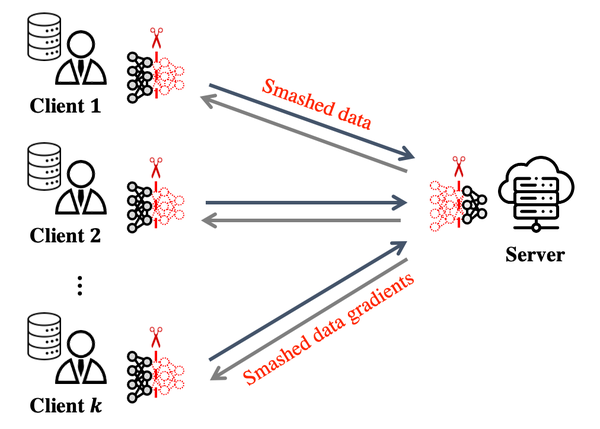
- The global deep neural network is partitioned into two sub-models at a designated cut layer: a client model (trained locally) and a server model (trained on the server).
- Clients perform forward pass on raw data using their client model and send only the resulting latent representations (smashed data) to the server, preserving raw data privacy.
- The server completes the forward pass using the server model, computes the loss, and sends gradients back to clients for local model updates via backpropagation.
- Training proceeds iteratively across rounds, with clients updating their models using gradients received from the server, mimicking a centralized training process.
- The cut layer size and position are tunable parameters that control the trade-off between information leakage in smashed data and model utility.
- The framework does not require sharing model architecture or parameters between clients and server, reducing the risk of model inversion and intellectual property leakage.
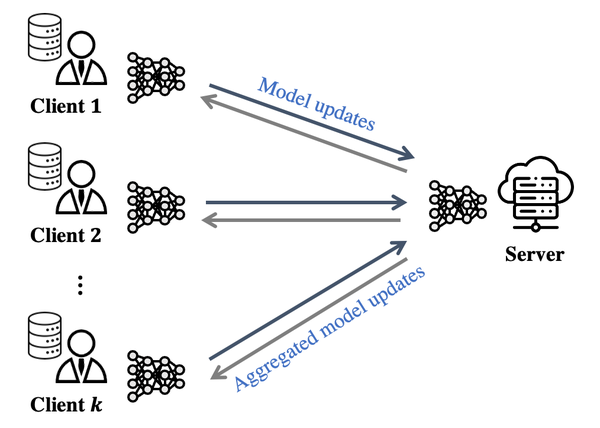
Experimental results
Research questions
- RQ1Can split learning achieve comparable model performance to centralized and federated learning while preserving patient data privacy in healthcare applications?
- RQ2How does split learning compare to federated learning in terms of privacy risks, especially regarding model inversion and membership inference attacks?
- RQ3What is the impact of cut layer location and size on the privacy-utility-efficiency trade-off in split learning for health data?
- RQ4Can split learning reduce computational burden on healthcare organizations while maintaining high model accuracy?
- RQ5How can split learning be adapted to heterogeneous data distributions and diverse biomedical data types such as medical images and EHRs?
Key findings
- Split learning achieved model performance comparable to centralized and federated learning across five diverse health datasets, including medical imaging and electronic health records.
- The framework significantly reduced client-side computational costs by offloading part of the model training to the server, improving efficiency for resource-constrained institutions.
- By limiting knowledge of the global model to partial components, split learning reduced the risk of model inversion and membership inference attacks compared to federated learning.
- The use of smashed data—latent representations from the client model—minimized information leakage, especially when using deeper cut layers that contain less input-specific information.
- Configurable cut layer placement allowed users to balance privacy, utility, and efficiency, offering greater flexibility than federated learning.
- Despite increased communication overhead compared to federated learning, the framework remains viable with potential optimizations such as edge servers and asynchronous training.
Read this paper
Open the full text in the Nubint reader and ask about any passage as you read.
Read this paper on NubintThis review was generated by AI from the original paper. Please check the paper before citing it.