
[Paper Review] SSLIDE: Sound Source Localization for Indoors based on Deep Learning
SSLIDE proposes a deep learning-based sound source localization method using an encoder-decoder architecture with two parallel decoders to jointly estimate sound source locations and mitigate multipath artifacts in reverberant indoor environments. It achieves state-of-the-art performance across simulated and real-world data, outperforming MUSIC, SRP-PHAT, SBL, and CNN with lower mean absolute error and strong generalization across reverberation, microphone spacing, and unseen speech signals.
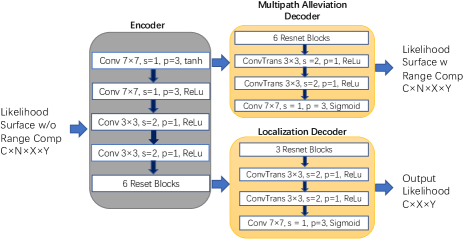
This paper presents SSLIDE, Sound Source Localization for Indoors using DEep learning, which applies deep neural networks (DNNs) with encoder-decoder structure to localize sound sources with random positions in a continuous space. The spatial features of sound signals received by each microphone are extracted and represented as likelihood surfaces for the sound source locations in each point. Our DNN consists of an encoder network followed by two decoders. The encoder obtains a compressed representation of the input likelihoods. One decoder resolves the multipath caused by reverberation, and the other decoder estimates the source location. Experiments based on both the simulated and experimental data show that our method can not only outperform multiple signal classification (MUSIC), steered response power with phase transform (SRP-PHAT), sparse Bayesian learning (SBL), and a competing convolutional neural network (CNN) approach in the reverberant environment but also achieve a good generalization performance.
Motivation & Objective
- To develop a robust sound source localization (SSL) method for reverberant indoor environments where traditional methods fail due to multipath effects.
- To enable continuous-space localization without relying on predefined candidate DOA grids, enhancing real-world applicability.
- To improve generalization across varying reverberation times, microphone configurations, and unseen speech signals.
- To jointly estimate source locations and suppress multipath artifacts using a single deep neural network with two parallel decoders.
Proposed method
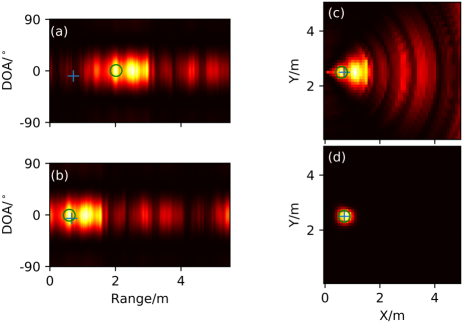
- The method uses a deep neural network with an encoder that compresses input likelihood surfaces derived from beamforming in the time-frequency domain.
- Two parallel decoders are employed: one for estimating the sound source location and another for mitigating multipath artifacts caused by room reverberation.
- Input features are likelihood surfaces $ P_{ns}( heta,d) $ computed via beamforming using short-time Fourier transform (STFT) and steering vector projections for angle $ \theta $ and distance $ d $.
- The likelihood surfaces are represented on a 2D grid of $ U \times V $ points for angle and distance, forming a tensor input to the DNN.
- The network is trained end-to-end using supervised learning with ground-truth source positions and multipath-aware targets.
- The multipath alleviation decoder is specifically designed to learn to suppress reverberation-induced distortions in the likelihood representation.
Experimental results
Research questions
- RQ1Can a deep learning model with a dual-decoder architecture outperform classical SSL methods like MUSIC and SRP-PHAT in highly reverberant indoor environments?
- RQ2Does the proposed method generalize well across different reverberation times, microphone spacings, and unseen speech signals?
- RQ3Is the multipath alleviation decoder essential for performance, and does its removal degrade localization accuracy?
- RQ4Can the model achieve accurate localization without prior knowledge of candidate DOA directions, unlike most baseline methods?
Key findings
- SSLIDE achieves a mean absolute error (MAE) of 6.7 meters in simulated data with 0.6 s reverberation time, outperforming SRP-PHAT (25 m), MUSIC (27 m), SBL (17 m), and CNN (16 m).
- In the MIRD dataset, SSLIDE achieves an MAE of 8.1° for DOA estimation, significantly lower than SRP-PHAT (19°), MUSIC (18°), SBL (18°), and CNN (9.8°).
- The ablation study shows that removing the multipath alleviation decoder increases MAE by 0.2–0.3 meters in simulated data and 0.06–0.12° in MIRD data, confirming its critical role.
- SSLIDE generalizes well under perturbations: when tested with 0.7 s RT60 (vs. 0.6 s training), MAE increases only from 0.77 m to 0.93 m, outperforming CNN (1.1 m to 1.7 m).
- When tested on 3 new unseen speech recordings, SSLIDE maintains an MAE of 0.45 m, compared to CNN’s 12.0 m, demonstrating superior robustness to speech variation.
- The model achieves strong performance without relying on predefined DOA candidate grids, unlike SRP-PHAT, MUSIC, SBL, and CNN, which require such priors.
Read this paper
Open the full text in the Nubint reader and ask about any passage as you read.
Read this paper on NubintThis review was generated by AI from the original paper. Please check the paper before citing it.