
[Paper Review] Stable Differentiable Causal Discovery
This paper proposes Stable Differentiable Causal Discovery (SDCD), a two-stage differentiable causal discovery method that improves numerical stability and scalability by introducing a spectral acyclicity constraint and a sparsity-aware training procedure. SDCD achieves faster convergence and higher accuracy than prior methods, scaling effectively to thousands of variables on both observational and interventional data.
Inferring causal relationships as directed acyclic graphs (DAGs) is an important but challenging problem. Differentiable Causal Discovery (DCD) is a promising approach to this problem, framing the search as a continuous optimization. But existing DCD methods are numerically unstable, with poor performance beyond tens of variables. In this paper, we propose Stable Differentiable Causal Discovery (SDCD), a new method that improves previous DCD methods in two ways: (1) It employs an alternative constraint for acyclicity; this constraint is more stable, both theoretically and empirically, and fast to compute. (2) It uses a training procedure tailored for sparse causal graphs, which are common in real-world scenarios. We first derive SDCD and prove its stability and correctness. We then evaluate it with both observational and interventional data and on both small-scale and large-scale settings. We find that SDCD outperforms existing methods in both convergence speed and accuracy and can scale to thousands of variables. We provide code at https://github.com/azizilab/sdcd.
Motivation & Objective
- To address the numerical instability and poor scalability of existing Differentiable Causal Discovery (DCD) methods beyond tens of variables.
- To develop a more stable and computationally efficient acyclicity constraint for continuous optimization in causal discovery.
- To design a two-stage optimization framework that enhances sparsity learning and preserves true causal edges in high-dimensional settings.
- To empirically validate SDCD on observational and interventional datasets across small- and large-scale problems.
- To demonstrate that SDCD achieves superior convergence speed, accuracy, and scalability compared to state-of-the-art DCD methods.
Proposed method
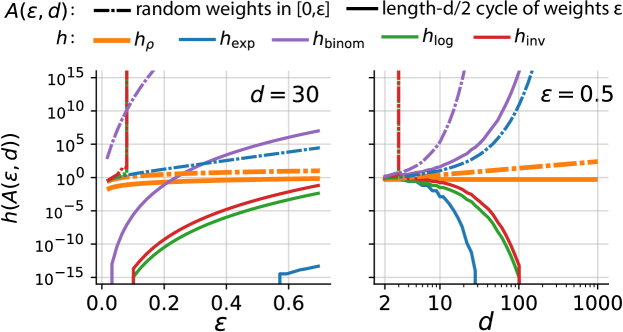
- SDCD employs a spectral acyclicity constraint based on the spectral radius of the adjacency matrix, which is theoretically and empirically more stable than previous penalty-based constraints.
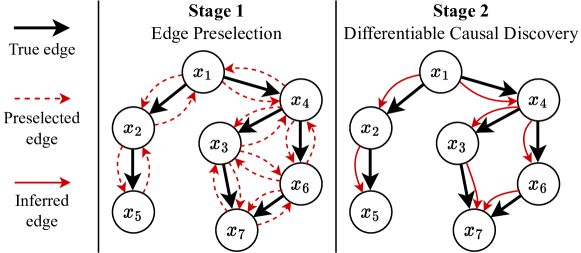
- The method uses a two-stage optimization: first, a pruning stage that removes weak edges without enforcing acyclicity; second, a DCD stage with the spectral constraint to enforce acyclicity.
- The first stage uses a learned mask to suppress non-essential edges, preserving true causal relationships while improving training stability.
- The second stage initializes with the mask and edge weights from stage one, enabling faster convergence and better generalization.
- The framework is tailored for sparse causal graphs, common in real-world applications such as genomics and systems biology.
- Theoretical analysis proves that the first stage does not remove true edges, and empirical results confirm improved robustness and accuracy.
Experimental results
Research questions
- RQ1Can a new acyclicity constraint be designed to improve numerical stability in differentiable causal discovery?
- RQ2Does a two-stage optimization procedure enhance convergence speed and accuracy in large-scale causal discovery?
- RQ3Can SDCD effectively scale to thousands of variables while maintaining high accuracy on both observational and interventional data?
- RQ4How does the spectral acyclicity constraint compare to existing penalty-based constraints in terms of stability and computational efficiency?
- RQ5To what extent does the two-stage design preserve true causal edges while enabling scalable optimization?
Key findings
- SDCD outperforms existing DCD methods in both convergence speed and accuracy, achieving the lowest Structural Hamming Distance (SHD) across all tested settings.
- On observational data with d=40 variables and s=4 edges per variable, SDCD achieves an SHD of 69.0, significantly lower than DCDI (87.0) and other baselines.
- SDCD scales effectively to 40 variables with 55% average edge density, achieving an SHD of 222.3, while GIES fails to run at d≥30.
- The ablation study confirms that enforcing the mask in stage 2 is critical: SDCD-warm-nomask performs much worse than SDCD, indicating the importance of constraint enforcement.
- SDCD-warm (with weight transfer) shows only marginal improvement, suggesting that the two-stage design is robust and does not require additional warm-start tuning.
- SDCD maintains high precision and recall across increasing intervention rates and variable counts, as shown in boxplots of precision and recall over 5 random datasets.
Read this paper
Open the full text in the Nubint reader and ask about any passage as you read.
Read this paper on NubintThis review was generated by AI from the original paper. Please check the paper before citing it.