
[Paper Review] Star formation beyond galaxies: widespread in-situ formation of intra-cluster stars
This study uses the TNG50 cosmological simulation to demonstrate that 8%–28% of intra-cluster light (ICL) stars form in-situ within the circum-cluster medium (CCM), far from the central galaxy, via condensation of dense gas clouds in filamentary structures. These stars form directly in low-density regions, not through tidal stripping, and contribute a stellar mass comparable to the central galaxy, with a present-day diffuse star formation rate of ~1 M☉/yr.
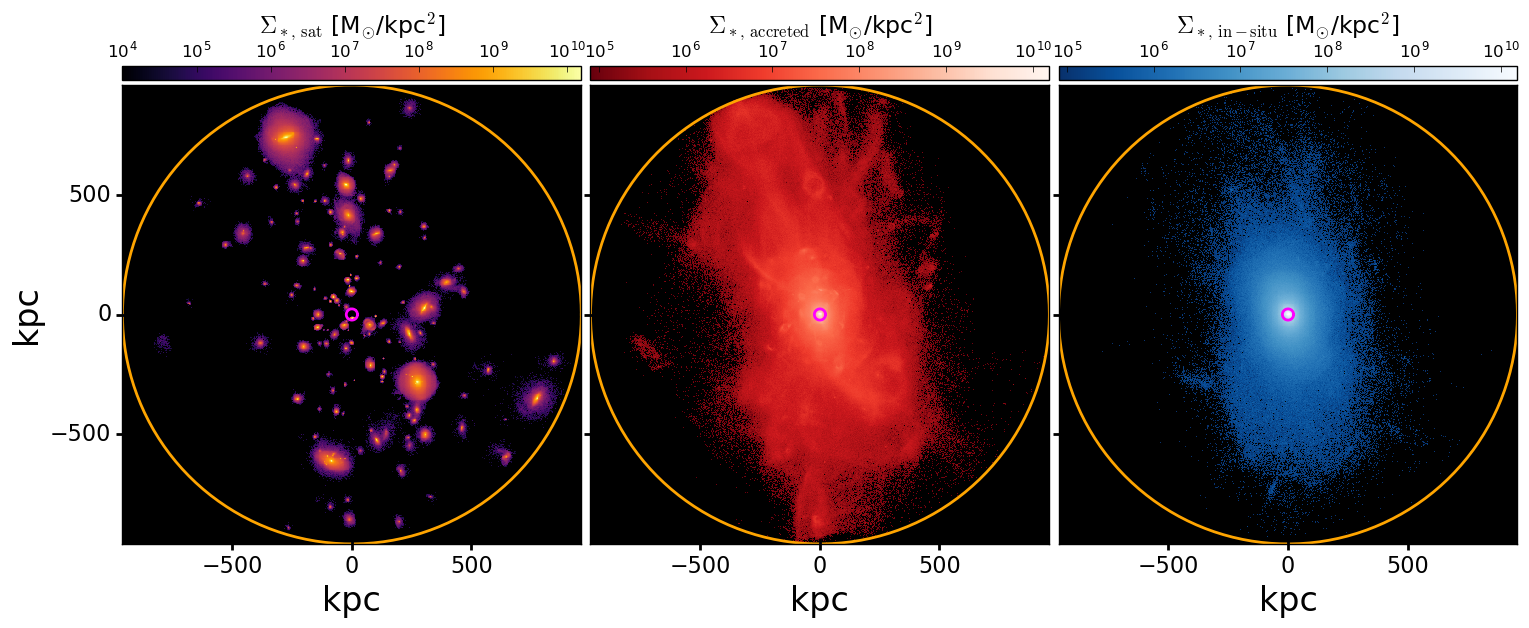
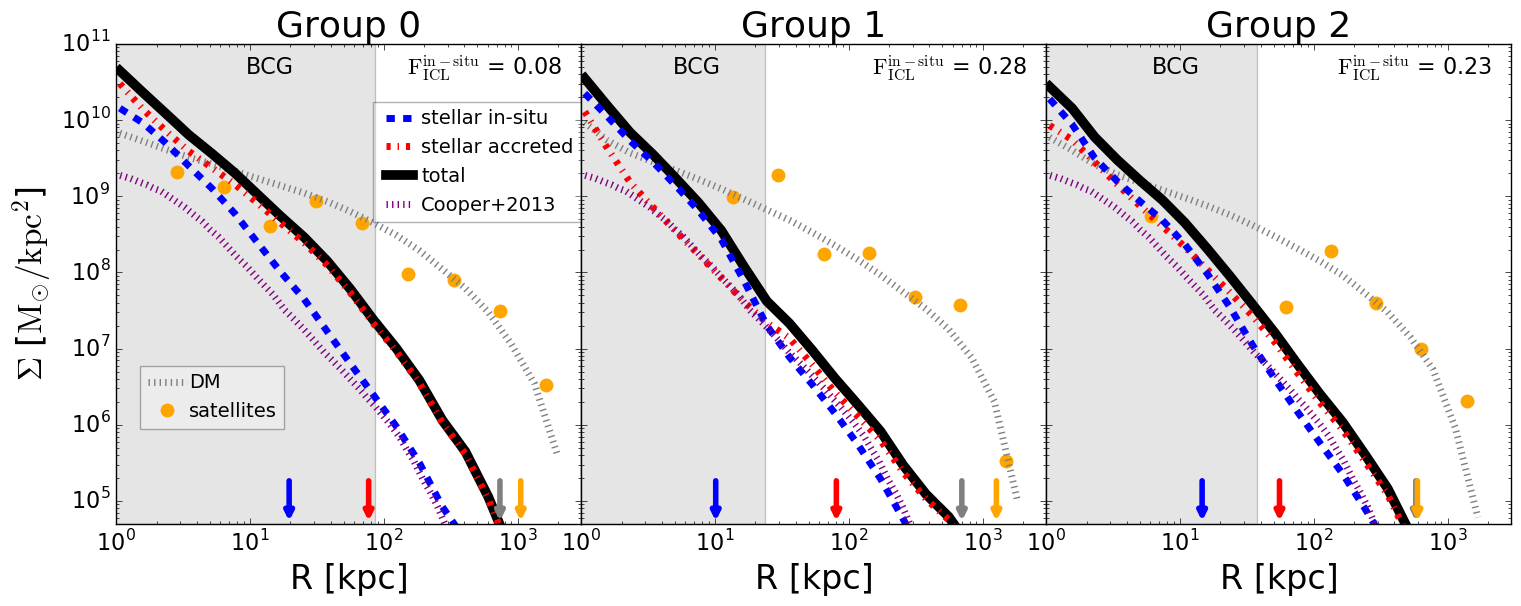
We study the fraction of the intra-cluster light (ICL) formed in-situ in the three most massive clusters of the TNG50 simulation, with virial masses $\sim 10^{14}$ M$_{\odot}$. We find that a significant fraction of ICL stars ($8\%$-$28\%$) are born in-situ. This amounts to a total stellar mass comparable to the central galaxy itself. Contrary to simple expectations, only a sub-dominant fraction of these in-situ ICL stars are born in the central regions and later re-distributed to more energetic orbits during mergers. Instead, many in-situ ICL stars form directly hundreds of kiloparsecs away from the central galaxy, in clouds condensing out of the circum-cluster medium. The simulations predict a present-date diffuse star formation rate of $\sim$1 $\mathrm{M}_{\odot}$/yr, with higher rates at higher redshifts. The diffuse star forming component of the ICL is filamentary in nature, extends for hundreds of kiloparsecs and traces the distribution of neutral gas in the cluster host halo. We discuss briefly how numerical details of the baryonic treatment in the simulation, in particular the density threshold for star formation and the equation of state, may play a role in this result. We conclude that a sensitivity of $1.6 imes 10^{-19} - 2.6 imes 10^{-18}$ erg s$^{-1}$ cm$^{-2}$ arcsec$^{-2}$ in H$_α$ flux (beyond current observational capabilities) would be necessary to detect this diffuse star-forming component in galaxy clusters.
Motivation & Objective
- To investigate the origin of intra-cluster light (ICL) stars in massive galaxy clusters, particularly whether a significant fraction form in-situ rather than through tidal stripping.
- To determine the spatial distribution and formation mechanisms of in-situ ICL stars in the circum-cluster medium (CCM), especially at large distances from the central galaxy.
- To assess the detectability of diffuse, low-surface-brightness star formation in the ICL using current and upcoming Hα surveys.
- To evaluate the role of numerical resolution and star formation threshold in simulating low-density star formation in the CCM.
Proposed method
- Utilized the TNG50 cosmological hydrodynamical simulation, which includes self-consistent baryonic physics and a moving-mesh approach (Arepo) to model galaxy formation and cluster evolution.
- Identified in-situ ICL stars as those formed in the cluster halo at distances >200 kpc from the central galaxy, with star formation occurring in dense gas clumps within the diffuse CCM.
- Tracked stellar formation history using merger trees and halo catalogs from the IllustrisTNG project to distinguish in-situ ICL from accreted or tidally stripped stars.
- Computed Hα surface brightness from diffuse star formation to assess detectability, using a Salpeter initial mass function and SN rate estimates.
- Analyzed spatial correlation between in-situ star-forming clouds, neutral gas, and dark matter to identify filamentary structures and environmental triggers.
- Varying the star formation threshold in sensitivity tests to evaluate numerical robustness of in-situ ICL formation in low-density environments.
Experimental results
Research questions
- RQ1What fraction of the intra-cluster light (ICL) in massive galaxy clusters forms in-situ rather than through tidal stripping from galaxies?
- RQ2Where and under what conditions do in-situ ICL stars form—near the central galaxy or in distant, diffuse regions of the circum-cluster medium (CCM)?
- RQ3Is the diffuse star formation in the ICL detectable with current or upcoming Hα surveys, and what sensitivity is required for detection?
- RQ4To what extent is the formation of in-situ ICL stars a numerical artifact, and how sensitive is this result to the choice of star formation threshold in the simulation?
- RQ5How does the spatial distribution of in-situ ICL stars relate to the underlying dark matter and neutral gas structures in the cluster halo?
Key findings
- Between 8% and 28% of the present-day intra-cluster light (ICL) in the three most massive TNG50 clusters formed in-situ, with a total stellar mass comparable to that of the central galaxy.
- The majority of in-situ ICL stars form directly in the diffuse circum-cluster medium (CCM), hundreds of kiloparsecs from the central galaxy, not through later redistribution from the central region.
- In-situ star formation occurs in filamentary, cloud-like structures aligned with neutral gas and dark matter distributions, not primarily driven by ram-pressure stripping from infalling galaxies.
- The present-day diffuse star formation rate in the ICL is ~1 M☉/yr, with higher rates at higher redshifts, indicating ongoing star formation over cosmic time.
- The Hα surface brightness of this diffuse star formation is ~6.8 × 10⁻¹⁹ erg s⁻¹ cm⁻² arcsec⁻², below the detection threshold of current surveys (e.g., VESTIGE) at 3 arcsec resolution.
- The formation of in-situ ICL stars is sensitive to the star formation threshold in the simulation, suggesting potential numerical dependence, though the result remains robust under tested conditions.
Read this paper
Open the full text in the Nubint reader and ask about any passage as you read.
Read this paper on NubintThis review was generated by AI from the original paper. Please check the paper before citing it.