
[논문 리뷰] Star-Planet Interaction at radio wavelengths in YZ Ceti: Inferring planetary magnetic field
이 연구는 우수한 메트레브웨이브 전파망원경(uGMRT)을 사용하여 YZ Ceti 시스템에서 항성-행성 상호작용(SPI)에 의한 오로라 전파 방출(ARE)이 전파 파장에서 처음으로 확인된 것으로 보고한다. 연구진은 YZ Cet b의 궤도 위상과 관련된 원형 편광 전파 폭발을 검출하여, 최소 0.4 G의 행성 자기장이 존재함을 추론하였으며, 이는 외계행성의 자기권을 간접적으로 측정한 최초의 사례이다.
In exoplanetary systems, the interaction between the central star and the planet can trigger Auroral Radio Emission (ARE), due to the Electron Cyclotron Maser mechanism. The high brightness temperature of this emission makes it visible at large distances, opening new opportunities to study exoplanets and to search for favourable conditions for the development of extra-terrestrial life, as magnetic fields act as a shield that protects life against external particles and influences the evolution of the planetary atmospheres. In the last few years, we started an observational campaign to observe a sample of nearby M-type stars known to host exoplanets with the aim to detect ARE. We observed YZ Ceti with the upgraded Giant Metrewave Radio Telescope (uGMRT) in band 4 (550-900 MHz) nine times over a period of five months. We detected radio emission four times, two of which with high degree of circular polarization. With statistical considerations we exclude the possibility of flares due to stellar magnetic activity. Instead, when folding the detections to the orbital phase of the closest planet YZ Cet b, they are at positions where we would expect ARE due to star-planet interaction (SPI) in sub-Alfvenic regime. With a degree of confidence higher than 4.37 sigma, YZ Cet is the first extrasolar systems with confirmed SPI at radio wavelengths. Modelling the ARE, we estimate a magnetic field for the star of about 2.4 kG and we find that the planet must have a magnetosphere. The lower limit for the polar magnetic field of the planet is 0.4 G.
연구 동기 및 목표
- 외계행성계에서 전파 파장으로 항성-행성 상호작용(SPI)에 의한 오로라 전파 방출(ARE)을 탐지하기 위해.
- M형 항성계에서의 항성 플레어와 구별하여 SPI에 의해 유도된 전파 방출을 식별하기 위해.
- 전파 방출 모델링을 통해 행성 자기장의 존재 및 강도를 추론하기 위해.
- 외계행성계에서 ARE에 대한 홀로우 콘 비스듬한 모델을 검증하기 위해.
- 전파 방출을 통해 외계행성 자기권을 간접적으로 탐지하는 방법을 수립하기 위해.
제안 방법
- 5개월 동안 YZ Ceti를 550–900 MHz 대역에서 uGMRT를 사용해 9회 관측하여 전파 방출을 탐지함.
- 원형 편광과 시간적 변동성을 분석하여 ARE와 항성 플레어를 구별함.
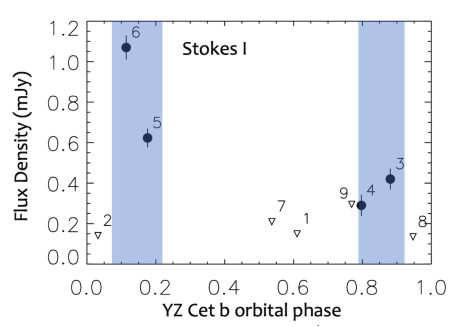
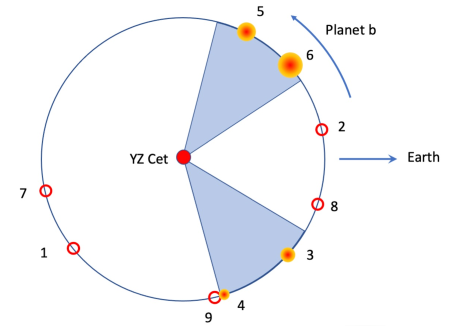
- YZ Cet b의 궤도 위상에 따라 검출 결과를 폴딩하여 예상되는 SPI 영역과의 상관관계를 확인함.
- 관측된 전파 방출을 전자 사이클로트론 마스터 방출(ECME) 메커니즘을 사용해 모델링함.
- 입사 자기력과 관측된 전파 방출 간의 에너지 균형을 이용해 행성 자기권 단면적을 추론함.
- 일반화된 전파-자기 Bode 법칙과 이중극자 자기장 스케일링을 적용하여 행성 자기장의 하한값을 추정함.
실험 결과
연구 질문
- RQ1외계행성계에서 항성-행성 상호작용에 의한 오로라 전파 방출(ARE)은 전파 파장에서 탐지될 수 있는가?
- RQ2YZ Ceti에서 탐지된 전파 방출은 항성 플레어가 아닌 SPI에 의한 ARE와 일치하는가?
- RQ3전파 방출 모델링을 통해 YZ Cet b의 행성 자기장 하한값은 무엇인가?
- RQ4관측된 방출 패tern은 ARE에 대한 홀로우 콘 비스듬한 모델을 지지하는가?
- RQ5전파 방출은 간접적으로 외계행성 자기권을 탐지하는 데 사용될 수 있는가?
주요 결과
- 9회의 uGMRT 관측 중 4회에서 전파 방출을 탐지하였으며, 그 중 2회는 높은 원형 편광을 보여 일관된 방출임을 시사함.
- 방출은 YZ Cet b의 궤도 위상과 강하게 상관되어 있으며, 대칭적인 두 영역에서 피크를 보이며, ARE의 홀로우 콘 비스듬한 모델과 일치함.
- 통계적 분석을 통해 항성 플레어가 방출의 원인일 가능성은 4.37σ 이상의 신뢰수준에서 배제됨.
- 관측된 전파광도(1.0–1.7×10²² erg s⁻¹)는 행성이 자기권을 갖지 않을 경우 입사 자기력의 최대치를 초과하므로, 자기권 단면적이 최소한 행성 반지름의 2.4배 이상이어야 함을 시사함.
- 이중극자 자기장과 에너지 균형을 가정할 경우, YZ Cet b의 극 자기장 하한값으로 0.4 G를 도출함.
- 이 결과는 외계행성계에서 행성 자기장이 간접적으로 탐지된 최초의 사례이며, 생명 가능성과 대기 진화에 대한 함의를 지님.
더 나은 연구,지금 바로 시작하세요
논문 읽기부터 검토까지, 연구 시간을 획기적으로 줄여보세요.
카드 등록 없음 · 무료 플랜 제공
이 리뷰는 AI가 만들고, 인간 에디터가 검토했습니다.