
[Paper Review] Stimulated emission of signal photons from dark matter waves
This paper proposes a quantum-enhanced dark matter search using a superconducting cavity prepared in a Fock state |n=4⟩ to stimulate emission of signal photons from dark matter waves. By initializing the cavity in a high-photon Fock state, the signal rate and scan rate are enhanced by a factor of 2.78, enabling a 90% confidence exclusion of dark photon kinetic mixing angle ε ≥ 4.24×10⁻¹³ at 5.965 GHz.
The manipulation of quantum states of light has resulted in significant advancements in both dark matter searches and gravitational wave detectors [1-4]. Current dark matter searches operating in the microwave frequency range use nearly quantum-limited amplifiers [3, 5, 6]. Future high frequency searches will use photon counting techniques [1] to evade the standard quantum limit. We present a signal enhancement technique that utilizes a superconducting qubit to prepare a superconducting microwave cavity in a non-classical Fock state and stimulate the emission of a photon from a dark matter wave. By initializing the cavity in an $|n=4 angle$ Fock state, we demonstrate a quantum enhancement technique that increases the signal photon rate and hence also the dark matter scan rate each by a factor of 2.78. Using this technique, we conduct a dark photon search in a band around $\mathrm{5.965\, GHz \, (24.67\, μeV)}$, where the kinetic mixing angle $ε\geq 4.35 imes 10^{-13}$ is excluded at the $90\%$ confidence level.
Motivation & Objective
- To overcome the standard quantum limit in dark matter searches by leveraging non-classical states of light.
- To enhance the signal photon rate and scan speed in microwave-frequency dark matter detection using quantum state engineering.
- To demonstrate compatibility of Fock state initialization with low-noise, sub-SQL photon counting techniques.
- To set a new exclusion limit on the dark photon kinetic mixing angle ε using stimulated emission in a superconducting cavity system.
Proposed method
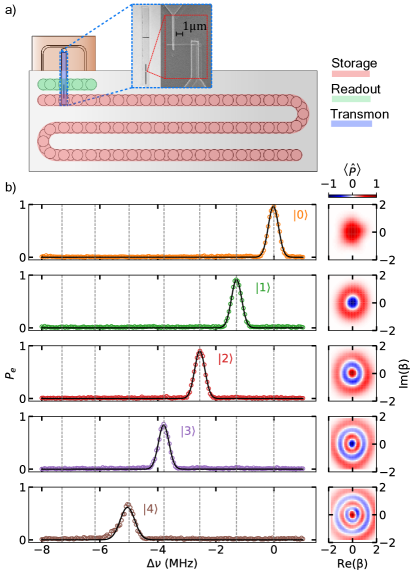
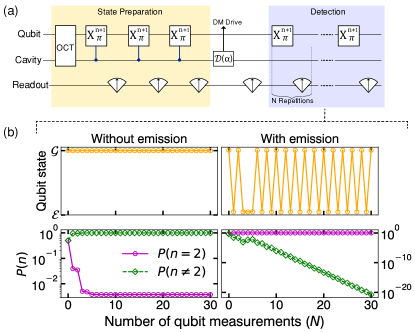
- Prepares a superconducting microwave cavity in a |n=4⟩ Fock state using optimal control pulses (OCT) on a transmon qubit.
- Uses the Fock state as a seed state to stimulate emission of photons from a coherent dark matter wave via resonant coupling.
- Employs a qubit-based single-photon detector to achieve sub-SQL background rates and high-fidelity photon number measurement.
- Applies a quantum-enhanced signal rate scaling: signal rate enhanced by (n+1)η, where n=4 and η is detection efficiency.
- Performs Ramsey interferometry to measure cavity frequency and quality factor with sub-Hz precision to reduce systematic uncertainty.
- Convolved the dark matter lineshape (Q_DM ~10⁶) with the cavity response to determine the excluded parameter space.
Experimental results
Research questions
- RQ1Can a Fock state in a superconducting cavity enhance the signal rate for dark matter detection beyond the standard quantum limit?
- RQ2To what extent does Fock state initialization improve the dark matter scan rate in microwave-frequency searches?
- RQ3What is the maximum tolerable background photon occupation before Fock state fidelity degrades significantly during state preparation?
- RQ4How does the inclusion of a Fock state seed affect the sensitivity to dark photon kinetic mixing angle ε?
- RQ5Can the stimulated emission technique be combined with sub-SQL photon counting to achieve enhanced detection sensitivity?
Key findings
- The signal photon rate and dark matter scan rate are enhanced by a factor of 2.78 when the cavity is initialized in a |n=4⟩ Fock state.
- A 90% confidence level exclusion is set for dark photon kinetic mixing angle ε ≥ 4.24×10⁻¹³ at 5.965 GHz, based on experimental data and error propagation.
- Fidelity of Fock state preparation degrades significantly when the mean injected photon number exceeds n̄ > 0.05, setting a practical limit on background tolerance.
- The dominant systematic uncertainty in the exclusion limit arises from the amplitude of the coherent drive (a₀), with σ_ε ≈ 3.30×10⁻¹³.
- The technique is compatible with existing sub-SQL photon counting, enabling noise-limited detection while enhancing signal rate.
- The effective signal enhancement scales as (n+1)η, confirming the theoretical prediction of stimulated emission in a cavity with a Fock state seed.
Read this paper
Open the full text in the Nubint reader and ask about any passage as you read.
Read this paper on NubintThis review was generated by AI from the original paper. Please check the paper before citing it.