
[Paper Review] Surveillance Face Presentation Attack Detection Challenge
This paper presents the Surveillance Face Presentation Attack Detection Challenge at CVPR 2023, introducing the SuHiFiMask dataset—10,195 videos from 101 subjects captured by 7 surveillance cameras under realistic long-distance conditions. The challenge evaluated 37 teams on robustness to quality variations, with top models achieving ACER as low as 4.73%, demonstrating the effectiveness of large-scale, high-fidelity surveillance data for advancing face anti-spoofing in real-world scenarios.
Face Anti-spoofing (FAS) is essential to secure face recognition systems from various physical attacks. However, most of the studies lacked consideration of long-distance scenarios. Specifically, compared with FAS in traditional scenes such as phone unlocking, face payment, and self-service security inspection, FAS in long-distance such as station squares, parks, and self-service supermarkets are equally important, but it has not been sufficiently explored yet. In order to fill this gap in the FAS community, we collect a large-scale Surveillance High-Fidelity Mask (SuHiFiMask). SuHiFiMask contains $10,195$ videos from $101$ subjects of different age groups, which are collected by $7$ mainstream surveillance cameras. Based on this dataset and protocol-$3$ for evaluating the robustness of the algorithm under quality changes, we organized a face presentation attack detection challenge in surveillance scenarios. It attracted 180 teams for the development phase with a total of 37 teams qualifying for the final round. The organization team re-verified and re-ran the submitted code and used the results as the final ranking. In this paper, we present an overview of the challenge, including an introduction to the dataset used, the definition of the protocol, the evaluation metrics, and the announcement of the competition results. Finally, we present the top-ranked algorithms and the research ideas provided by the competition for attack detection in long-range surveillance scenarios.
Motivation & Objective
- Address the lack of large-scale, realistic surveillance-based face anti-spoofing datasets for long-distance scenarios.
- Develop a standardized benchmark protocol to evaluate FAS algorithms under real-world variations such as image quality, identity, and attack type.
- Drive research progress in face presentation attack detection for remote surveillance by organizing a competitive challenge with rigorous evaluation.
- Enable the development of robust models capable of handling low-resolution, motion-blurred, and occluded face images typical in public surveillance environments.
Proposed method
- Collected SuHiFiMask, a large-scale dataset with 10,195 videos from 101 subjects across 7 mainstream surveillance cameras under diverse lighting, weather, and pose conditions.
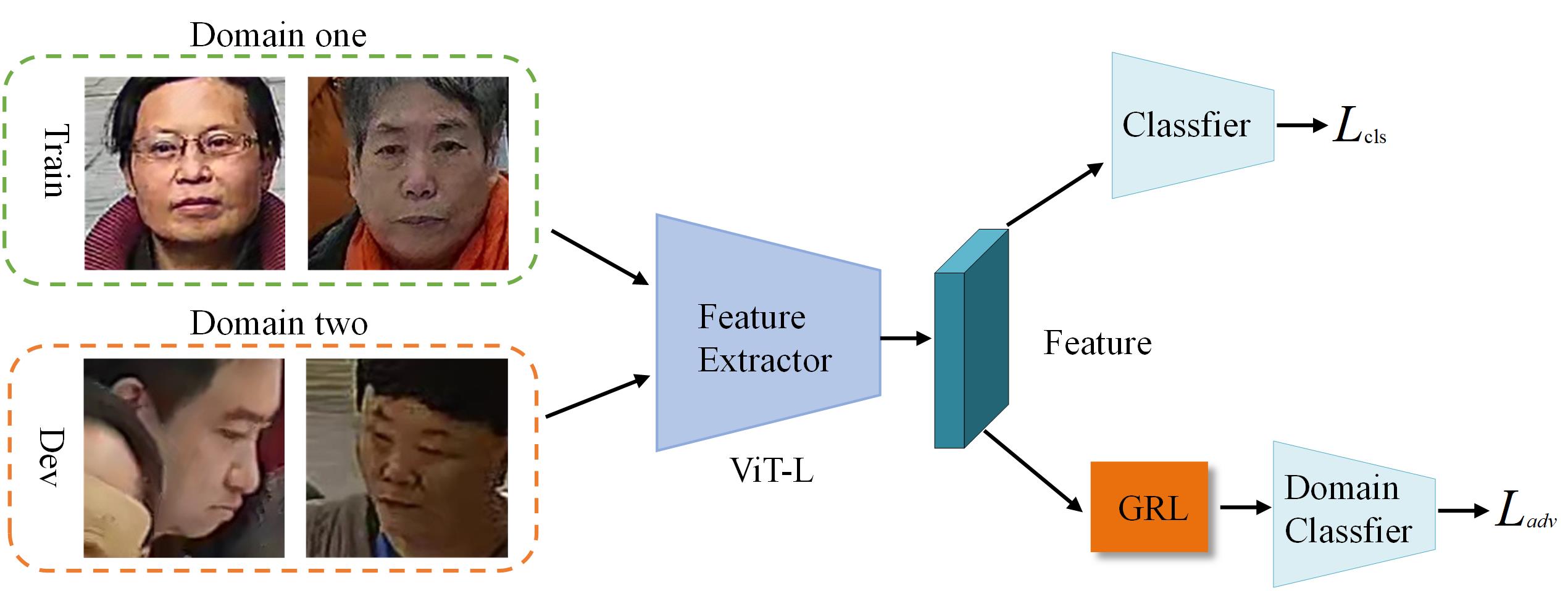
- Designed a multi-protocol evaluation framework including ID shift, mask type shift, and image quality variation to test algorithm generalization.
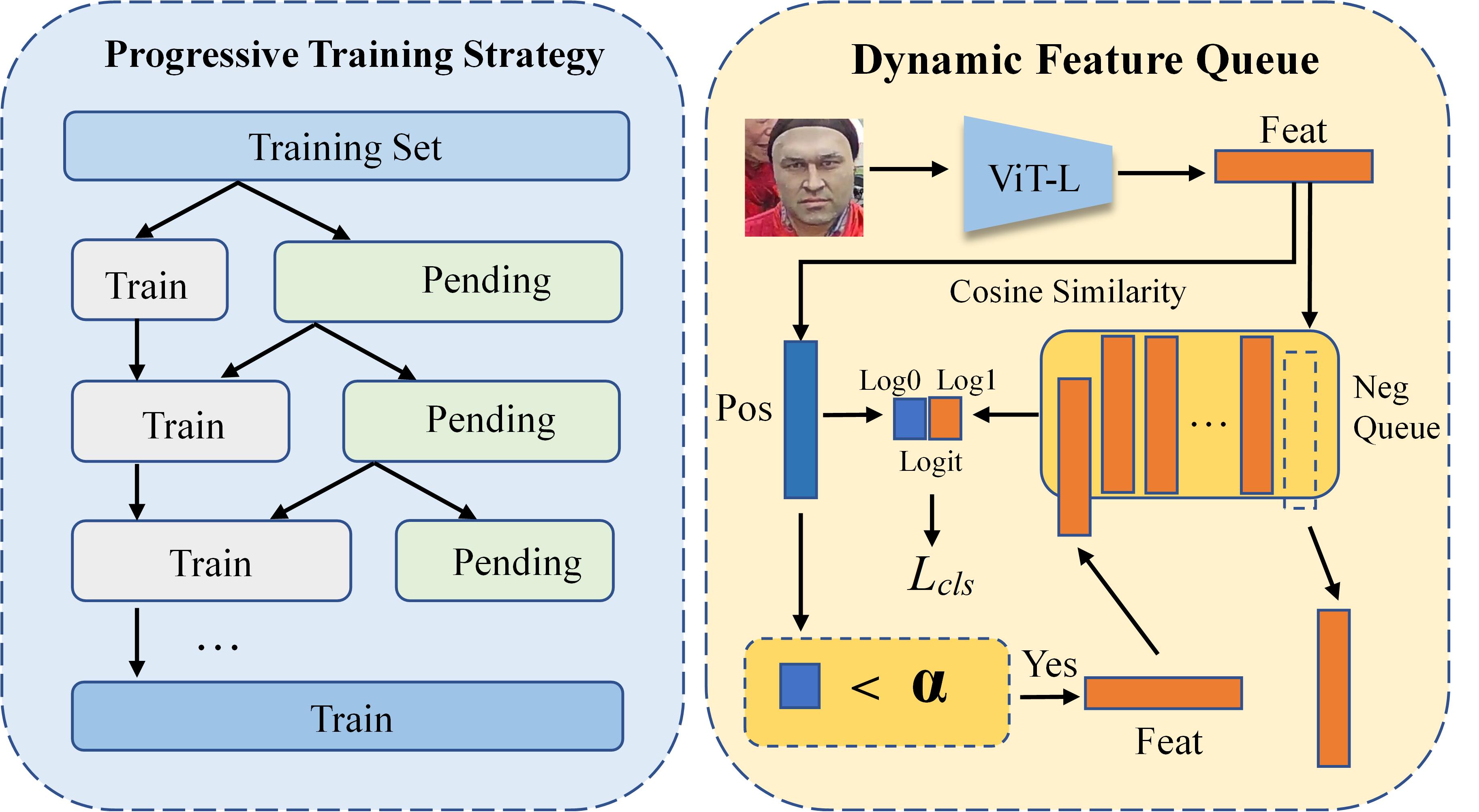
- Employed standard deep learning training with backbone networks (e.g., Swin-Tiny, Swin-Base), using cross-entropy and angular margin loss (ArcFace) for feature discrimination.
- Applied data augmentation and class balancing techniques to improve model generalization and reduce overfitting.
- Used AdamW optimizer with cosine decay learning rate scheduling and early stopping to improve convergence and prevent overfitting.
- Conducted final model evaluation on a held-out test set using CodaLab, with re-verification by organizers to ensure fair ranking.
Experimental results
Research questions
- RQ1How do state-of-the-art face anti-spoofing models perform under realistic long-distance surveillance conditions with low-resolution and degraded image quality?
- RQ2To what extent does model performance degrade when tested under ID shift, attack type shift, or image quality variation in surveillance settings?
- RQ3Can large-scale, high-fidelity datasets like SuHiFiMask significantly improve the robustness and generalization of FAS models in real-world deployments?
- RQ4What architectural and training strategies are most effective for face anti-spoofing in challenging surveillance environments with limited image quality?
- RQ5How do data pre-processing and multi-branch feature learning contribute to model stability and performance on surveillance FAS benchmarks?
Key findings
- The top-performing team (MateoH) achieved an ACER of 4.73%, indicating strong generalization and robustness to spoofing attacks in long-distance surveillance.
- Eight of the top nine teams were from industry, highlighting the real-world relevance and practical importance of surveillance FAS in commercial applications.
- ACER scores across the top nine teams ranged from 4.73% to 12.00%, showing significant performance disparity and confirming the challenge’s difficulty.
- Large backbone networks (e.g., Swin-Tiny, Swin-Base) outperformed smaller models, indicating that model scale is a key factor in handling low-quality surveillance data.
- Multi-branch feature learning and data augmentation techniques were widely adopted and contributed to improved model stability and performance.
- The challenge demonstrated that current FAS models still struggle with extreme degradation, suggesting a need for advanced super-resolution and feature recovery methods in future work.
Read this paper
Open the full text in the Nubint reader and ask about any passage as you read.
Read this paper on NubintThis review was generated by AI from the original paper. Please check the paper before citing it.