
[Paper Review] Survey of Gravitationally lensed Objects in HSC Imaging (SuGOHI) $-$ X. Strong Lens Finding in The HSC-SSP using Convolutional Neural Networks
This study applies a convolutional neural network (CNN) to the Hyper Suprime-Cam Subaru Strategic Program (HSC-SSP) survey to detect strong gravitational lenses in multi-band imaging. The model identifies 43 definite and 269 probable lens systems from 2.35 million galaxies, including 97 new discoveries, significantly advancing lens detection efficiency and enabling future spectroscopic follow-up for cosmological modeling.
We apply a novel model based on convolutional neural networks (CNNs) to identify gravitationally-lensed galaxies in multi-band imaging of the Hyper Suprime Cam Subaru Strategic Program (HSC-SSP) Survey. The trained model is applied to a parent sample of 2 350 061 galaxies selected from the $\sim$ 800 deg$^2$ Wide area of the HSC-SSP Public Data Release 2. The galaxies in HSC Wide are selected based on stringent pre-selection criteria, such as multiband magnitudes, stellar mass, star formation rate, extendedness limit, photometric redshift range, etc. Initially, the CNNs provide a total of 20 241 cutouts with a score greater than 0.9, but this number is subsequently reduced to 1 522 cutouts by removing definite non-lenses for further inspection by human eyes. We discover 43 definite and 269 probable lenses, of which 97 are completely new. In addition, out of 880 potential lenses, we recovered 289 known systems in the literature. We identify 143 candidates from the known systems that had higher confidence in previous searches. Our model can also recover 285 candidate galaxy-scale lenses from the Survey of Gravitationally lensed Objects in HSC Imaging (SuGOHI), where a single foreground galaxy acts as the deflector. Even though group-scale and cluster-scale lens systems were not included in the training, a sample of 32 SuGOHI-c (i.e., group/cluster-scale systems) lens candidates was retrieved. Our discoveries will be useful for ongoing and planned spectroscopic surveys, such as the Subaru Prime Focus Spectrograph project, to measure lens and source redshifts in order to enable detailed lens modelling.
Motivation & Objective
- To develop and apply a deep learning model for automated detection of strong gravitational lenses in wide-field optical imaging.
- To improve upon traditional lens-finding methods by leveraging convolutional neural networks (CNNs) for higher accuracy and scalability.
- To identify new lens systems in the HSC-SSP survey, particularly galaxy-scale lenses, and recover known systems with higher confidence.
- To enable future spectroscopic follow-up by providing a refined list of high-priority lens candidates for projects like the Prime Focus Spectrograph.
- To assess the model’s generalization capability by detecting group- and cluster-scale lenses despite not being included in training.
Proposed method
- A custom convolutional neural network (CNN) is trained on a curated dataset of lensed and non-lensed galaxy cutouts from the HSC-SSP survey.
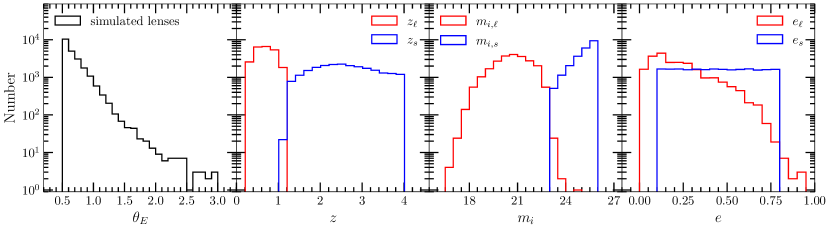
- The model processes multi-band imaging cutouts (g, r, i, z, y) of 2,350,061 galaxies pre-selected based on magnitude, stellar mass, star formation rate, extendedness, and photometric redshift.
- Cutouts with CNN confidence scores >0.9 are selected for further analysis, reducing the initial pool from 20,241 to 1,522 candidates after removing obvious non-lenses.
- Human experts perform visual inspection on the remaining candidates, assigning grades A (definite), B (probable), or C (possible) based on lens morphology.
- The model’s predictions are cross-referenced with existing lens catalogs to identify duplicates and reclassify previously graded systems.
- The method is tested on known systems, including 285 galaxy-scale lenses from the SuGOHI survey and 289 known systems from the literature.
Experimental results
Research questions
- RQ1Can a deep learning model based on CNNs effectively detect strong gravitational lenses in large-scale, multi-band optical surveys like HSC-SSP?
- RQ2How does the CNN-based approach compare to previous automated and human-inspection methods in terms of discovery rate and confidence?
- RQ3To what extent can a model trained on galaxy-scale lenses generalize to detect group- and cluster-scale lens systems?
- RQ4What fraction of new lens candidates are truly novel, and how many were previously misclassified or overlooked?
- RQ5Can the model recover known lens systems with higher confidence than prior searches?
Key findings
- The CNN identified 20,241 cutouts with a confidence score >0.9, which were reduced to 1,522 after removing obvious non-lenses through visual inspection.
- The final sample includes 43 definite (grade A) and 269 probable (grade B) strong lens candidates, with 97 being completely new discoveries.
- Among the 880 grade C candidates, 143 were previously graded as A or B in earlier literature, indicating improved detection confidence.
- The model successfully recovered 285 known galaxy-scale lens candidates from the SuGOHI survey, demonstrating strong generalization.
- Despite no group- or cluster-scale lenses in the training data, the model retrieved 32 candidates from the SuGOHI-c sample, suggesting latent generalization ability.
- The lens galaxies in the candidates have photometric redshifts ranging from 0.2 to 1.2, supporting their suitability for follow-up spectroscopy and lens modeling.
Read this paper
Open the full text in the Nubint reader and ask about any passage as you read.
Read this paper on NubintThis review was generated by AI from the original paper. Please check the paper before citing it.