
[Paper Review] Suspicion-Agent: Playing Imperfect Information Games with Theory of Mind Aware GPT-4
The paper presents Suspicion-Agent, a GPT-4 based agent that uses structured prompts and theory-of-mind reasoning to play imperfect information games without specialized training, demonstrating competitive performance in Leduc Hold’em and qualitative success across multiple games.
Unlike perfect information games, where all elements are known to every player, imperfect information games emulate the real-world complexities of decision-making under uncertain or incomplete information. GPT-4, the recent breakthrough in large language models (LLMs) trained on massive passive data, is notable for its knowledge retrieval and reasoning abilities. This paper delves into the applicability of GPT-4's learned knowledge for imperfect information games. To achieve this, we introduce extbf{Suspicion-Agent}, an innovative agent that leverages GPT-4's capabilities for performing in imperfect information games. With proper prompt engineering to achieve different functions, Suspicion-Agent based on GPT-4 demonstrates remarkable adaptability across a range of imperfect information card games. Importantly, GPT-4 displays a strong high-order theory of mind (ToM) capacity, meaning it can understand others and intentionally impact others' behavior. Leveraging this, we design a planning strategy that enables GPT-4 to competently play against different opponents, adapting its gameplay style as needed, while requiring only the game rules and descriptions of observations as input. In the experiments, we qualitatively showcase the capabilities of Suspicion-Agent across three different imperfect information games and then quantitatively evaluate it in Leduc Hold'em. The results show that Suspicion-Agent can potentially outperform traditional algorithms designed for imperfect information games, without any specialized training or examples. In order to encourage and foster deeper insights within the community, we make our game-related data publicly available.
Motivation & Objective
- Motivate leveraging pre-trained LLMs for imperfect information games without task-specific training.
- Introduce a modular prompt-based architecture enabling observation interpretation, rule understanding, and planning.
- Incorporate theory-of-mind (ToM) reasoning to predict and influence opponents’ actions.
- Demonstrate generalization across multiple games and compare with traditional imperfect-information algorithms.
Proposed method
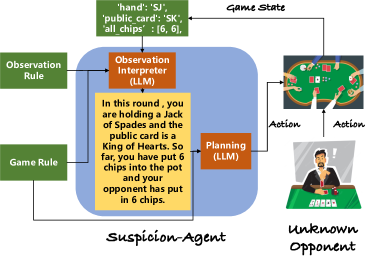
- Decompose game solving into modules: Observation Interpreter, Game Rule Understanding, Planning, Reflexion, and Evaluator.
- Convert low-level game states into natural language descriptions to feed GPT-4.
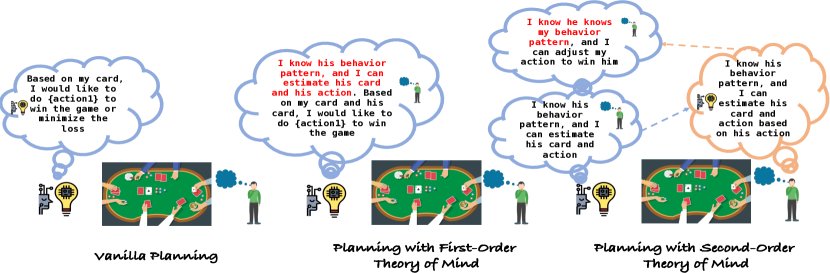
- Use a vanilla planning flow with Reflexion to learn from history and plan actions.
- Introduce first-order and second-order ToM planning to predict opponent behavior and adapt plans.
- Implement a planning with ToM that estimates opponent hand strength and likely responses to plans.
- Evaluate across three two-player games qualitatively and in Leduc Hold’em quantitatively against CFR, NFSP, DMC, and DQN.
Experimental results
Research questions
- RQ1Can Suspicion-Agent match or surpass traditional imperfect-information algorithms without specialized training?
- RQ2How does ToM (first and second order) affect performance against diverse opponents?
- RQ3Can the GPT-4 based approach generalize to multiple imperfect information games beyond Leduc Hold’em?
- RQ4What is the impact of including opponent observations and hindsight on performance?
- RQ5How do different ToM orders compare in terms of strategic effectiveness?
Key findings
- Suspicion-Agent, powered by GPT-4, outperforms baselines trained specifically on Leduc Hold’em in the presented experiments.
- GPT-4 based agents with ToM planning show superior adaptability to varied opponent strategies (CFR, DMC, NFSP) than vanilla planning.
- GPT-4 (GPT-4) significantly outperforms GPT-3.5 in the same setup, with GPT-3.5 showing a noticeable performance drop.
- Second-order ToM planning enables more aggressive and exploitative strategies (e.g., bluffing) leading to higher chip gains when facing bluff-prone opponents.
- Qualitative results demonstrate generalization to Coup and Texas Hold’em Limit without additional training or examples.
Read this paper
Open the full text in the Nubint reader and ask about any passage as you read.
Read this paper on NubintThis review was generated by AI from the original paper. Please check the paper before citing it.