
[Paper Review] Swamplandish Unification of the Dark Sector
The paper argues from Swampland principles that a single extra mesoscopic dimension (the dark dimension) explains the small dark energy and unifies dark energy with dark matter as gravitons in the dark dimension, predicting a micron-scale extra dimension and a decaying KK graviton dark matter tower that differs from ΛCDM.
We provide a short overview of recent progress made in our understanding of the dark sector based on the Swampland program which in turn is rooted in lessons from string theory. We explain how the existence of one extra mesoscopic dimension (the ``dark dimension") in the micron range emerges and how this can lead to a unification of the dark energy and dark matter. In particular the smallness of the dark energy leads to the prediction of the existence of a tower of weakly interacting light particles which can naturally play the role of dark matter. Moreover this unifies dark matter with gravity as dark matter ends up being excitations of graviton in the dark dimension. We also explain how in combination with other Swampland principles one finds an explanation of the ``why now" and the ``cosmological coincidence" problems. This model is consistent with the cosmological bounds as well as the Newton's inverse square law, but makes predictions which differ from $Λ$CDM. It also gives rise to an appealing picture of hierarchy of scales in particle physics pegged to the dark energy, including a possible origin of the electroweak hierarchy and the prediction of masses of QCD axion and sterile neutrinos both in the 1-10 meV range. This review is intended for a broad audience of high energy theorists and cosmologists without prior knowledge of string theory and it explains the motivations and predictions of this program in a non-technical form.
Motivation & Objective
- Motivate naturalness and UV/IR mixing from the Swampland program using string theory probes.
- Predict a single micron-scale extra dimension (the dark dimension) from the small dark energy scale.
- Propose a unification of dark energy and dark matter via a tower of light KK/graviton states.
- Describe cosmological consequences and a dynamical dark matter mechanism from bulk-brane couplings.
- Outline experimental prospects, especially tests of Newton’s inverse-square law at micron scales.
Proposed method
- Apply distance/conjecture and de Sitter/Bulk Swampland conjectures to our universe to infer a light tower of states with mass m ~ Λ^a and a light extra dimension with R ∼ Λ^(-1/4).
- Argue that SM fields are confined to a 3+1D brane in a (3+n)+1D space, with n micrometer-scale dimensions arising from consistency with ISL tests and collider bounds.
- Estimate energy leakage to bulk KK gravitons using gravitational-strength couplings and derive dark matter production during the radiation-dominated era.
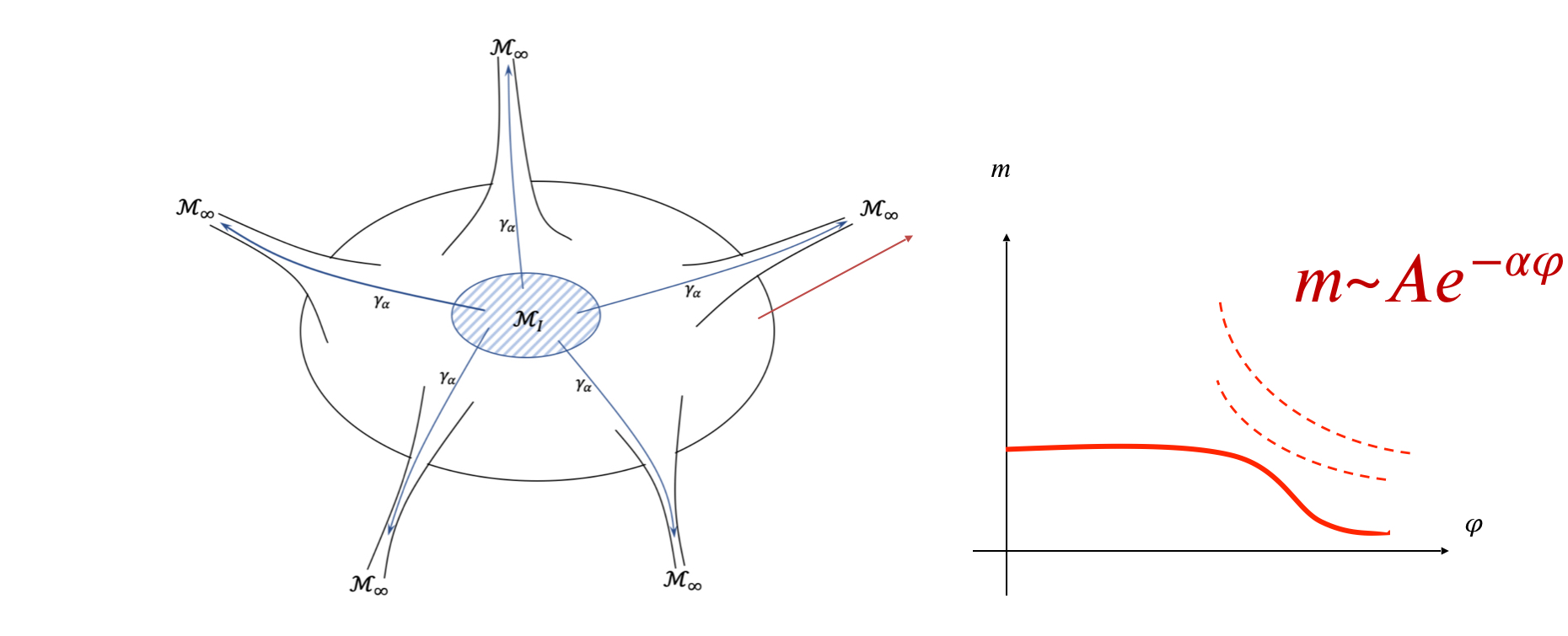
- Derive a cosmological evolution for the KK dark gravitons, including decay rates Γ ~ m^3/M_p^2 and a time-evolving mass m(t) ~ t^(-7/2).
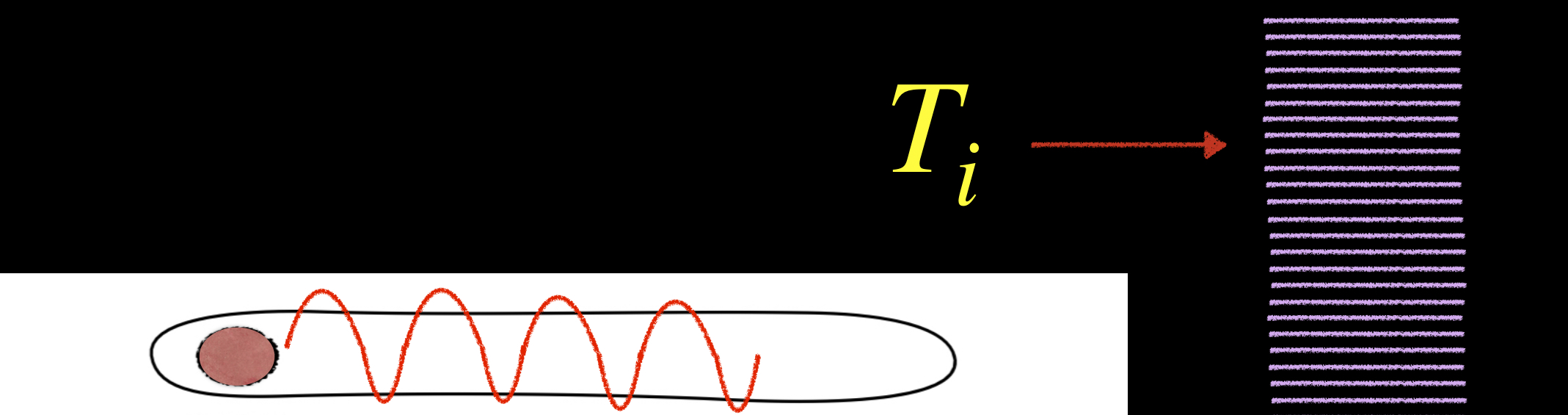
- Connect initial temperatures Teff to observed dark matter abundance and the cosmological coincidence via scaling relations such as y_DM ~ T_i^3 Λ^(-1/4).
- Discuss experimental constraints from ISL tests, neutron star bounds, and CMB/BBN considerations.
Experimental results
Research questions
- RQ1Can Swampland constraints naturally predict a micron-scale dark dimension?
- RQ2Does a tower of KK gravitons provide a viable, weakly interacting dark matter candidate that unifies with dark energy?
- RQ3What are the cosmological implications and decay signatures of such a KK graviton dark sector?
- RQ4What experimental tests (especially ISL deviations) can confirm or falsify the dark dimension scenario?
- RQ5How do Swampland conjectures address the "why now" and cosmological coincidence problems in this framework?
Key findings
- Prediction of one extra mesoscopic dimension in the micron range (R ≳ 88 μm) consistent with ISL tests and phenomenology.
- A tower of light KK/graviton states provides a natural dark matter candidate that unifies with dark energy.
- Dark matter is produced from SM-brane couplings to bulk gravitons and evolves as a decaying dynamical dark matter tower with Γ ~ m^3/M_p^2.
- Dark matter today is expected around 50–100 keV mass range after evolution from an initial GeV-scale mass.
- Predictions include ISL deviations at 1–10 μm scales and a small kick velocity for decay products that can affect structure formation.
- The model offers an explanation for the cosmological coincidence via scaling relations linking T_i, Λ, and T_DE.
Read this paper
Open the full text in the Nubint reader and ask about any passage as you read.
Read this paper on NubintThis review was generated by AI from the original paper. Please check the paper before citing it.