
[Paper Review] SwitchGPT: Adapting Large Language Models for Non-Text Outputs
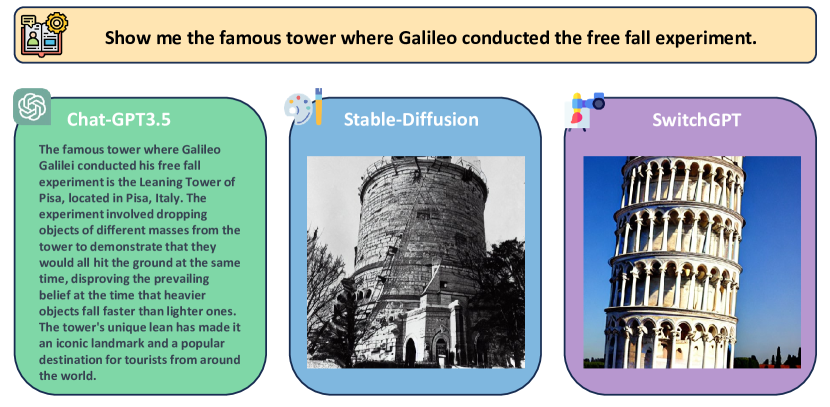
SwitchGPT proposes a novel method to adapt text-based large language models (LLMs) for generating non-text outputs—such as images and audio—by instructing them to recognize intended output modalities through minimal, modality-aligned instruction tuning. This enables LLMs to act as intelligent controllers that route instructions to pre-trained modality conversion models, achieving high accuracy and prompt quality without requiring multi-modal pretraining or complex fine-tuning.
Large Language Models (LLMs), primarily trained on text-based datasets, exhibit exceptional proficiencies in understanding and executing complex linguistic instructions via text outputs. However, they falter when requests to generate non-text ones. Concurrently, modality conversion models, such as text-to-image, despite generating high-quality images, suffer from a lack of extensive textual pretraining. As a result, these models are only capable of accommodating specific image descriptions rather than comprehending more complex instructions. To bridge this gap, we propose a novel approach, \methodname, from a modality conversion perspective that evolves a text-based LLM into a multi-modal one. We specifically employ a minimal dataset to instruct LLMs to recognize the intended output modality as directed by the instructions. Consequently, the adapted LLM can effectively summon various off-the-shelf modality conversion models from the model zoos to generate non-text responses. This circumvents the necessity for complicated pretraining that typically requires immense quantities of paired multi-modal data, while simultaneously inheriting the extensive knowledge of LLMs and the ability of high-quality generative models. To evaluate and compare the adapted multi-modal LLM with its traditional counterparts, we have constructed a multi-modal instruction benchmark that solicits diverse modality outputs. The experiment results reveal that, with minimal training, LLMs can be conveniently adapted to comprehend requests for non-text responses, thus achieving higher flexibility in multi-modal scenarios. Code and data will be made available at https://github.com/xinke-wang/SwitchGPT.
Motivation & Objective
- To address the limitation of text-based LLMs in generating non-text outputs such as images and audio.
- To overcome the knowledge gap in modality conversion models, which lack the reasoning and common-sense understanding of LLMs.
- To enable LLMs to act as intelligent coordinators that select and invoke appropriate off-the-shelf modality conversion models based on instruction intent.
- To develop a computationally efficient alternative to existing LLM-as-controller frameworks that suffer from high latency and instability.
- To establish a benchmark for evaluating multi-modal instruction following in LLMs with diverse output modalities.
Proposed method
- Introduce a modality-alignment instruction tuning phase where LLMs are fine-tuned on a minimal dataset to recognize the intended output modality from instructions.
- Map each instruction to a specific modality (text, image, audio) and pair it with the corresponding output, enabling the LLM to learn modality-specific response patterns.
- Use the adapted LLM as a controller to invoke pre-trained, off-the-shelf modality conversion models (e.g., Stable Diffusion for images, TTS for audio) based on predicted modality.
- Leverage the LLM’s reasoning and knowledge capabilities to generate high-quality prompts for modality-specific models, improving generation quality.
- Train the LLM using standard instruction tuning, avoiding complex multi-modal pretraining or end-to-end fine-tuning on paired data.
- Ensure the LLM’s reasoning and text-generation capabilities remain intact by preserving performance on standard language benchmarks.
Experimental results
Research questions
- RQ1Can a text-based LLM be effectively adapted to understand and generate non-text outputs without direct exposure to non-text data?
- RQ2How well can a minimal instruction-tuning approach enable LLMs to correctly identify the intended output modality from natural language instructions?
- RQ3Does using an LLM as a controller for pre-trained modality conversion models outperform direct prompting or black-box LLM control in terms of modality accuracy and output quality?
- RQ4To what extent does modality-aligned instruction tuning preserve the LLM’s original language understanding and reasoning capabilities?
- RQ5Can the proposed method generalize to diverse, complex, and conversational instructions beyond the training distribution?
Key findings
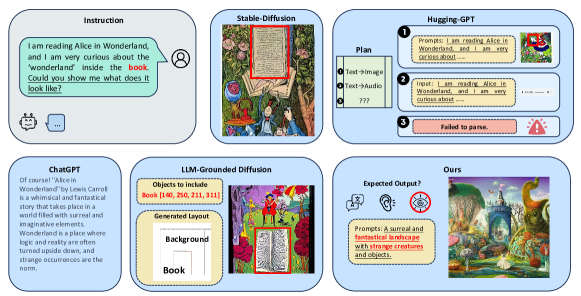
- SwitchGPT achieves state-of-the-art modality accuracy, matching GPT-3.5-turbo and surpassing all other methods, including HuggingGPT and LLM-grounded Diffusion.
- The method significantly outperforms OPT-6.7B, which fails to generate non-text outputs and defaults to text, highlighting the importance of proper instruction tuning.
- SwitchGPT achieves the highest CLIP score among all methods, indicating superior prompt quality for image generation models.
- The LLM maintains strong language understanding, achieving accuracy comparable to Llama2-7B on standard language benchmarks.
- Qualitative results show that SwitchGPT correctly interprets diverse conversational inputs and generates appropriate multi-modal responses, even when instructions differ from training examples.
- The approach enables effective, low-cost adaptation of LLMs to multi-modal generation without requiring multi-modal pretraining or access to paired data.
Read this paper
Open the full text in the Nubint reader and ask about any passage as you read.
Read this paper on NubintThis review was generated by AI from the original paper. Please check the paper before citing it.