
[Paper Review] SynFlowNet: Design of Diverse and Novel Molecules with Synthesis Constraints
SynFlowNet uses a GFlowNet with a reaction-based action space to generate synthesisable molecules, achieving high diversity and favorable drug-like properties. It outperforms fragment-based GFlowNets in synthesisability while maintaining diversity.
Generative models see increasing use in computer-aided drug design. However, while performing well at capturing distributions of molecular motifs, they often produce synthetically inaccessible molecules. To address this, we introduce SynFlowNet, a GFlowNet model whose action space uses chemical reactions and purchasable reactants to sequentially build new molecules. By incorporating forward synthesis as an explicit constraint of the generative mechanism, we aim at bridging the gap between in silico molecular generation and real world synthesis capabilities. We evaluate our approach using synthetic accessibility scores and an independent retrosynthesis tool to assess the synthesizability of our compounds, and motivate the choice of GFlowNets through considerable improvement in sample diversity compared to baselines. Additionally, we identify challenges with reaction encodings that can complicate traversal of the MDP in the backward direction. To address this, we introduce various strategies for learning the GFlowNet backward policy and thus demonstrate how additional constraints can be integrated into the GFlowNet MDP framework. This approach enables our model to successfully identify synthesis pathways for previously unseen molecules.
Motivation & Objective
- Motivate synthesis-aware de novo molecular design that guarantees synthetic pathways.
- Propose a GFlowNet framework with an action space built from documented chemical reactions and purchasable reactants.
- Demonstrate that synthesis-constrained generation yields competitive or superior synthesisability and quality metrics.
- Compare reaction-based action space to fragment-based GFlowNets in terms of diversity, SA/QED, and synthesis paths.
Proposed method
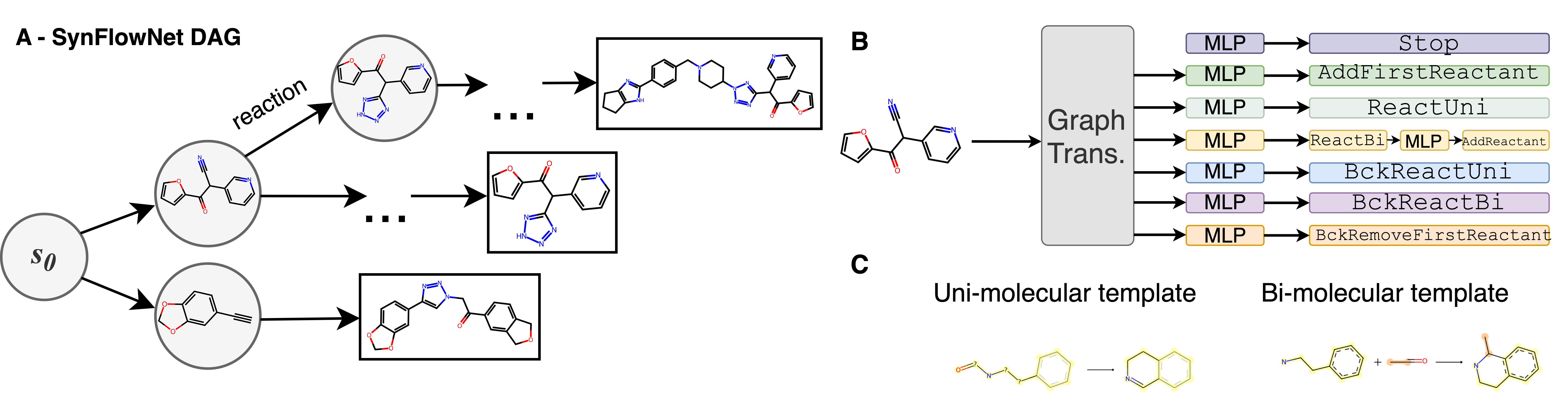
- Define five forward action types (Stop, AddFirstReactant, ReactUni, ReactBi, AddReactant) to construct molecules via chemical reactions and reactants.
- Represent reactions with SMARTS templates and use pre-computed masks to ensure compatibility.
- Parameterize forward and backward policies with a graph transformer and separate MLPs for each action type.
- Train with trajectory balance objective to learn state flows and policies.
- Use a reward proportional to predicted sEH binding energy from a pretrained proxy model and apply reward modulation with a temperature parameter beta.
- Evaluate using QED, SA Score, SCScore, ligand efficiency, validity, uniqueness, and diversity, plus AiZynthFinder retrosynthesis validation.
Experimental results
Research questions
- RQ1Can a GFlowNet trained over a chemistry-driven action space generate molecules with comparable or better rewards and diversity than fragment-based action spaces?
- RQ2Does a reaction-based action space improve synthesisability of generated molecules as assessed by SA/SC scores and retrosynthetic tools?
Key findings
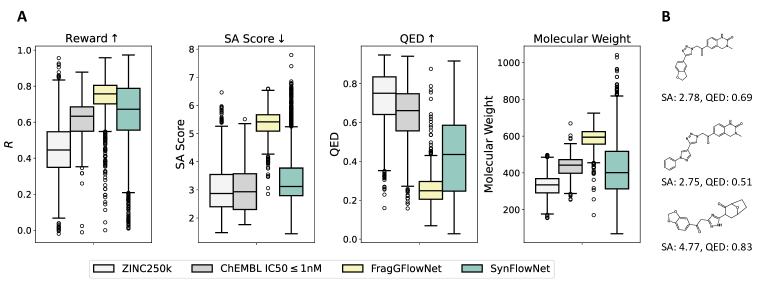
- SynFlowNet achieves better SA and SC scores than the fragment-based GFlowNet and better QED scores.
- SynFlowNet attains higher ligand efficiency on average.
- Pairwise Tanimoto diversity (Morgan fingerprints) is 0.81, indicating maintained diversity despite the constrained action space.
- AiZynthFinder retrosynthesis shows 47% of SynFlowNet molecules had successful routes versus 0% for the fragment GFlowNet.
- SynFlowNet molecules align with ChEMBL actives for sEH targets in four metrics (except QED).
- SynFlowNet enables synthesis-aware generation where about half of top molecules have viable synthetic routes.
Read this paper
Open the full text in the Nubint reader and ask about any passage as you read.
Read this paper on NubintThis review was generated by AI from the original paper. Please check the paper before citing it.