
[Paper Review] Temporal Perceiving Video-Language Pre-training
TemPVL introduces a text-video localization pre-training task that merges short video and text streams into long sequences to learn fine-grained, temporally-aware cross-modal alignment without temporal annotations, improving multiple video-language tasks.
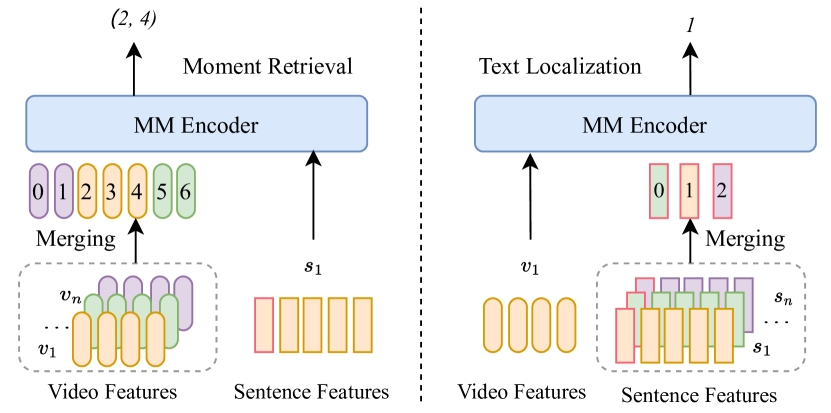
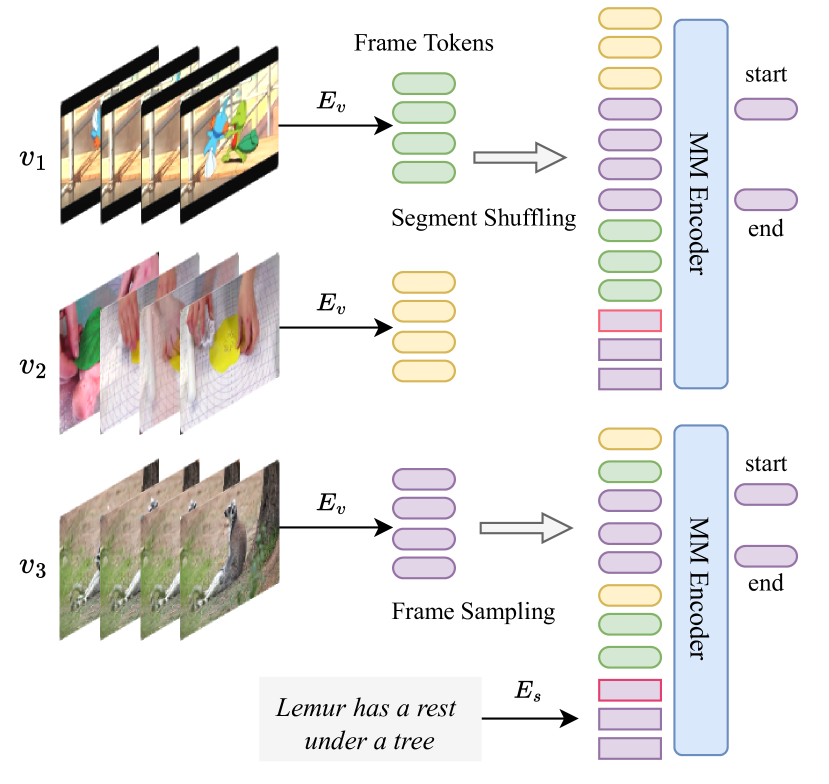
Video-Language Pre-training models have recently significantly improved various multi-modal downstream tasks. Previous dominant works mainly adopt contrastive learning to achieve global feature alignment across modalities. However, the local associations between videos and texts are not modeled, restricting the pre-training models' generality, especially for tasks requiring the temporal video boundary for certain query texts. This work introduces a novel text-video localization pre-text task to enable fine-grained temporal and semantic alignment such that the trained model can accurately perceive temporal boundaries in videos given the text description. Specifically, text-video localization consists of moment retrieval, which predicts start and end boundaries in videos given the text description, and text localization which matches the subset of texts with the video features. To produce temporal boundaries, frame features in several videos are manually merged into a long video sequence that interacts with a text sequence. With the localization task, our method connects the fine-grained frame representations with the word representations and implicitly distinguishes representations of different instances in the single modality. Notably, comprehensive experimental results show that our method significantly improves the state-of-the-art performance on various benchmarks, covering text-to-video retrieval, video question answering, video captioning, temporal action localization and temporal moment retrieval. The code will be released soon.
Motivation & Objective
- Motivate learning fine-grained temporal and semantic alignment between video frames and text descriptions.
- Develop a pre-training task that does not require temporal annotations to supervise localization.
- Enhance generalization across downstream video-language tasks through localization-guided multimodal learning.
Proposed method
- Use dual encoders for video and text with a multi-modal encoder to fuse features.
- Construct long video sequences by merging frame features from multiple videos and align with merged text tokens.
- Introduce two localization objectives: moment retrieval with language and text localization with video.
- Apply a text-video contrastive objective along with masked language modeling and the proposed localization losses.
- Predict start/end boundaries for merged video frames and matched positions for merged text tokens using a classification-based loss.
Experimental results
Research questions
- RQ1Can a localization-based pre-training objective improve fine-grained frame-to-word alignment without temporal annotations?
- RQ2Does merging short video-text pairs into long sequences enable effective moment localization and text localization during pre-training?
- RQ3What is the impact of text-video localization on zero-shot and fine-tuned performance across retrieval, QA, captioning, and temporal localization tasks?
- RQ4How do merging strategies for video and text sequences affect localization quality and downstream task performance?
Key findings
- TemPVL improves zero-shot text-to-video retrieval on MSR-VTT and DiDeMo and gains in MSVD and LSMDC.
- The method yields improvements in video question answering and video captioning over strong baselines.
- Temporal action localization and moment retrieval benefit from the extracted features and localization-guided pre-training, with gains over prior methods.
- Hard sampling for video merging and CLS-based text merging enhance localization accuracy and downstream task performance.
- Using different backbones (SwinT, ViT) with TVL shows consistent gains across tasks, indicating robust generalization.
Read this paper
Open the full text in the Nubint reader and ask about any passage as you read.
Read this paper on NubintThis review was generated by AI from the original paper. Please check the paper before citing it.