
[Paper Review] Testing correlation of unlabeled random graphs
This paper studies the problem of detecting edge correlation between two unlabeled random graphs under a latent node correspondence. Using the conditional second-moment method, it establishes sharp thresholds for correlation detection in dense Gaussian and Erdős-Rényi graphs, and determines the threshold within a constant factor for sparse Erdős-Rényi graphs, revealing a phase transition in testing error probability as n→∞.
We study the problem of detecting the edge correlation between two random graphs with $n$ unlabeled nodes. This is formalized as a hypothesis testing problem, where under the null hypothesis, the two graphs are independently generated; under the alternative, the two graphs are edge-correlated under some latent node correspondence, but have the same marginal distributions as the null. For both Gaussian-weighted complete graphs and dense Erdős-Rényi graphs (with edge probability $n^{-o(1)}$), we determine the sharp threshold at which the optimal testing error probability exhibits a phase transition from zero to one as $n o \infty$. For sparse Erdős-Rényi graphs with edge probability $n^{-Ω(1)}$, we determine the threshold within a constant factor. The proof of the impossibility results is an application of the conditional second-moment method, where we bound the truncated second moment of the likelihood ratio by carefully conditioning on the typical behavior of the intersection graph (consisting of edges in both observed graphs) and taking into account the cycle structure of the induced random permutation on the edges. Notably, in the sparse regime, this is accomplished by leveraging the pseudoforest structure of subcritical Erdős-Rényi graphs and a careful enumeration of subpseudoforests that can be assembled from short orbits of the edge permutation.
Motivation & Objective
- To formalize and solve the problem of testing correlation between two unlabeled random graphs under a latent node correspondence.
- To determine the fundamental limits of detecting edge correlation when node labels are unknown and only isomorphism classes are observed.
- To analyze the phase transition in testing error probability for various random graph models, including Gaussian-weighted and Erdős-Rényi graphs.
- To develop a conditional second-moment method that accounts for the cycle structure of edge permutations induced by latent node correspondences.
- To establish sharp or nearly sharp thresholds for detection in dense and sparse graph regimes, respectively.
Proposed method
- Formulates the problem as a hypothesis test: H₀ (independent graphs) vs. H₁ (edge-correlated graphs under latent node correspondence).
- Applies the conditional second-moment method to bound the truncated second moment of the likelihood ratio, conditioning on the typical structure of the intersection graph.
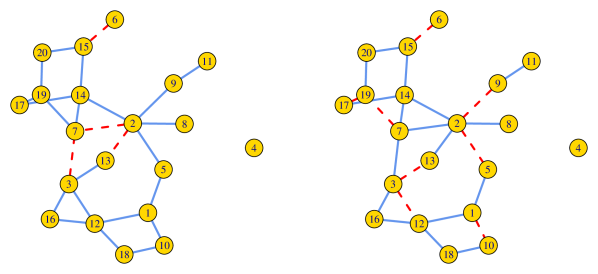
- Uses cycle decomposition of the random permutation induced by the latent node correspondence to analyze edge orbit structures.
- For the dense regime, derives a sharp threshold using generating functions and asymptotic analysis of the second moment under Gaussian and dense Erdős-Rényi models.
- For the sparse regime, leverages pseudoforest structure in subcritical Erdős-Rényi graphs and enumerates subpseudoforests from short orbits of the edge permutation.
- Employs concentration inequalities (Hanson-Wright and Chernoff) and random permutation facts (cycle counts and Poisson approximation) to control tail behavior.
Experimental results
Research questions
- RQ1What is the fundamental limit of detecting edge correlation between two unlabeled random graphs when node labels are unknown?
- RQ2How does the testing error probability behave as the number of nodes n→∞ in dense and sparse random graph models?
- RQ3What role does the cycle structure of the latent node permutation play in the detectability of edge correlation?
- RQ4Can the conditional second-moment method be adapted to handle the combinatorial complexity introduced by unlabeled graphs and latent isomorphisms?
- RQ5What is the sharp threshold for correlation detection in dense Gaussian-weighted and dense Erdős-Rényi graphs?
Key findings
- For dense Gaussian-weighted and dense Erdős-Rényi graphs (edge probability n^{-o(1)}), the paper establishes a sharp threshold at which the testing error probability undergoes a phase transition from 0 to 1 as n→∞.
- For sparse Erdős-Rényi graphs with edge probability n^{-Ω(1)}, the paper determines the detection threshold within a constant factor, showing that correlation detection is impossible below this threshold.
- The impossibility results are proven via the conditional second-moment method, where the second moment of the likelihood ratio is bounded by conditioning on the typical intersection graph and analyzing the cycle structure of the edge permutation.
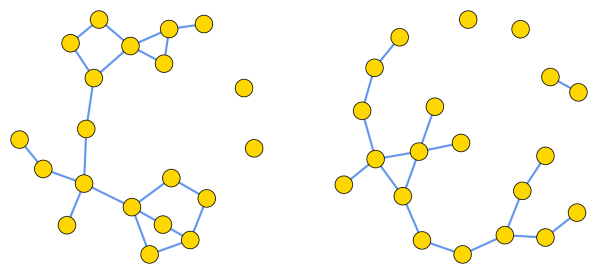
- In the sparse regime, the proof relies on the pseudoforest structure of subcritical Erdős-Rényi graphs and a careful enumeration of subpseudoforests formed from short orbits of the edge permutation.
- The analysis reveals that the dominant contribution to the second moment comes from configurations with short cycles in the edge permutation, which are linked to the backbone structure of the intersection graph.
- The results demonstrate that graph invariants and topological structure alone can enable detection of correlation, even when node identities are unknown, under appropriate sparsity and correlation regimes.
Read this paper
Open the full text in the Nubint reader and ask about any passage as you read.
Read this paper on NubintThis review was generated by AI from the original paper. Please check the paper before citing it.