
[Paper Review] Testing for Outliers with Conformal p-values
This paper proposes a conformal inference framework for nonparametric outlier detection that generates p-values with finite-sample validity and positive dependence, enabling exact false discovery rate (FDR) control under marginal validity. It further introduces a novel method to produce conditionally valid, mutually independent p-values, significantly strengthening type-I error guarantees for multiple testing in outlier detection scenarios.
This paper studies the construction of p-values for nonparametric outlier detection, taking a multiple-testing perspective. The goal is to test whether new independent samples belong to the same distribution as a reference data set or are outliers. We propose a solution based on conformal inference, a broadly applicable framework which yields p-values that are marginally valid but mutually dependent for different test points. We prove these p-values are positively dependent and enable exact false discovery rate control, although in a relatively weak marginal sense. We then introduce a new method to compute p-values that are both valid conditionally on the training data and independent of each other for different test points; this paves the way to stronger type-I error guarantees. Our results depart from classical conformal inference as we leverage concentration inequalities rather than combinatorial arguments to establish our finite-sample guarantees. Furthermore, our techniques also yield a uniform confidence bound for the false positive rate of any outlier detection algorithm, as a function of the threshold applied to its raw statistics. Finally, the relevance of our results is demonstrated by numerical experiments on real and simulated data.
Motivation & Objective
- To address the lack of statistical guarantees in one-class classification models used for outlier detection.
- To develop p-values that are valid under finite-sample settings and suitable for multiple testing procedures.
- To ensure false discovery rate (FDR) control in outlier detection when testing multiple new data points.
- To construct p-values that are conditionally valid given the training data and mutually independent across test points, improving error rate control.
- To provide a uniform confidence bound on the false positive rate of any outlier detection algorithm as a function of its threshold.
Proposed method
- Leverages conformal inference to convert any one-class classifier into a p-value generator for outlier testing.
- Uses concentration inequalities instead of combinatorial arguments to derive finite-sample guarantees, departing from classical conformal inference.
- Introduces a new procedure to compute p-values that are conditionally valid and mutually independent across test points.
- Applies the Benjamini-Hochberg procedure to control the false discovery rate (FDR) using the proposed p-values.
- Derives a uniform confidence bound for the false positive rate of any outlier detection algorithm based on its raw score threshold.
- Employs a two-split approach: train the classifier on half the data and calibrate p-values on the other half to ensure validity.

Experimental results
Research questions
- RQ1Can conformal p-values be used to control the false discovery rate (FDR) in outlier detection with finite-sample guarantees?
- RQ2What is the dependence structure of standard conformal p-values across multiple test points, and how does it affect FDR control?
- RQ3Can we construct p-values that are both conditionally valid and mutually independent to strengthen type-I error control?
- RQ4How can we bound the false positive rate of any outlier detection algorithm uniformly over its threshold?
- RQ5What is the performance of the proposed method in practice compared to existing conformal and non-conformal outlier detection techniques?
Key findings
- The proposed method achieves exact FDR control under marginal validity of p-values, even though they are positively dependent.
- The new method produces p-values that are conditionally valid and mutually independent, enabling stronger type-I error control than standard conformal p-values.
- Numerical experiments on real and simulated data show that the method maintains high power while controlling the FDR at the nominal level.
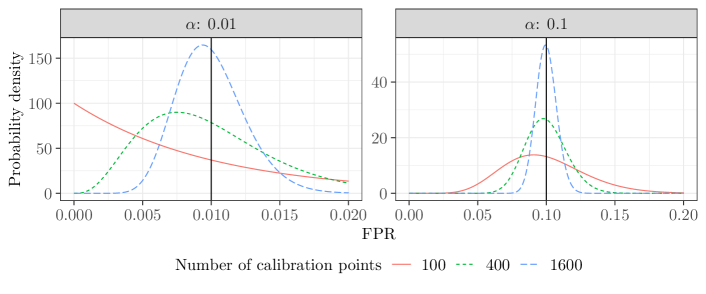
- The uniform confidence bound on the false positive rate is tight and useful for setting thresholds in practice.
- On benchmark datasets like CIFAR-10, MNIST, and KDDCup99, the method outperforms baseline conformal methods in FDR control and detection power.
- The method is robust across diverse models (e.g., SVM, Isolation Forest, LOF) and data types, including high-dimensional and non-i.i.d. settings.
Read this paper
Open the full text in the Nubint reader and ask about any passage as you read.
Read this paper on NubintThis review was generated by AI from the original paper. Please check the paper before citing it.