
[논문 리뷰] TextMI: Textualize Multimodal Information for Integrating Non-verbal Cues in Pre-trained Language Models
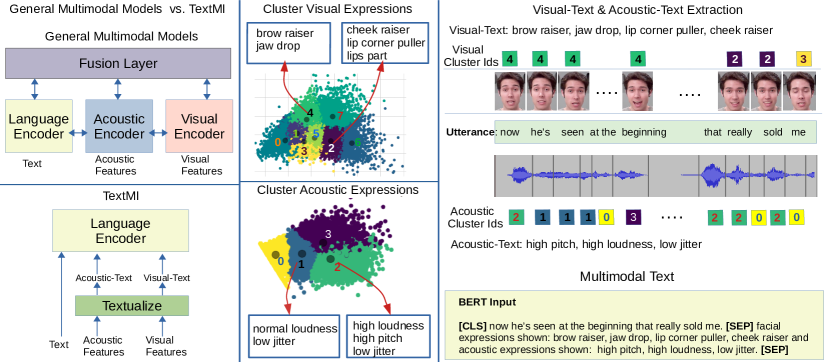
TextMI는 비디오에서 청각적 및 시각적 비언어적 신호를 자연어로 텍스트화한 후, 이를 말하기로 된 텍스트와 결합하여 사전에 훈련된 BERT 모델에 입력하여 다중모달 행동 이해를 수행한다. 이 방법은 다중모달 비웃음 감지에서 뛰어난 성능을 보이며, 감정 및 유머 감지에서도 거의 최고의 성능을 기록하며, 모델 복잡도를 크게 줄이고 해석 가능성도 향상시킨다.
Pre-trained large language models have recently achieved ground-breaking performance in a wide variety of language understanding tasks. However, the same model can not be applied to multimodal behavior understanding tasks (e.g., video sentiment/humor detection) unless non-verbal features (e.g., acoustic and visual) can be integrated with language. Jointly modeling multiple modalities significantly increases the model complexity, and makes the training process data-hungry. While an enormous amount of text data is available via the web, collecting large-scale multimodal behavioral video datasets is extremely expensive, both in terms of time and money. In this paper, we investigate whether large language models alone can successfully incorporate non-verbal information when they are presented in textual form. We present a way to convert the acoustic and visual information into corresponding textual descriptions and concatenate them with the spoken text. We feed this augmented input to a pre-trained BERT model and fine-tune it on three downstream multimodal tasks: sentiment, humor, and sarcasm detection. Our approach, TextMI, significantly reduces model complexity, adds interpretability to the model's decision, and can be applied for a diverse set of tasks while achieving superior (multimodal sarcasm detection) or near SOTA (multimodal sentiment analysis and multimodal humor detection) performance. We propose TextMI as a general, competitive baseline for multimodal behavioral analysis tasks, particularly in a low-resource setting.
연구 동기 및 목표
- 사전에 훈련된 언어 모델이 비언어적 신호를 텍스트 형태로 제시받을 경우 효과적으로 통합할 수 있는지 조사하는 것.
- 종단간 다중모달 융합을 피하여 다중모달 행동 이해에서 모델 복잡도와 데이터 요구량을 줄이는 것.
- 비언어적 특징을 인간이 읽을 수 있는 텍스트 형태로 표현함으로써 모델 결정의 해석 가능성 향상.
- 특히 자원이 제한된 상황에서 다양한 다중모달 정서 컴퓨팅 작업에 적용 가능한 단순하고 일반화 가능한 기준 모델 설정.
제안 방법
- OpenFace와 OpenSMILE를 사용하여 비디오에서 시각적 및 청각적 특징을 추출한다.
- K-means 군집화를 사용하여 추출된 특징을 유한한 그룹으로 분할하여 대표적인 비언어적 패턴을 형성한다.
- 프롬프트 기반 방법을 사용하여 각 군집에 대해 자연어 기술서(시각적-텍스트 및 청각적-텍스트)를 생성한다.
- 기존의 말하기 텍스트에 생성된 시각적-텍스트 및 청각적-텍스트를 보완하여 통합된 텍스트 입력을 형성한다.
- 하류 다중모달 작업을 위해 증강된 텍스트 입력으로 사전에 훈련된 BERT 모델을 미세조정한다.
- 공개 데이터셋을 사용하여 세 가지 다중모달 작업(감성, 유머, 비웃음 감지)에서 모델을 평가한다.
실험 결과
연구 질문
- RQ1사전에 훈련된 언어 모델이 비언어적 신호를 텍스트 형태로 제시받을 경우 효과적으로 이해하고 활용할 수 있는가?
- RQ2시각적 및 청각적 특징을 텍스트화하는 것이 기존의 다중모달 융합 방식과 비교해 다중모달 행동 이해 작업 성능에 어떤 영향을 미치는가?
- RQ3이 방법이 자원이 제한된 환경에서 모델 복잡도를 얼마나 줄이고 해석 가능성을 향상시키는가?
- RQ4이 방법이 다양한 다중모달 정서 컴퓨팅 작업에 강력하고 일반화 가능한 기준 모델로 기능할 수 있는가?
주요 결과
- TextMI는 다중모달 비웃음 감지에서 최고 성능(SOTA)을 달성하며, 기존의 SOTA 모델들을 능가한다.
- 모든 평가 지표에서 다중모달 감성 분석 및 유머 감지에서 거의 최고 성능을 기록한다.
- 제거 실험 결과, 청각-텍스트 및 시각-텍스트를 추가함으로써 정확도가 크게 향상됨을 확인하였으며, 특히 CMU-MOSI 및 MUStARD와 같은 작은 데이터셋에서 두드러진다.
- 텍스트 전용 BERT보다 감성 강도 예측 성능이 향상되어 비언어적 뉘앙스의 통합이 더 잘 이루어졌음을 시사한다.
- 비언어적 신호를 자연어 기술서를 통해 접근 가능하게 하여 모델 결정의 해석 가능성 향상.
- 사전에 훈련된 언어 모델과 낮은 훈련 복잡도를 활용함으로써 계산 효율성이 높고, 자원이 제한된 환경에 적합하다.
![Figure 2: A multimodal sentiment analysis example to illustrate how the model put importance on text, acoustic and visual words. (a) word importance’s are highlighted by color. (b) shows how the visual-text and acoustic-text are extracted. [CLS] and [SEP] are special tokens of BERT.](https://ar5iv.labs.arxiv.org/html/2303.15430/assets/x2.png)
더 나은 연구,지금 바로 시작하세요
논문 읽기부터 검토까지, 연구 시간을 획기적으로 줄여보세요.
카드 등록 없음 · 무료 플랜 제공
이 리뷰는 AI가 만들고, 인간 에디터가 검토했습니다.