
[Paper Review] The ALMA Survey of 70 μm Dark High-mass Clumps in Early Stages (ASHES). VIII. Dynamics of Embedded Dense Cores
This study analyzes the dynamics of 294 dense cores in 12 infrared dark clouds (IRDCs) using ALMA observations to assess high-mass star formation mechanisms. It finds that protostellar cores are more gravitationally bound than prestellar cores, with no significant increase in turbulence from prestellar to protostellar phases, supporting 'clump-fed' models over 'core-fed' scenarios.
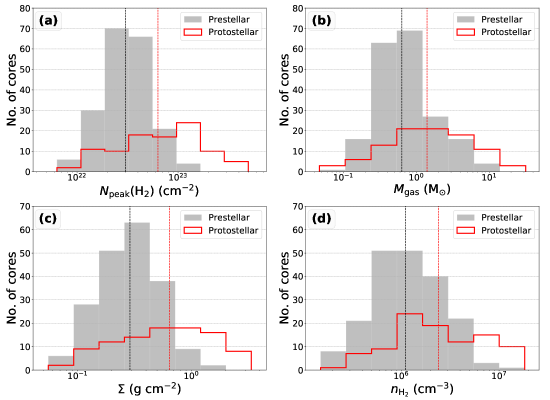
We present the dynamical properties of 294 cores embedded in twelve IRDCs observed as part of the ASHES Survey. Protostellar cores have higher gas masses, surface densities, column densities, and volume densities than prestellar cores, indicating core mass growth from the prestellar to the protostellar phase. We find that ~80% of cores with virial parameter ($α$) measurements are gravitationally bound ($α$< 2). We also find an anti-correlation between the mass and the virial parameter of cores, with massive cores having on average lower virial parameters. Protostellar cores are more gravitationally bound than prestellar cores, with an average virial parameter of 1.2 and 1.5, respectively. The observed non-thermal velocity dispersion (from N$_{2}$D$^{+}$ or DCO$^{+}$) is consistent with simulations in which turbulence is continuously injected, whereas the core-to-core velocity dispersion is neither in agreement with driven nor decaying turbulence simulations. We find no significant increment in the line velocity dispersion from prestellar to protostellar cores, suggesting that dense gas within the core traced by these deuterated molecules is not yet severely affected by turbulence injected from outflow activity at the early evolutionary stages traced in ASHES. The most massive cores are strongly self-gravitating and have greater surface density, Mach number, and velocity dispersion than cores with lower masses. Dense cores have not significant velocity shifts relative to their low-density envelopes, suggesting that dense cores are co-moving with their envelopes. We conclude that the observed core properties are more in line with predictions of ``clump-fed" scenarios rather than with ``core-fed" scenarios.
Motivation & Objective
- To investigate the dynamical properties of embedded dense cores in early-stage high-mass star-forming regions.
- To determine whether core properties align with 'core-fed' or 'clump-fed' high-mass star formation models.
- To assess the role of turbulence, gravitational collapse, and core-envelope kinematics in early core evolution.
- To compare observed core dynamics with theoretical simulations of driven and decaying turbulence.
- To evaluate the influence of accretion and feedback on core velocity dispersion during the earliest stages of core evolution.
Proposed method
- Acquired high-resolution ALMA data at 70 μm dark IRDCs to identify and characterize embedded dense cores.
- Measured core virial parameters (α) using gas mass, size, and velocity dispersion from N2D+ and DCO+ line emissions.
- Calculated turbulent Mach numbers from nonthermal velocity dispersion and core size.
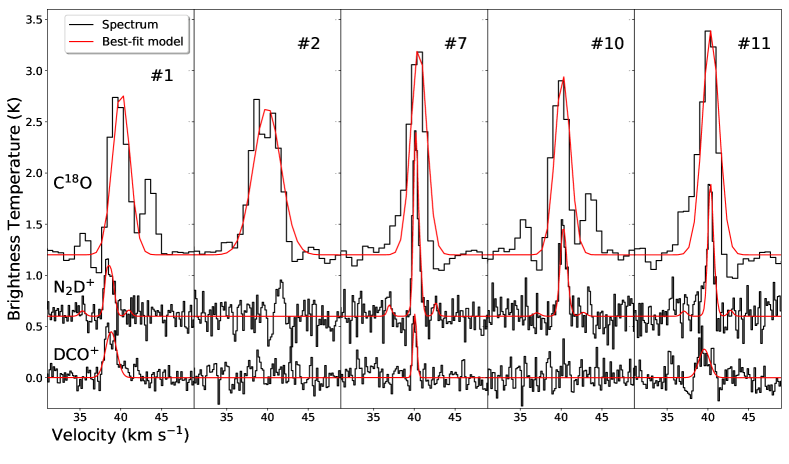
- Compared core-to-core velocity dispersion with clump-scale C18O data to assess kinematic decoupling.
- Applied statistical tools (e.g., LINMIX) to analyze correlations between mass, surface density, and velocity dispersion.
- Evaluated line width scaling with radius to test the first Larson relation across scales.
Experimental results
Research questions
- RQ1Are protostellar cores more gravitationally bound than prestellar cores, and how does this evolve with mass?
- RQ2Does turbulence increase significantly from the prestellar to protostellar phase, indicating outflow feedback?
- RQ3Are dense cores kinematically comoving with their low-density envelopes or moving ballistically?
- RQ4How do observed core dynamics compare to predictions from 'core-fed' versus 'clump-fed' high-mass star formation models?
- RQ5Is gravitational collapse a dominant contributor to line width in protostellar cores?
Key findings
- Approximately 80% of cores with virial parameter measurements are gravitationally bound (α < 2), with protostellar cores averaging α = 1.2 and prestellar cores α = 1.5.
- Massive cores have lower virial parameters on average, indicating stronger self-gravity, and exhibit higher surface density, Mach number, and velocity dispersion than less massive cores.
- There is no significant increase in line velocity dispersion from prestellar to protostellar cores, suggesting deuterated molecules trace gas not yet strongly affected by outflow-driven turbulence.
- Core-to-core velocity dispersion is consistent with simulations of continuously injected turbulence, while core velocity dispersion does not match driven or decaying turbulence models.
- Dense cores show small velocity shifts relative to their low-density envelopes (C18O), indicating comoving motion rather than ballistic motion.
- The first Larson relation (velocity dispersion vs. size) holds from GMC to core scales, and the observed dynamics are inconsistent with 'core-fed' turbulent accretion models but partially consistent with 'clump-fed' models like competitive accretion and global hierarchical collapse.
Read this paper
Open the full text in the Nubint reader and ask about any passage as you read.
Read this paper on NubintThis review was generated by AI from the original paper. Please check the paper before citing it.