
[Paper Review] The asymmetry of dawn: evidence for asymmetric reionization histories from a joint analysis of cosmic microwave background and astrophysical data
This study presents a joint analysis of cosmic microwave background (CMB) polarization data, Hubble Frontier Field UV luminosity data, and neutral hydrogen fraction measurements from quasars and gamma-ray bursts to constrain the reionization history. It introduces an extended ionization history model allowing asymmetric evolution of the ionized hydrogen fraction with redshift, finding strong evidence (4σ) against symmetric reionization, with τ = 0.0542⁺⁰.⁰⁰¹⁷₋₀.⁰⁰²⁸ at 68% CL, tighter than Planck 2018 alone and robust across alternative CMB likelihoods.
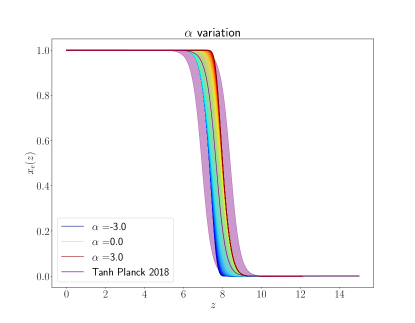
We show that by jointly fitting cosmic microwave background (CMB) and astrophysical data - a compilation of UV luminosity data from the Hubble Frontier Field and neutral hydrogen data from distant sources-, we can infer on the shape of the evolution of the ionized hydrogen fraction with redshift in addition to constraining the average optical depth $τ$.For this purpose, we introduce here a novel extended model that includes hydrogen ionization histories which are monotonic with redshift, but allow for an asymmetry as indicated from our previous works on a free reconstruction of reionization. By using our baseline data combination, we obtain $τ=0.0542^{+0.0017}_{-0.0028}$, consistent with our previous works and tighter than the one inferred by Planck 2018 data because of the combination of CMB with astrophysical data. We find that the symmetric hypothesis within our parametrization is disfavoured at 4 $σ$.We test our findings by using alternative likelihoods for CMB polarization at low multipoles, i.e. based on the 2020 reprocessing of Planck HFI data or on the joint analysis of WMAP and Planck LFI data, obtaining consistent results that disfavour the symmetric hypothesis of the reionization history at high statistical significant level.These results will be further tested by more precise astrophysical data such as from JWST and Euclid deep fields.
Motivation & Objective
- To improve constraints on the reionization history beyond the average optical depth τ by combining CMB and astrophysical data.
- To test the symmetry of the reionization history using a novel extended model that allows for asymmetric evolution of the ionized hydrogen fraction with redshift.
- To assess the robustness of asymmetric reionization findings across different CMB polarization likelihoods and data combinations.
- To evaluate the preference for asymmetric models over symmetric hyperbolic tangent (Tanh) models using Bayesian evidence.
Proposed method
- The authors introduce an extended reionization model parameterizing the ionized hydrogen fraction as a monotonic function with redshift that includes an asymmetry parameter α to allow for non-symmetric rise and fall of ionization.
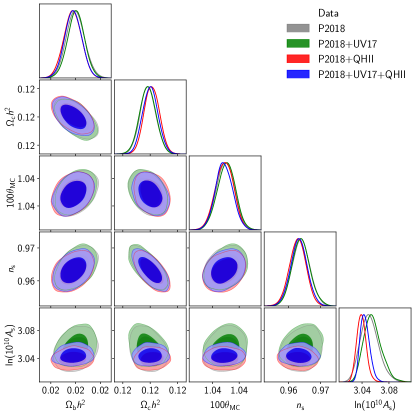
- They combine Planck 2018 CMB polarization data with UV luminosity density measurements from the Hubble Frontier Field (HFF) at redshifts z = 6.5–11 and neutral hydrogen fraction data from quasars, GRBs, and galaxies.
- The analysis uses a Bayesian framework to infer posterior distributions for reionization parameters, including τ and the asymmetry parameter α, under both symmetric and asymmetric model assumptions.
- Alternative CMB likelihoods are tested, including the 2020 reprocessed Planck HFI data and a joint WMAP+Planck LFI likelihood, to assess robustness.
- The model comparison uses Bayesian evidence to evaluate the preference for the extended asymmetric model versus the symmetric Tanh model with adjustable width.
- A prior on the asymmetry parameter α is extended to negative values to test the robustness of the preference for positive asymmetry.
Experimental results
Research questions
- RQ1Is the reionization history symmetric or asymmetric, as constrained by joint CMB and astrophysical data?
- RQ2How does combining CMB polarization with UV luminosity and neutral hydrogen fraction data improve constraints on τ and the shape of the ionization history?
- RQ3Does the evidence for asymmetry in reionization remain robust across different CMB polarization likelihoods, such as Planck 2018, reprocessed HFI, and WMAP+LFI?
- RQ4What is the Bayesian preference for an extended asymmetric model versus the standard symmetric Tanh model?
- RQ5How do different UV magnitude cuts (e.g., -15 vs. -17) affect the inference of asymmetry and optical depth?
Key findings
- The joint analysis of Planck 2018 CMB polarization, HFF UV luminosity data (limiting magnitude -17), and neutral hydrogen fraction data yields τ = 0.0542⁺⁰.⁰⁰¹⁷₋₀.⁰⁰²⁸ at 68% credible level, tighter than Planck 2018 alone.
- The symmetric reionization hypothesis is disfavored at more than 4σ significance within the extended model framework.
- Alternative CMB polarization likelihoods—SROLL2 (2020 reprocessed Planck HFI) and WMAP+Planck LFI—yield consistent results, with τ = 0.0552⁺⁰.⁰⁰³¹₋₀.⁰⁰¹⁸ and τ = 0.0562⁺⁰.⁰⁰¹⁹₋₀.⁰⁰⁴⁰ respectively, both disfavoring symmetry.
- The extended model with asymmetry is decisively preferred over the symmetric Tanh model in the full data combination, based on Bayesian evidence.
- A negative prior on the asymmetry parameter α still favors positive α values, with α > 5.28 at 68% CL and α > 3.07 at 95% CL, indicating a sharp onset and gradual end to reionization.
- The UV15 data set (fainter sources, limiting magnitude -15) is less constraining, and the symmetric model is disfavored only at 95% C.L., highlighting the importance of depth in UV data for detecting asymmetry.
Read this paper
Open the full text in the Nubint reader and ask about any passage as you read.
Read this paper on NubintThis review was generated by AI from the original paper. Please check the paper before citing it.