
[논문 리뷰] The baryon cycle in modern cosmological hydrodynamical simulations
이 논문은 uniform Eulerian 방법을 사용하여 가스 흐름을 측정하는 세 가지 공공 우주론 수치 해석 시뮬레이션(EAGLE, IllustrisTNG, SIMBA)에서 바리온 사이클을 비교하고, 서로 다른 모델에서의 유출 범위와 재활용 특성을 드러낸다.
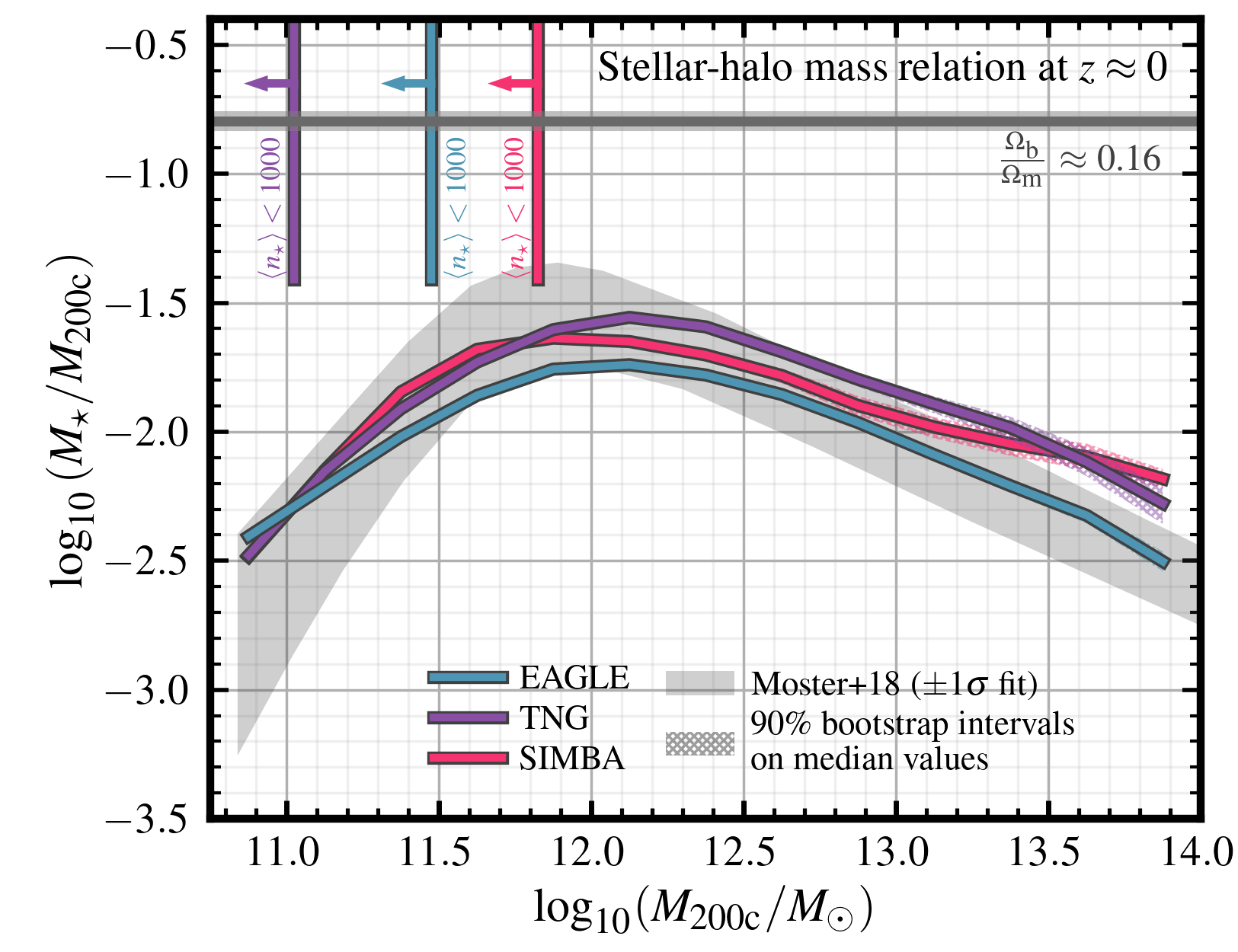
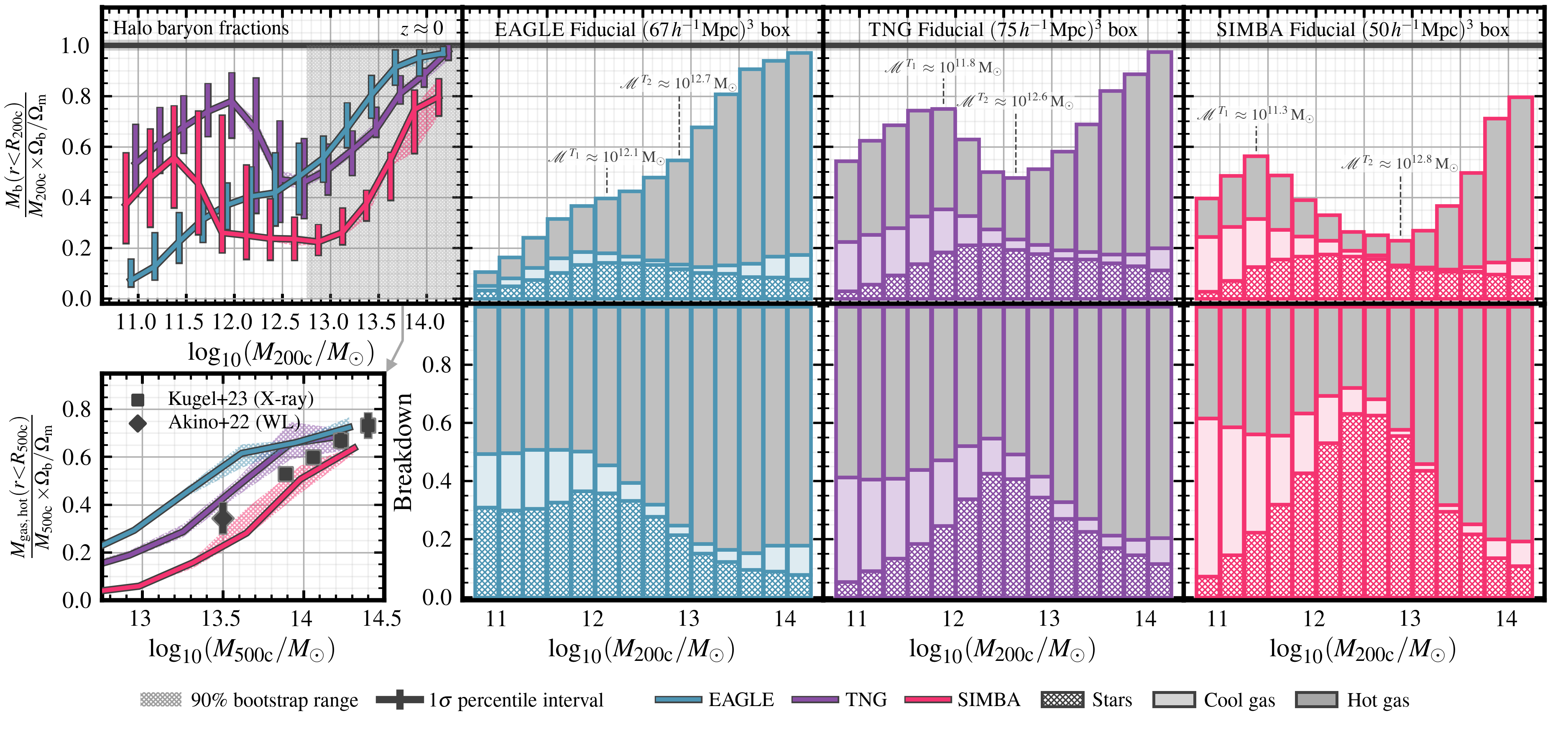
In recent years, cosmological hydrodynamical simulations have proven their utility as key interpretative tools in the study of galaxy formation and evolution. In this work, we present a like-for-like comparison between the baryon cycle in three publicly available, leading cosmological simulation suites: EAGLE, IllustrisTNG, and SIMBA. While these simulations broadly agree in terms of their predictions for the stellar mass content and star formation rates of galaxies at $z\approx0$, they achieve this result for markedly different reasons. In EAGLE and SIMBA, we demonstrate that at low halo masses ($M_{ m 200c}\lesssim 10^{11.5}\, M_{\odot}$), stellar feedback (SF)-driven outflows can reach far beyond the scale of the halo, extending up to $2-3 imes R_{ m 200c}$. In contrast, in TNG, SF-driven outflows, while stronger at the scale of the ISM, recycle within the CGM (within $R_{ m 200c}$). We find that AGN-driven outflows in SIMBA are notably potent, reaching several times $R_{ m 200c}$ even at halo masses up to $M_{ m 200c}\approx10^{13.5}\, M_{\odot}$. In both TNG and EAGLE, AGN feedback can eject gas beyond $R_{ m 200c}$ at this mass scale, but seldom beyond $2-3 imes R_{ m 200c}$. We find that the scale of feedback-driven outflows can be directly linked with the prevention of cosmological inflow, as well as the total baryon fraction of haloes within $R_{ m 200c}$. This work lays the foundation to develop targeted observational tests that can discriminate between feedback scenarios, and inform sub-grid feedback models in the next generation of simulations.
연구 동기 및 목표
- 다른 서브그리드 피드백 구현이 현대 시뮬레이션의 바리온 사이클에 미치는 영향을 이해한다.
- halo 질량 전반에 걸친 별 주도 및 AGN 주도 유출의 공간적 범위를 정량화한다.
- 유출의 스케일이 halo 가스 함량 및 바리온 보존에 미치는 영향을 평가한다.
- 피드백 모델을 구분하기 위한 관찰 프레임워크를 제공한다.
제안 방법
- EAGLE, IllustrisTNG, SIMBA에서 중심 은하를 둘러싼 구형 쉘을 가로지르는 Eulerian 가스 흐름 측정 사용.
- r = R 및 0.2 R 폭의 Δr에서 경계 가스 요소를 식별하고 반지름 방향 속도에 따라 유입과 유출을 분류한다.
- 경계에서의 질량 흐름을 ot{M}_{k}(r=R) = (1/Δr) sum_i (m_i v_{r,i}) 형태의 공식으로 계산하며, v_{r,i}는 반지름 방향 속도 성분이다.
- halo 중심, 질량, 반지름(R_{200c})을 정의하기 위해 FOF + SUBFIND(EAGLE/TNG) 또는 ROCKSTAR(SIMBA)를 통한 호라이즌 카탈로그를 구축한다.
- 시뮬레이션 간 R_{200c} 내의 정적 바리온 함량과 상(相) 분포를 비교하여 흐름 측정을 해석한다.
- 피드백 패러다임의 like-for-like 비교를 가능하게 하기 위해 일관된 정의에 기초한 분석을 수행한다.
실험 결과
연구 질문
- RQ1EAGLE, IllustrisTNG, SIMBA 간의 별 주도 및 AGN 주도 유출이 공간적 범위와 재활용 특성에서 어떻게 다른가?
- RQ2피드백 주도 유출의 규모와 홀의 우주적 흡입 억제 사이의 관계는 무엇인가?
- RQ3유출이 도달하는 범위의 차이가 halo의 총 바리온 분획 및 halo 내부의 별, 냉각 가스, 뜨거운 가스로의 분배에 어떤 영향을 미치는가?
- RQ4이러한 시뮬레이션에서 구현된 피드백 구현을 구분하는 단일 관찰 프레임워크가 있는가?
주요 결과
- EAGLE와 SIMBA의 별 피드백 주도 유출은 저질량 헤일로에서 2-3 R200c를 넘어 확장된다(M200c ≲ 10^11.5 M⊙).
- IllustrisTNG에서 별 주도 바람은 ISM 규모에서 가장 강하고 CGM(내 R200c) 내에서 재순환한다.
- SIMBA의 AGN 주도 유출은 매우 강력하여 R200c의 여러 배에 이르며 M200c ≈ 10^13.5 M⊙까지 헤일로 질량에서 확장된다.
- TNG와 EAGLE 모두에서 이 질량에서 AGN 피드백은 R200c 너머로 가스를 배출할 수 있지만 Rare하게 2-3 R200c 너머까지는 가지 않는다.
- 피드백 주도 유출의 규모는 우주론적 유입 차단 및 R200c 내의 전체 halo 바리온 분획에 직접적으로 연결되어 있다.
- 이 연구는 피드백 시나리오를 구분하기 위한 표적 관찰 시험의 기초를 제공하고 향후 시뮬레이션용 서브그리드 피드백 모델에 정보를 제공한다.
더 나은 연구,지금 바로 시작하세요
연구 설계부터 논문 작성까지, 연구 시간을 획기적으로 줄여보세요.
카드 등록 없음 · 무료 플랜 제공
이 리뷰는 AI가 만들고, 인간 에디터가 검토했습니다.