
[Paper Review] The Case for Super-Eddington Accretion: Connecting Weak X-ray and UV Line Emission in JWST Broad-Line AGN During the First Gyr of Cosmic Time
This paper tests super-Eddington accretion models to explain the observed X-ray weakness and lack of high-ionization UV lines in z~5 JWST broad-line AGN, finding results consistent with slim-disk accretion reducing UV/X-ray output.
A multitude of JWST studies reveal a surprising over-abundance of over-massive accreting super-massive blackholes (SMBHs) -- leading to a deepening tension between theory and observation in the first billion years of cosmic time. Across X-ray to infrared wavelengths, models built off of pre-JWST predictions fail to easily reproduce observed AGN signatures (or lack thereof), driving uncertainty around the true nature of these sources. Using a sample of JWST AGN identified via their broadened Halpha emission and covered by the deepest X-ray surveys, we find neither any measurable X-ray emission nor any detection of high-ionization emission lines frequently associated with accreting SMBHs. We propose that these sources are accreting at or beyond the Eddington limit, which reduces the need for efficient production of heavy SMBH seeds at cosmic dawn. Using a theoretical model of super-Eddington accretion, we can produce the observed relative dearth of both X-ray and ultraviolet emission, as well as the high Balmer decrements, without the need for significant dust attenuation. This work indicates that super-Eddington accretion is easily achieved through-out the early Universe, and further study is required to determine what environments are required to trigger this mode of black hole growth.
Motivation & Objective
- Motivate the need to understand the multiwavelength properties of JWST-detected broad-line AGN in the first billion years of cosmic time.
- Investigate whether super-Eddington accretion can reconcile weak X-ray emission with broad H-alpha lines in z~4–7 BL AGN.
- Assess how accretion-mode affects UV line production and Balmer decrements without invoking heavy dust obscuration.
- Evaluate implications for black hole growth scenarios and the inferred black hole masses in the early universe.
Proposed method
- Select a robust sample of z~4–7 JWST broad-line AGN covered by deep X-ray surveys (GOODS-North/CDFN and GOODS-South/CDFS).
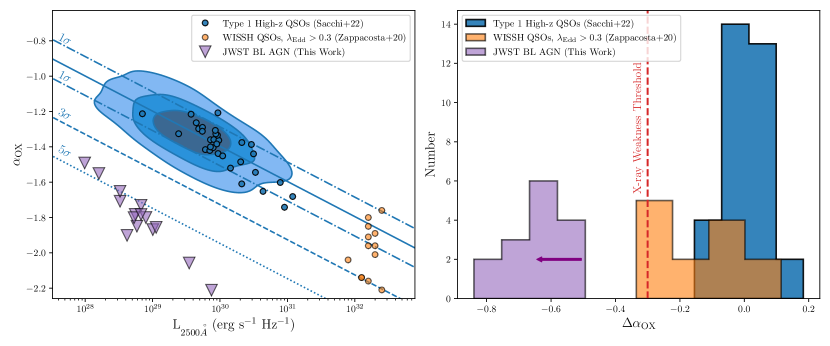
- Estimate rest-frame 2 keV upper limits from stacked Chandra data assuming Gamma=2 and derive L2500 from JWST spectra via bolometric corrections.
- Obtain and reprocess JWST/NIRSpec spectra for 8 sources with G140M coverage; extract 1D spectra and fit emission lines to measure H-alpha, H-beta, [O III], and search for C IV.
- Compare observed X-ray/UV properties with predictions from sub-Eddington (agnsed) and super-Eddington slim-disk (agnslim) accretion models using Cloudy BLR simulations.
- Predict C IV, He II, and [Ne V] line luminosities under both accretion scenarios to test the presence/absence of high-ionization UV lines.
Experimental results
Research questions
- RQ1Do z~4–7 JWST BL AGN exhibit X-ray weakness inconsistent with the standard αOX relation?
- RQ2Can super-Eddington (slim-disk) accretion reproduce the observed lack of X-ray and high-ionization UV line emission without invoking heavy dust attenuation?
- RQ3How does the accretion mode impact the UV/optical continuum, Balmer decrements, and broad-line region line production?
- RQ4What are the implications of high Eddington ratios for black hole mass estimates and seed formation in the early Universe?
Key findings
- X-ray upper limits for 14 sources lie at least 5 sigma below predicted X-ray luminosities (median ΔαOX = −0.64).
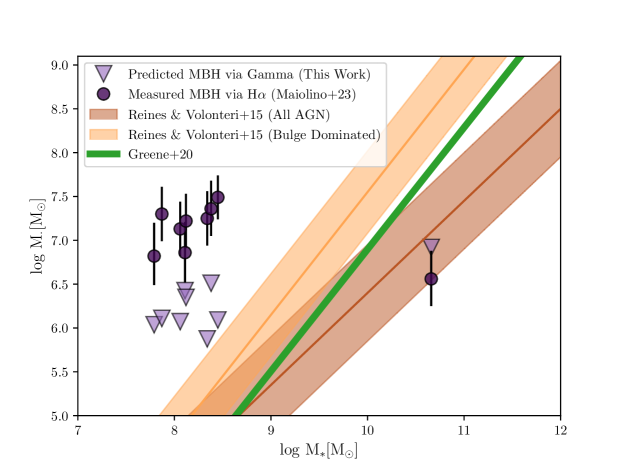
- Black hole mass upper limits inferred from X-ray non-detections are, on average, an order of magnitude below some literature values, implying higher Eddington ratios could ease growth constraints.
- C IV and other high-ionization UV lines are undetected in JWST/NIRSpec G140M data for the subset with coverage, consistent with a softer ionizing continuum.
- Slim-disk (super-Eddington) accretion predicts substantially suppressed C IV and He II emission compared to sub-Eddington models, even without dust obscuration.
- Intrinsic reddening of the SED is produced by high-Eddington accretion in agnslim, leading to higher Balmer decrements (Hα/Hβ ≈ 8.5 vs ≈ 3.5 in sub-Eddington).
- The modeling shows that high-Eddington accretors may be more common than assumed, affecting growth scenarios for the first SMBHs and their expected multiwavelength signatures.
Read this paper
Open the full text in the Nubint reader and ask about any passage as you read.
Read this paper on NubintThis review was generated by AI from the original paper. Please check the paper before citing it.