
[Paper Review] The colourful antenna subtraction method
This paper introduces the colourful antenna subtraction method, a process-independent framework for NNLO QCD calculations that systematically constructs subtraction terms by leveraging the infrared structure of virtual amplitudes in colour space. It overcomes limitations of traditional antenna subtraction in high-multiplicity and non-leading-colour processes, enabling automation for generic processes and successfully applied to three-jet production at NNLO.
We present a general subtraction scheme for NNLO calculations in massless QCD: the extit{colourful antenna subtraction method}. It is a reformulation of the antenna subtraction approach designed to address some of the limitations of the traditional framework, especially aiming at high-multiplicity processes. In the context of the new formalism, structures needed to locally subtract the infrared-divergent behaviour of real emission corrections are systematically inferred from virtual subtraction terms, relying on the cancellation of infrared singularities and on the correspondence between integrated and unintegrated antenna functions. We illustrate in detail how the colourful antenna subtraction method works up to NNLO. The algorithm is particularly suited to be fully automated for the generation of NNLO subtraction terms for generic processes. We employ the new formalism to assemble the subtraction terms required for the calculation of the NNLO correction to hadronic three-jet production and describe their validation procedure.
Motivation & Objective
- To develop a general, process-independent subtraction scheme for NNLO QCD calculations that scales efficiently with parton multiplicity.
- To address the limitations of traditional antenna subtraction in non-leading-colour and high-multiplicity processes where colour correlations become complex.
- To systematize the construction of real emission subtraction terms by exploiting the predictability of virtual amplitude singularities in colour space.
- To enable full automation of NNLO subtraction term generation for arbitrary processes.
- To validate the method through the explicit construction and verification of subtraction terms for hadronic three-jet production at NNLO.
Proposed method
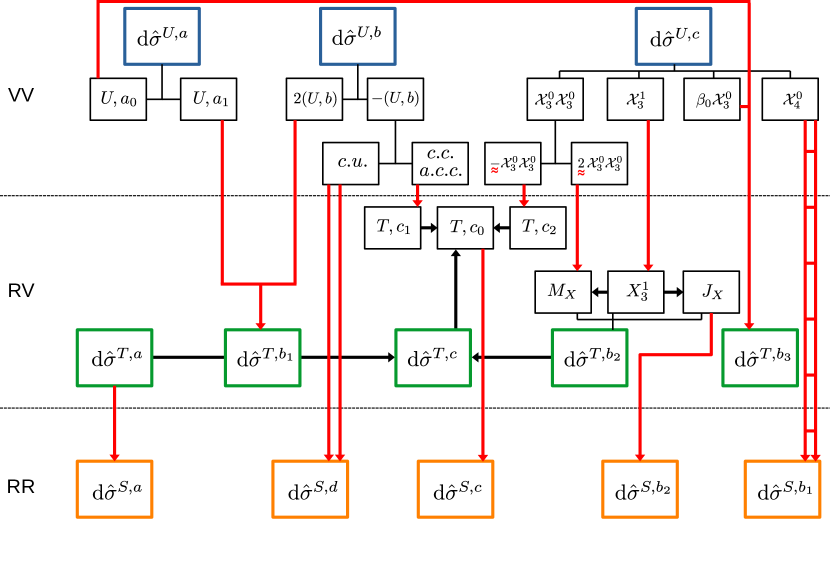
- The method reformulates antenna subtraction by deriving real emission subtraction terms from the infrared structure of virtual amplitudes, ensuring cancellation of singularities.
- It relies on a correspondence between integrated and unintegrated antenna functions, with explicit replacement rules to map integrated forms to their unintegrated counterparts in identity-changing limits.
- The approach uses colour-ordered virtual amplitudes as a foundation, allowing systematic inference of subtraction terms without relying on physical antenna processes.
- The formalism is built on the predictability of infrared singularities in colour space, enabling a general and automated construction of subtraction terms.
- Replacement rules are derived for all four-parton antenna functions (quark-antiquark, quark-gluon, gluon-gluon), including identity-changing limits involving hard partons.
- The method is implemented via a systematic algorithm that maps virtual subtraction terms to real emission counterterms, ensuring local cancellation of infrared divergences.
Experimental results
Research questions
- RQ1How can the antenna subtraction method be generalized to handle high-multiplicity and non-leading-colour QCD processes more systematically?
- RQ2Can the infrared structure of virtual amplitudes in colour space be used to directly construct real emission subtraction terms without relying on physical antenna processes?
- RQ3What is the minimal set of replacement rules required to map integrated antenna functions to their unintegrated forms in identity-changing limits?
- RQ4To what extent can the subtraction term construction process be automated for generic NNLO QCD processes?
- RQ5How can the new formalism be validated for a complex, phenomenologically relevant process like three-jet production at NNLO?
Key findings
- The colourful antenna subtraction method enables a fully automated construction of NNLO subtraction terms for arbitrary QCD processes, overcoming scalability issues of traditional antenna subtraction.
- The method successfully handles non-leading-colour contributions by relying on the infrared structure of virtual amplitudes in colour space rather than physical colour connections.
- Explicit replacement rules are derived to convert integrated four-parton antenna functions into their unintegrated forms, including identity-changing limits with hard partons.
- The formalism was successfully applied to construct the full set of subtraction terms for hadronic three-jet production at NNLO, a high-multiplicity process.
- The validation procedure confirms the correctness of the subtraction terms through the cancellation of infrared divergences and agreement with known results.
- The method provides a systematic and general framework that paves the way for industrial-scale NNLO computations in QCD, analogous to the automation achieved at NLO.
Read this paper
Open the full text in the Nubint reader and ask about any passage as you read.
Read this paper on NubintThis review was generated by AI from the original paper. Please check the paper before citing it.