
[Paper Review] The defender's perspective on automatic speaker verification: An overview
This paper provides a comprehensive review of defense mechanisms against adversarial attacks and partially fake speech in automatic speaker verification (ASV), emphasizing self-supervised learning (SSL) models, transition boundary detection, and score-based anomaly detection. It highlights state-of-the-art methods such as fine-tuned XLS-R for fake speech detection and re-synthesis-based techniques for adversarial sample identification, achieving top performance in challenges like ADD 2022.
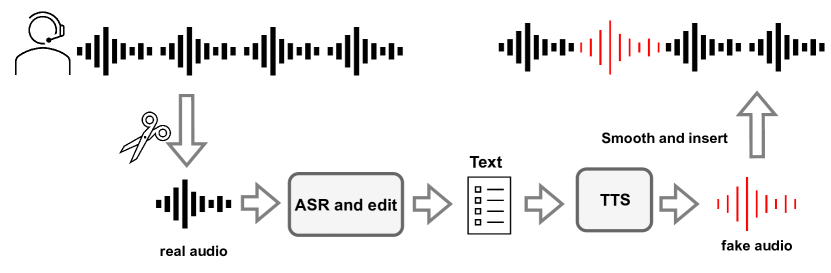
Automatic speaker verification (ASV) plays a critical role in security-sensitive environments. Regrettably, the reliability of ASV has been undermined by the emergence of spoofing attacks, such as replay and synthetic speech, as well as adversarial attacks and the relatively new partially fake speech. While there are several review papers that cover replay and synthetic speech, and adversarial attacks, there is a notable gap in a comprehensive review that addresses defense against adversarial attacks and the recently emerged partially fake speech. Thus, the aim of this paper is to provide a thorough and systematic overview of the defense methods used against these types of attacks.
Motivation & Objective
- To address the lack of comprehensive reviews on defenses against adversarial attacks and partially fake speech in automatic speaker verification (ASV).
- To systematize and compare existing defense strategies for two emerging threats: adversarial attacks and partially fake speech.
- To identify key research gaps and future directions in data collection, model efficiency, and re-synthesis-based detection for improved robustness.
- To inspire further research by summarizing state-of-the-art techniques and their performance in real-world challenges like ADD 2022.
Proposed method
- Utilizes self-supervised learning (SSL) models like XLS-R as feature extractors, fine-tuned on partially fake speech data to improve detection accuracy.
- Applies extraction-based question-answering frameworks to detect transition boundaries between genuine and fake speech segments in partially fake audio.
- Employs segment-level classification using fine-tuned SSL models to distinguish between genuine and synthetic speech segments.
- Leverages score inconsistency between original and re-synthesized utterances as a detection signal for adversarial samples.
- Uses twin ASV models—one fragile (premier), one robust (mirror)—to detect adversarial samples through prediction divergence.
- Applies hand-crafted and learnable masks (e.g., MLFB-H, MLFB-D) to highlight differences in ASV scores before and after masking, identifying adversarial perturbations.
Experimental results
Research questions
- RQ1How can transition boundaries between genuine and fake segments in partially fake speech be effectively detected using self-supervised learning?
- RQ2What role do self-supervised learning models play in improving the detection of partially fake speech compared to traditional acoustic features?
- RQ3How can score inconsistency between original and re-synthesized audio be used to detect adversarial ASV samples?
- RQ4What are the most effective methods for identifying adversarial samples using twin ASV models or feature masking?
- RQ5What future research directions are critical for improving the robustness and efficiency of ASV defenses?
Key findings
- Fine-tuning the 2-billion-parameter XLS-R model with a lightweight head achieved first place in the ADD 2022 challenge, demonstrating the effectiveness of SSL-based features for partially fake speech detection.
- Transition boundary detection using question-answering-style models outperforms segment-level classification in identifying subtle fake insertions in real speech.
- Re-synthesis-based detection methods achieve state-of-the-art performance by exploiting large score differences between original and re-synthesized utterances for adversarial samples.
- The use of twin ASV models—where one is fragile and one is robust—enables effective detection of adversarial samples through prediction inconsistency.
- Hand-crafted and learnable masks (e.g., MLFB-H, MLFB-D) effectively amplify differences in ASV scores for adversarial samples, enabling high-accuracy detection.
- Model compression, linear probing, adapter, and prompt tuning techniques are promising for reducing training costs and model size in SSL-based detection systems.

Read this paper
Open the full text in the Nubint reader and ask about any passage as you read.
Read this paper on NubintThis review was generated by AI from the original paper. Please check the paper before citing it.