
[Paper Review] The eigenvalue spectrum of a large real antisymmetric random matrix with non-zero mean
This paper investigates the eigenvalue spectrum of large real antisymmetric random matrices with non-zero mean using a fermionic replica trick. It shows that for non-zero mean values above a critical threshold, isolated eigenvalues emerge outside the Wigner semicircle, confirming a phase transition analogous to that in symmetric random matrices, with results validated numerically.
We study the eigenvalue spectrum of a large real antisymmetric random matrix $J_{ij}$. Using a fermionic approach and replica trick, we obtain a semicircular spectrum of eigenvalues when the mean value of each matrix element is zero, and in the case of a non-zero mean, we show that there is a set of critical finite mean values above which eigenvalues arise that are split off from the semicircular continuum of eigenvalues. The result converged with numerical simulations.
Motivation & Objective
- To generalize the Wigner semicircle law for antisymmetric random matrices to the case of non-zero mean matrix elements.
- To determine the critical mean value above which isolated eigenvalues appear outside the semicircular continuum.
- To apply the replica trick and fermionic path integral formalism to compute the eigenvalue density in the large-N limit.
- To establish a connection between the spectral transition and the SYK2 model with Majorana fermions.
- To validate analytical results through numerical simulations of the eigenvalue distribution.
Proposed method
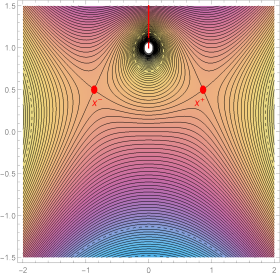
- Formulate the eigenvalue density using the Sokhotski–Plemelj formula and express it via the logarithmic derivative of the determinant of a resolvent matrix.
- Represent the determinant using Grassmann integrals (fermionic approach) to enable disorder averaging over random matrix elements.
- Apply the replica trick by introducing n replicated copies of the system, treating n as a continuous parameter before taking the limit n→0.
- Use the identity lim_{n→0} (x^n - 1)/n = log x to convert the eigenvalue density into a functional integral over Grassmann variables.
- Derive a generating functional for the eigenvalue density and perform Gaussian integrals over the replicated fermionic fields.
- Extract the spectral density by taking the imaginary part and derivative with respect to λ, followed by analytic continuation to n→0.
Experimental results
Research questions
- RQ1How does a non-zero mean in the matrix elements affect the eigenvalue spectrum of large real antisymmetric random matrices?
- RQ2Does a critical mean value exist above which isolated eigenvalues emerge outside the Wigner semicircle?
- RQ3What is the analytical form of the eigenvalue density when the mean is non-zero, and how does it differ from the zero-mean semicircular law?
- RQ4Can the replica trick and fermionic formalism accurately describe the spectral transition in antisymmetric matrices, as in symmetric ones?
- RQ5How do the analytical predictions compare with numerical simulations of finite-size matrices?
Key findings
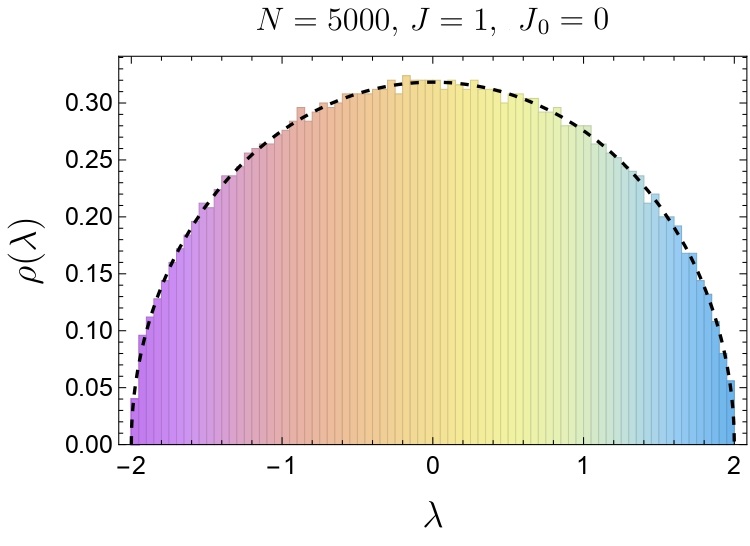
- For zero mean, the eigenvalue spectrum converges to the Wigner semicircle law, consistent with known results in random matrix theory.
- When the mean value exceeds a critical threshold |J₀| > J, isolated eigenvalues appear outside the semicircular continuum.
- The isolated eigenvalue is located at λ = J₀ + J²/J₀, which matches the prediction from the replica method and numerical simulations.
- Below the critical mean |J₀| < J, the spectrum remains semicircular with no isolated states, indicating a phase transition at |J₀| = J.
- The analytical results derived via the fermionic replica trick are in excellent agreement with numerical eigenvalue simulations.
- The spectral transition in antisymmetric matrices mirrors that in symmetric matrices, confirming universality of the critical behavior across matrix ensembles.
Read this paper
Open the full text in the Nubint reader and ask about any passage as you read.
Read this paper on NubintThis review was generated by AI from the original paper. Please check the paper before citing it.