
[Paper Review] The Eighteenth Data Release of the Sloan Digital Sky Surveys: Targeting and First Spectra from SDSS-V
DR18 marks the first SDSS-V data release, detailing targeting databases and first spectra, with ~25,000 new SDSS spectra and eFEDS X-ray source spectra, plus software and VAC updates.
The eighteenth data release of the Sloan Digital Sky Surveys (SDSS) is the first one for SDSS-V, the fifth generation of the survey. SDSS-V comprises three primary scientific programs, or "Mappers": Milky Way Mapper (MWM), Black Hole Mapper (BHM), and Local Volume Mapper (LVM). This data release contains extensive targeting information for the two multi-object spectroscopy programs (MWM and BHM), including input catalogs and selection functions for their numerous scientific objectives. We describe the production of the targeting databases and their calibration- and scientifically-focused components. DR18 also includes ~25,000 new SDSS spectra and supplemental information for X-ray sources identified by eROSITA in its eFEDS field. We present updates to some of the SDSS software pipelines and preview changes anticipated for DR19. We also describe three value-added catalogs (VACs) based on SDSS-IV data that have been published since DR17, and one VAC based on the SDSS-V data in the eFEDS field.
Motivation & Objective
- Describe SDSS-V’s scientific goals and hardware, and summarize DR18 scope and data access.
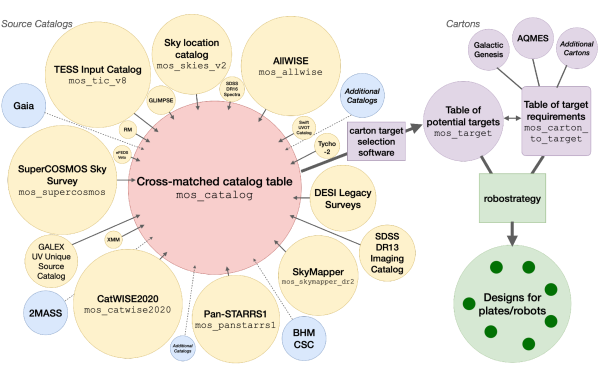
- Present the MOS targeting databases, catalog cross-matching, and carton concept for SDSS-V target selection.
- Inform on new spectra, including eFEDS, and accompanying VACs and software updates.
Proposed method
- Introduce the SDSS-V MOS targeting architecture and the creation of a unified mos_catalog from cross-matched input catalogs.
- Define cartons as target selection algorithms grouped by science programs and link them to observable designs via mos_carton_to_target.
- Detail data access pathways via CAS/SAS and data models used for DR18.
- Describe the handling of eFEDS spectra and the associated VAC.
- Outline updates to SDSS software, especially the BOSS spectral reduction package.
Experimental results
Research questions
- RQ1How does DR18 organize SDSS-V targeting information and enabling schemes for MWM and BHM?
- RQ2What new data products (spectra, cartons, VACs) are released in DR18 and how can researchers access them?
- RQ3How are cartons and targeting generations versioned and utilized to plan future SDSS-V observations?
- RQ4What are the updates to software pipelines and data models in DR18?
Key findings
- DR18 provides targeting information for MWM and BHM totaling about 269.5 GB in MOS_TARGET_DIR.
- DR18 introduces the carton concept to organize targets by selection algorithm and science goals.
- Approximately 25,000 new SDSS spectra are released, including eFEDS optical spectra with 301.9 GB added to BOSS_SPECTRO_REDUX.
- New VACs based on DR17 and an updated DR15-based VAC are released alongside DR18.
- SDSS-V data access remains through CAS SkyServer and SAS with extensive tutorials and data models available.
Read this paper
Open the full text in the Nubint reader and ask about any passage as you read.
Read this paper on NubintThis review was generated by AI from the original paper. Please check the paper before citing it.