
[Paper Review] The Expressive Leaky Memory Neuron: an Efficient and Expressive Phenomenological Neuron Model Can Solve Long-Horizon Tasks
The Expressive Leaky Memory (ELM) neuron is a biologically inspired, phenomenological recurrent neuron model that uses a few slowly decaying memory states and two-layered nonlinear synaptic integration to accurately replicate the spike-level input-output behavior of a high-fidelity biophysical cortical neuron model with under 10,000 parameters—dramatically reducing the parameter count compared to prior methods. It achieves state-of-the-art performance on long-horizon tasks, including solving the Pathfinder-X task with over 70% accuracy at a 16k context length, outperforming Transformers and Chrono-LSTM.
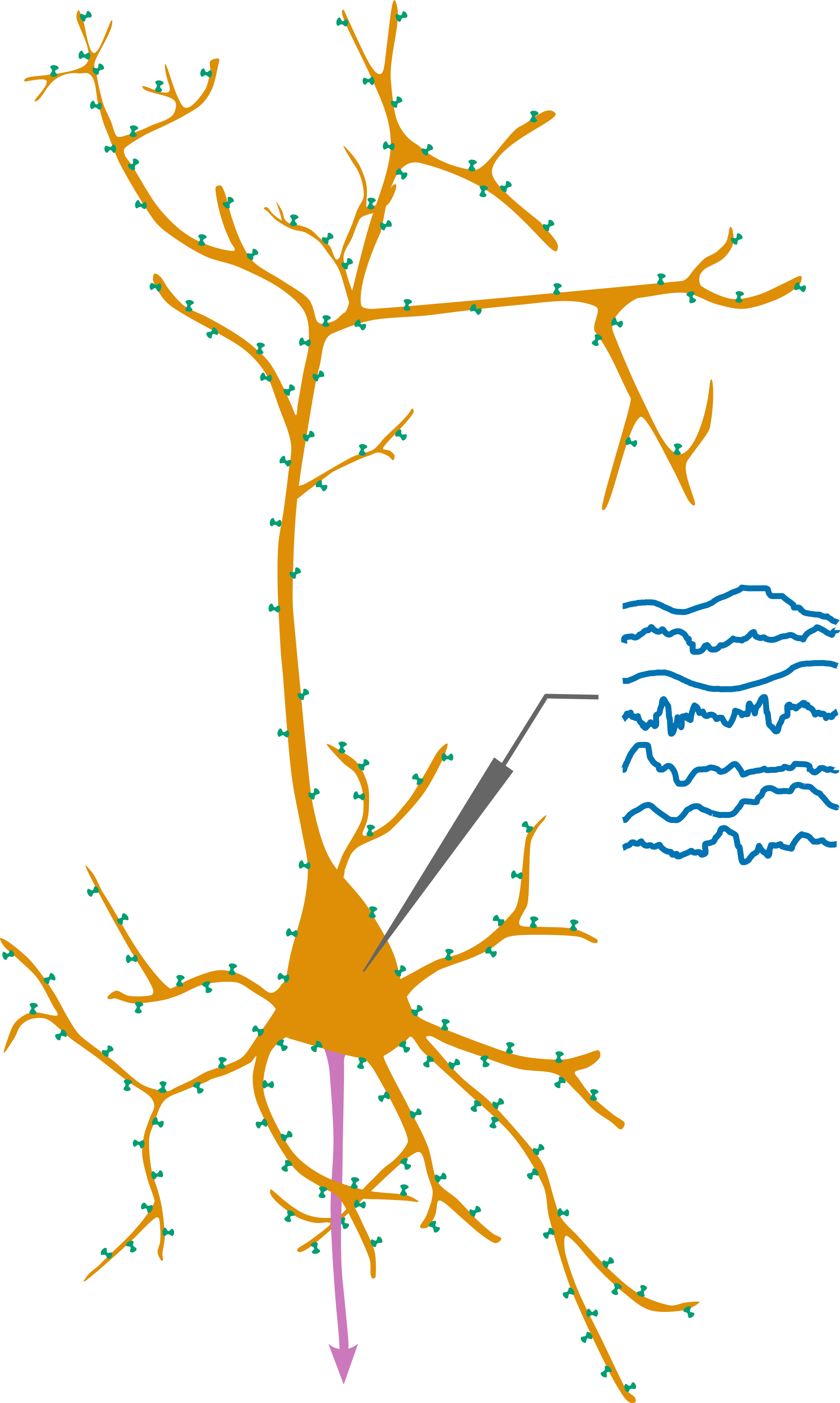
Biological cortical neurons are remarkably sophisticated computational devices, temporally integrating their vast synaptic input over an intricate dendritic tree, subject to complex, nonlinearly interacting internal biological processes. A recent study proposed to characterize this complexity by fitting accurate surrogate models to replicate the input-output relationship of a detailed biophysical cortical pyramidal neuron model and discovered it needed temporal convolutional networks (TCN) with millions of parameters. Requiring these many parameters, however, could stem from a misalignment between the inductive biases of the TCN and cortical neuron's computations. In light of this, and to explore the computational implications of leaky memory units and nonlinear dendritic processing, we introduce the Expressive Leaky Memory (ELM) neuron model, a biologically inspired phenomenological model of a cortical neuron. Remarkably, by exploiting such slowly decaying memory-like hidden states and two-layered nonlinear integration of synaptic input, our ELM neuron can accurately match the aforementioned input-output relationship with under ten thousand trainable parameters. To further assess the computational ramifications of our neuron design, we evaluate it on various tasks with demanding temporal structures, including the Long Range Arena (LRA) datasets, as well as a novel neuromorphic dataset based on the Spiking Heidelberg Digits dataset (SHD-Adding). Leveraging a larger number of memory units with sufficiently long timescales, and correspondingly sophisticated synaptic integration, the ELM neuron displays substantial long-range processing capabilities, reliably outperforming the classic Transformer or Chrono-LSTM architectures on LRA, and even solving the Pathfinder-X task with over 70% accuracy (16k context length).
Motivation & Objective
- To develop a biologically inspired, efficient surrogate model for cortical neurons that captures complex temporal integration without relying on massive parameter counts.
- To investigate whether appropriate inductive biases—such as leaky memory units and nonlinear dendritic integration—can reduce the model complexity required to fit high-fidelity biophysical neuron I/O relationships.
- To evaluate whether such a model can effectively solve long-horizon machine learning tasks, particularly those with extreme temporal dependencies.
- To explore the computational implications of mimicking biological neuron mechanisms like slow memory decay and nonlinear integration in artificial neural networks.
- To determine if a minimal, interpretable neuron model can match or exceed the performance of deep architectures on long-context tasks.
Proposed method
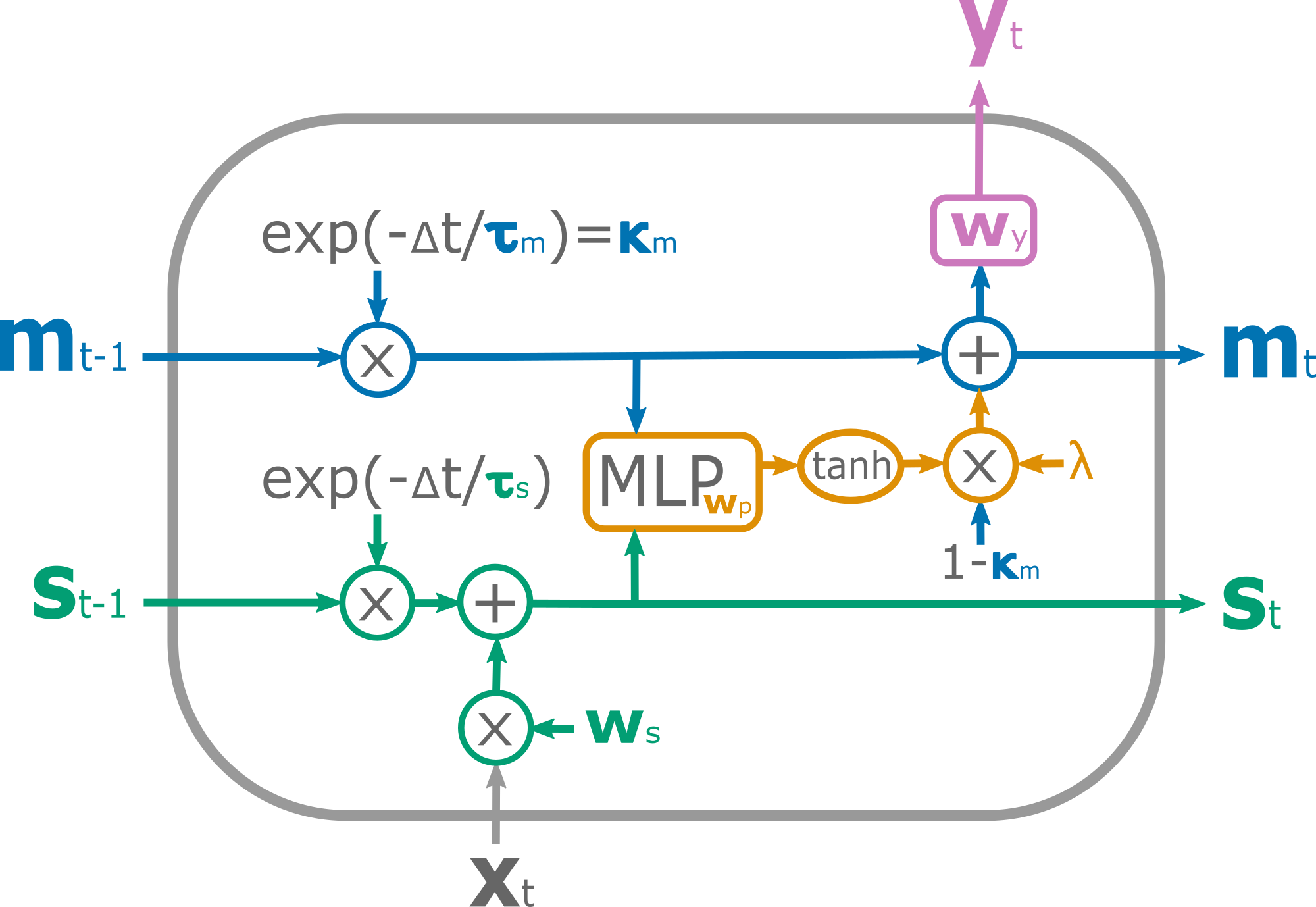
- The ELM neuron employs a set of slowly decaying memory states (leaky integrators) that store temporal information over long timescales.
- Synaptic inputs are nonlinearly integrated across multiple memory units via a two-layered nonlinear transformation, enabling expressive computation without deep architecture.
- The model uses backpropagation through time (BPTT) for training, with memory timescales and nonlinearity carefully tuned to task demands.
- The architecture is designed to align with the inductive biases of cortical computation, such as temporal integration and dendritic nonlinearities, rather than relying on architectural complexity.
- Model hyperparameters, including memory timescales and number of memory units, are adjusted based on task length and complexity, with longer timescales enabling performance on longer-context tasks.
- The model is evaluated on both the Long Range Arena (LRA) benchmark and a novel neuromorphic dataset (SHD-Adding), with performance compared to Transformers, LSTMs, and S4 models.
Experimental results
Research questions
- RQ1Can a phenomenological neuron model with minimal parameters and biologically inspired inductive biases accurately replicate the spike-level input-output relationship of a detailed biophysical cortical neuron model?
- RQ2Does the inclusion of leaky memory units and nonlinear dendritic integration significantly reduce the number of parameters required to model complex cortical computations compared to standard temporal convolutional networks?
- RQ3Can such a model reliably solve long-horizon machine learning tasks, particularly those with extreme context lengths like 16k tokens?
- RQ4How does the performance of the ELM neuron compare to established architectures like Transformers and LSTMs on tasks with long-range dependencies?
- RQ5To what extent do memory timescale and number of memory units influence the model’s ability to capture long-term temporal structures?
Key findings
- The ELM neuron achieves accurate replication of the high-fidelity biophysical neuron’s input-output relationship using fewer than 10,000 trainable parameters, a dramatic reduction from the millions required by prior temporal convolutional networks.
- On the Pathfinder-X task with a 16,000-token context length, the ELM neuron achieves over 70% accuracy—a result that only a single run of Chrono-LSTM achieved once during hyperparameter tuning, and that Transformers and Longformer completely failed to achieve.
- The ELM neuron outperforms both standard LSTMs and Chrono-LSTM on the SHD-Adding neuromorphic dataset, demonstrating strong generalization on biologically motivated long-context tasks.
- The model’s performance is highly sensitive to memory timescale initialization, with longer timescales enabling reliable performance on longer-context tasks.
- The ELM model’s success suggests that inductive biases aligned with biological computation—such as leaky memory and nonlinear integration—can drastically improve sample and parameter efficiency in sequence modeling.
- Despite its biological inspiration, the model does not provide mechanistic explanations of neural computation, as it abstracts away biophysical details for computational efficiency and interpretability.
Read this paper
Open the full text in the Nubint reader and ask about any passage as you read.
Read this paper on NubintThis review was generated by AI from the original paper. Please check the paper before citing it.