
[Paper Review] The extended "stellar halo" of the Ursa Minor dwarf galaxy
This study identifies five ultra-faint stars in the extreme outskirts of the Ursa Minor dwarf galaxy—up to 12 half-light radii away—using Gaia EDR3 data and confirms their membership via high-precision radial velocities and metallicities from GRACES spectroscopy. Detailed chemical abundance analysis reveals a consistent outside-in star formation history with contributions from core-collapse supernovae, AGB stars, and SNe Ia, supporting tidal disruption as the origin of the extended stellar halo.
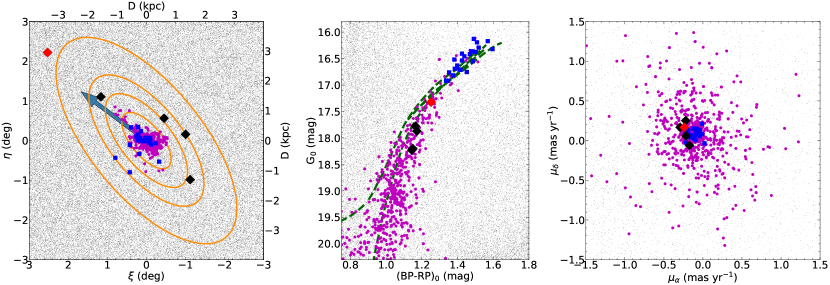
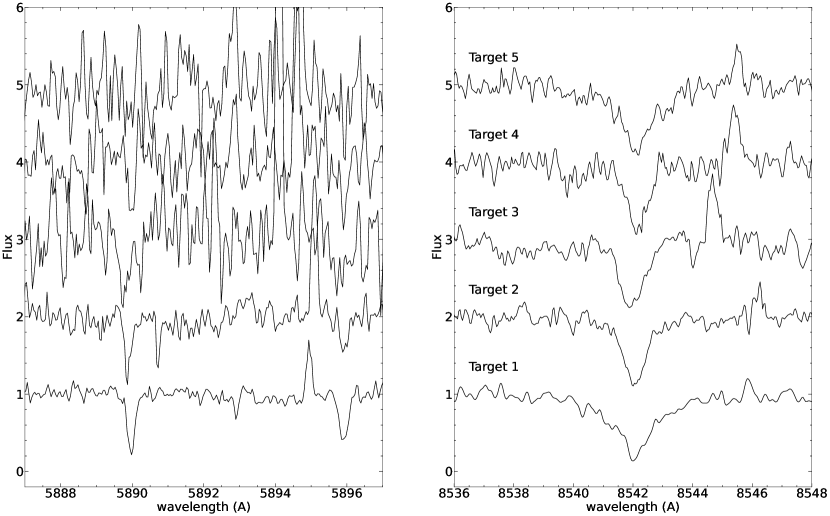
Stellar candidates in the Ursa Minor (UMi) dwarf galaxy have been found using a new Bayesian algorithm applied to extit{Gaia} EDR3 data. Five of these targets are located in the extreme outskirts of UMi, from $\sim5$ to 12 elliptical half-light radii (r$_h$), where r$_h$(UMi) $= 17.32 \pm 0.11$ arcmin, and have been observed with the GRACES high resolution spectrograph at the Gemini-Northern telescope. Precise radial velocities ($σ_{ m{RV}} < 2$ km s$^{-1}$) and metallicities ($σ_{ m{[Fe/H]}} < 0.2$ dex) confirm their memberships of UMi. Detailed analysis of the brightest and outermost star (Target~1, at $\sim12$ r$_h$), yields precision chemical abundances for the $α$- (Mg, Ca, Ti), odd-Z (Na, K, Sc), Fe-peak (Fe, Ni, Cr), and neutron-capture (Ba) elements. With data from the literature and APOGEE DR17, we find the chemical patterns in UMi are consistent with an outside-in star formation history that includes yields from core collapse supernovae, asymptotic giant branch stars, and supernovae Ia. Evidence for a knee in the [$α$/Fe] ratios near [Fe/H] $\sim-2.1$ indicates a low star formation efficiency similar to that in other dwarf galaxies. Detailed analysis of the surface number density profile shows evidence that UMi's outskirts have been populated by tidal effects, likely as a result of completing multiple orbits around the Galaxy.
Motivation & Objective
- To identify and confirm the membership of extremely distant stars in the Ursa Minor dwarf galaxy's outer regions.
- To investigate the origin of the extended stellar halo in UMi, particularly whether it results from tidal stripping or merger events.
- To determine the chemical composition of the most distant stars in UMi to infer their formation history and evolutionary processes.
- To assess whether the chemical patterns in the outermost stars are consistent with in-situ formation or external accretion.
Proposed method
- A new Bayesian algorithm was applied to Gaia EDR3 astrometric and photometric data to identify stellar candidates in the extreme outskirts of Ursa Minor.
- High-resolution spectroscopy with the GRACES instrument on the Gemini-North telescope was used to measure precise radial velocities (σ < 2 km s⁻¹) and metallicities (σ < 0.2 dex).
- Detailed chemical abundance analysis was performed for α-, odd-Z, Fe-peak, and neutron-capture elements in the outermost star (Target 1) at ~12 rₕ.
- The chemical patterns were compared with literature data and APOGEE DR17 to model the star formation and enrichment history.
- Surface number density profiles were analyzed to assess the role of tidal effects in populating the outer regions.
- Chemical evolution models incorporating yields from core-collapse supernovae, AGB stars, and SNe Ia were used to interpret the observed abundance trends.
Experimental results
Research questions
- RQ1Are the ultra-distant stars in the Ursa Minor dwarf galaxy physically associated with the system, or are they field contaminants?
- RQ2What is the star formation history of Ursa Minor inferred from the chemical abundances of its outermost stars?
- RQ3Do the chemical patterns in the outermost stars support an outside-in formation scenario with contributions from multiple supernova types?
- RQ4Is the observed [α/Fe] knee at [Fe/H] ≈ -2.1 consistent with low star formation efficiency, as seen in other dwarf galaxies?
- RQ5To what extent have tidal interactions with the Milky Way shaped the extended stellar halo of Ursa Minor?
Key findings
- Five stars were confirmed as members of Ursa Minor at distances from 5 to 12 half-light radii (rₕ ≈ 17.32 arcmin), extending the known stellar distribution far beyond the core.
- The outermost star (Target 1) at ~12 rₕ has a precise radial velocity of 226.8 ± 0.8 km s⁻¹ and [Fe/H] = -2.12 ± 0.05 dex, confirming its membership.
- Detailed abundance analysis of Target 1 shows consistent patterns across α-, odd-Z, Fe-peak, and neutron-capture elements, indicating a complex enrichment history.
- The presence of a [α/Fe] knee near [Fe/H] ≈ -2.1 suggests low star formation efficiency, similar to other dwarf galaxies.
- The surface number density profile of UMi's outer regions shows evidence of tidal disruption, likely due to multiple orbits around the Milky Way.
- Chemical evolution models including yields from core-collapse supernovae, AGB stars, and SNe Ia best reproduce the observed abundance patterns in the outermost stars.
Read this paper
Open the full text in the Nubint reader and ask about any passage as you read.
Read this paper on NubintThis review was generated by AI from the original paper. Please check the paper before citing it.