
[Paper Review] The Great Wave: Evidence of a large-scale vertical corrugation propagating outwards in the Galactic disc
The paper analyzes two young stellar samples (giants and Cepheids) to map the Galactic warp and reveals a large-scale vertical corrugation propagating outward in the disc beyond the warp. It finds a corrugation with 150–200 pc amplitude over ~10 kpc, with outward vertical motions and a propagating wave pattern.
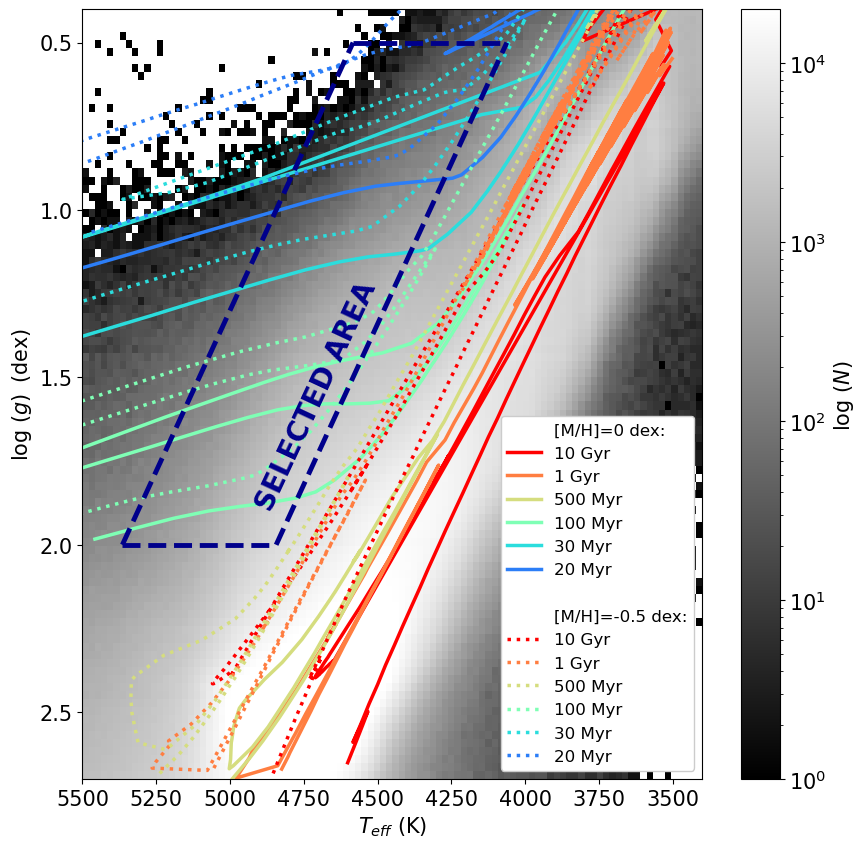
We analyse the three-dimensional structure and kinematics of two samples of young stars in the Galactic disc, containing respectively young giants ($\sim$17$\, $000 stars out to heliocentric distances of $\sim$7 kpc) and classical Cepheids ($\sim$3400 stars out to heliocentric distances of $\sim$15 kpc). The vertical structure of the two samples exhibit a consistent shape of the Milky Way's warp, whose amplitude reaches $\sim$700 pc at a Galactocentric radius R $\sim$ 14 kpc. Moreover, both samples show evidence of a large-scale vertical corrugation on top of the warp with a vertical height of $\sim$150-200 pc, extending over a large portion of the Galactic disc between Galactocentric radii $R \sim$ 10-12 kpc in the third Galactic quadrant (galactic longitudes $180^\circ < l < 270^\circ$) and $\sim$12-14 kpc in the second Galactic quadrant ($90^\circ < l < 180^\circ$). Its total length is at least 10 kpc and can possibly reach $\sim$ 20 kpc with the Cepheid sample. The stars in the corrugation exhibit both radial and vertical systematic motions, with Galactocentric radial velocities towards the outer disc of about 10-15 km/s. In the vertical motions, once the warp signature is subtracted, the residuals show a large-scale feature of systematically positive vertical velocities, which is shifted to slightly larger Galactocentric radii with respect to the spatial vertical corrugation (with a phase difference of roughly $π/2$), indicating an oscillatory behaviour. A comparison of the observed shift with a simple toy model suggests that the corrugation can be interpreted as a wave propagating towards the outer disc. The wave mapped in this work is located at larger heliocentric distances compared to the Radcliffe wave, a $\sim$2.7 kpc filament of dense gas clouds close to the Sun, and exhibits a larger coverage of the Galactic disc.
Motivation & Objective
- Characterize the three-dimensional structure and kinematics of the Galactic disc using two young stellar samples (giants and Cepheids).
- Map the warp and search for additional vertical perturbations on top of the warp in the outer disc.
- Quantify the vertical corrugation amplitude, radial extent, and kinematic signatures.
- Assess whether residuals after warp modeling indicate a propagating vertical wave.
- Compare warp results between independent tracers to test robustness.
Proposed method
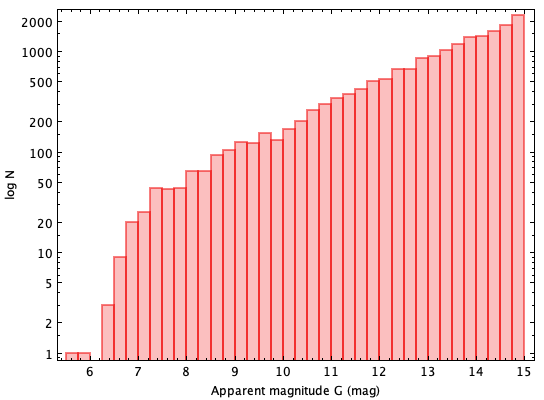
- Select two young stellar samples from Gaia DR3 and ancillary data: ~16,000 young giants and ~3,400 classical Cepheids.
- Infer distances via Bayesian distances with a disc-based prior and a selection-function-corrected luminosity function.
- Model the warp using an m=1 tilted-ring approach and a global parametric fit with amplitude h_w(R) and line-of-nodes phi_LON(R).
- Compute Z_w(R,phi)=h_w(R) sin(phi - phi_LON(R)) as the warp prediction and compare to observed Z to derive warp parameters.
- Inspect residuals after warp modeling to identify non-warp structures, revealing a radial corrugation feature.
- Validate results with both samples and discuss potential systematics (disc thickness, extinction, selection).
Experimental results
Research questions
- RQ1What is the large-scale vertical structure of the Galactic disc beyond the known warp when traced by young stars?
- RQ2Does a simple m=1 warp adequately describe the vertical distribution, or are residual corrugations present?
- RQ3What are the amplitude, radial dependence, and phase of the Galactic warp as traced by young giants and Cepheids?
- RQ4Do residuals after warp subtraction indicate a propagating vertical wave in the outer disc?
- RQ5How consistent are warp measurements across independent young-star tracers (giants vs Cepheids)?
Key findings
- Both young giants and Cepheids show a warp with vertical height 150–200 pc, radial width ~3 kpc, and length at least 10 kpc (potentially 20 kpc with Cepheids).
- Warp amplitudes rise with Galactocentric radius; phase angle shows changes around R ≈ 11–12 kpc, and a gradual twist of the line-of-nodes toward larger radii.
- Radial velocities show INward/outward motions toward the outer disc of ~10–15 km/s in V_R.
- After subtracting warp, residuals reveal a coherent large-scale vertical corrugation (Feature 1) extending ~10 kpc in azimuth with ~150–200 pc amplitude, and a potential symmetric Feature 2 at the map's edge.
- The corrugation pattern is consistent with a vertical wave propagating outward in the Galactic disc, with maxima roughly along the line of zero displacement.
Read this paper
Open the full text in the Nubint reader and ask about any passage as you read.
Read this paper on NubintThis review was generated by AI from the original paper. Please check the paper before citing it.