
[Paper Review] The helion charge radius from laser spectroscopy of muonic helium-3 ions
Laser spectroscopy of muonic helium-3 ions yields a highly precise helion (3He) rms charge radius, r_h = 1.97007(94) fm, via Lamb shift, hyperfine, and fine-structure measurements.
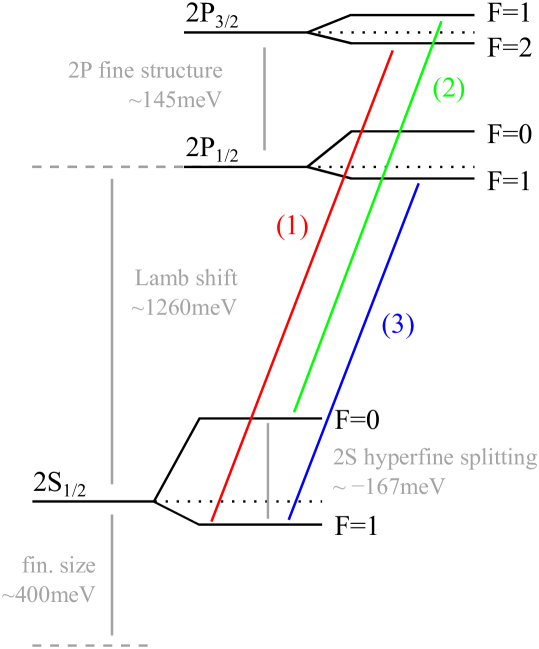
Hydrogen-like light muonic ions, in which one negative muon replaces all the electrons, are extremely sensitive probes of nuclear structure, because the large muon mass increases tremendously the wave function overlap with the nucleus. Using pulsed laser spectroscopy we have measured three 2S-2P transitions in the muonic helium-3 ion ($μ^3$He$^+$), an ion formed by a negative muon and bare helium-3 nucleus. This allowed us to extract the Lamb shift $E(2P_{1/2}-2S_{1/2})= 1258.598(48)^{ m exp}(3)^{ m theo}$ meV, the 2P fine structure splitting $E_{ m FS}^{ m exp} = 144.958(114)$ meV, and the 2S-hyperfine splitting (HFS) $E_{ m HFS}^{ m exp} = -166.495(104)^{ m exp}(3)^{ m theo}$ meV in $μ^3$He$^+$. Comparing these measurements to theory we determine the rms charge radius of the helion ($^3$He nucleus) to be $r_h$ = 1.97007(94) fm. This radius represents a benchmark for few nucleon theories and opens the way for precision tests in $^3$He atoms and $^3$He-ions. This radius is in good agreement with the value from elastic electron scattering, but a factor 15 more accurate. Combining our Lamb shift measurement with our earlier one in $μ^4$He$^+$ we obtain $r_h^2-r_α^2 = 1.0636(6)^{ m exp}(30)^{ m theo}$ fm$^2$ to be compared to results from the isotope shift measurements in regular He atoms, which are however affected by long-standing tensions. By comparing $E_{ m HFS}^{ m exp}$ with theory we also obtain the two-photon-exchange contribution (including higher orders) which is another important benchmark for ab-initio few-nucleon theories aiming at understanding the magnetic and current structure of light nuclei.
Motivation & Objective
- Measure three 2S-2P transitions in muonic helium-3 ions to extract key energy splittings (Lamb shift, 2S hyperfine, 2P fine).
- Extract the helion rms charge radius by comparing experimental Lamb shift with theory.
- Benchmark two-photon-exchange contributions and nuclear structure effects in light nuclei.
Proposed method
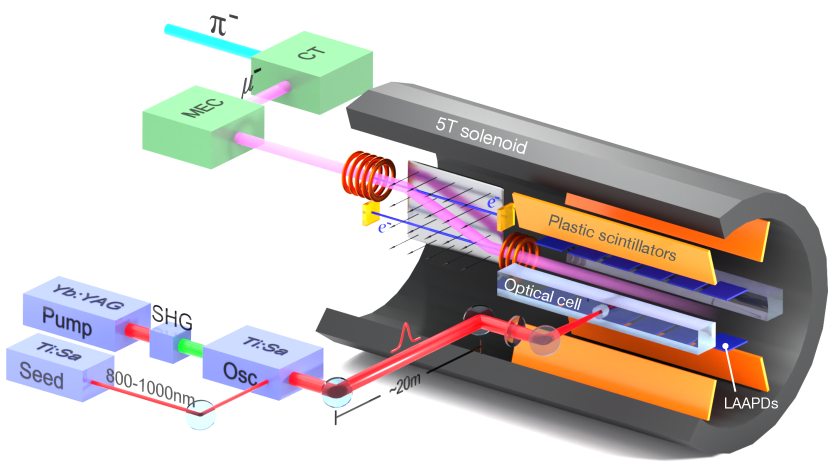
- Form muonic He+ ions by stopping keV muons in a low-pressure 3He target inside a 5 T solenoid.
- Use pulsed laser spectroscopy with a multi-pass optical cavity to drive 2S→2P transitions around 850–940 nm.
- Detect 8 keV Kα X-rays from 2P→1S de-excitation in time coincidence with laser firing to locate resonances.
- Extract transition frequencies from line-shape fits corrected for saturation and laser energy variations.
- Solve a system of equations relating measured energy differences to E_LS, E_HFS, and E_FS using updated 2P level theory and 2P centroid conventions.
Experimental results
Research questions
- RQ1What is the Lamb shift E_LS in muonic 3He+ inferred from the three measured transitions?
- RQ2What are the 2S hyperfine splitting E_HFS and the 2P fine splitting E_FS as extracted from the data?
- RQ3What is the helion charge radius r_h obtained from E_LS when combined with modern theory?
- RQ4How does the measured E_HFS constrain the two-photon-exchange (2PE) and higher-order nuclear structure contributions?
- RQ5How do the results compare with elastic electron scattering and nuclear theory predictions?
Key findings
- r_h = 1.97007(94) fm, derived from the Lamb shift with exp and theo inputs.
- E_LS^exp = 1258.598(48) meV and E_HFS^exp = -166.496(104) meV after combining with theory, with E_FS^exp = 144.958(114) meV.
- The measured E_FS^exp agrees with theory: 144.979(5) meV, validating the 2P level theory.
- The isotopic-shift-based quantity r_h^2 - r_alpha^2 = 1.0636(6)(30) fm^2, from combining muonic 3He+ and muonic 4He+ data, with a 3.6 sigma tension against the Amsterdam result in regular He atoms.
- The result improves the helion radius precision by ~15x over previous elastic-scattering determination and agrees with that value.
Read this paper
Open the full text in the Nubint reader and ask about any passage as you read.
Read this paper on NubintThis review was generated by AI from the original paper. Please check the paper before citing it.