
[Paper Review] The hot circumgalactic medium in the eROSITA All-Sky Survey I. X-ray surface brightness profiles
The paper uses stacking of eROSITA eRASS:4 data to detect and characterize the hot circum-galactic medium around Milky Way–mass and more massive central galaxies out to the virial radius, modeling and subtracting AGN/XRB contamination.
The circumgalactic medium (CGM) provides the material needed for galaxy formation and influences galaxy evolution. The hot ($T>10^6K$) CGM is poorly detected around galaxies with stellar masses ($M_*$) lower than $3 imes10^{11}M_\odot$ due to the low surface brightness. We used the X-ray data from the first four SRG/eROSITA All-Sky Surveys (eRASS:4). Based on the SDSS spectroscopic survey and halo-based group finder algorithm, we selected central galaxies with spectroscopic redshifts of $z_{ m spec}<0.2$ and stellar masses of $10.0<\log(M_*/M_\odot)<11.5$ (85,222 galaxies) -- or halo masses of $11.5<\log(M_{ m 200m}/M_\odot)<14.0$ (125,512 galaxies). By stacking the X-ray emission around galaxies, masking the detected X-ray point sources and carefully modeling the X-ray emission from the unresolved active galactic nuclei (AGN) and X-ray binaries (XRB), we obtain the X-ray emission from the hot CGM. We detected the X-ray emission around MW-mass and more massive central galaxies extending up to the virial radius ($R_{ m vir}$). We used a $β$ model to describe the X-ray surface brightness profile and found $β=0.43^{+0.10}_{-0.06}\,(0.37^{+0.04}_{-0.02})$ for MW-mass (M31-mass) galaxies.We estimated the baryon budget of the hot CGM and obtained a value that is lower than the prediction of $Λ$CDM cosmology, indicating significant gas depletion in these halos. We extrapolated the hot CGM profile measured within $R_{ m vir}$ to larger radii and found that within $\approx 3 R_{ m vir}$, the baryon budget is close to the $Λ$CDM cosmology prediction. Our results set a firm footing for the presence of the hot CGM around such galaxies. These measurements constitute a new benchmark for galaxy evolution models and possible implementations of feedback processes therein.
Motivation & Objective
- Motivate the study of the hot CGM as a major baryon reservoir and its role in galaxy evolution.
- Measure the X-ray surface brightness profile of the hot CGM around MW-mass and more massive central galaxies using eROSITA all-sky survey data.
- Develop and validate a robust stacking and masking framework to separate CGM emission from AGN and X-ray binaries.
- Construct carefully defined central and isolated galaxy samples to minimize satellite contamination in stacking analyses.
Proposed method
- Stack X-ray data from the first four eROSITA all-sky surveys (eRASS:4) in the 0.5–2 keV band.
- Build physical distance cubes for each galaxy, mask detected X-ray sources, and correct for masked area and absorption.
- Model residual emission from unresolved AGN and X-ray binaries to isolate hot CGM emission.
- Fit the resulting surface brightness profiles with a beta model, convolved with the eROSITA PSF, using MCMC to estimate parameters (S_X,0, beta, r_c).
- Estimate uncertainties via Poisson statistics and Jackknife resampling of the stacking.
Experimental results
Research questions
- RQ1What is the average X-ray surface brightness profile of the hot CGM around MW-mass and more massive central galaxies out to the virial radius?
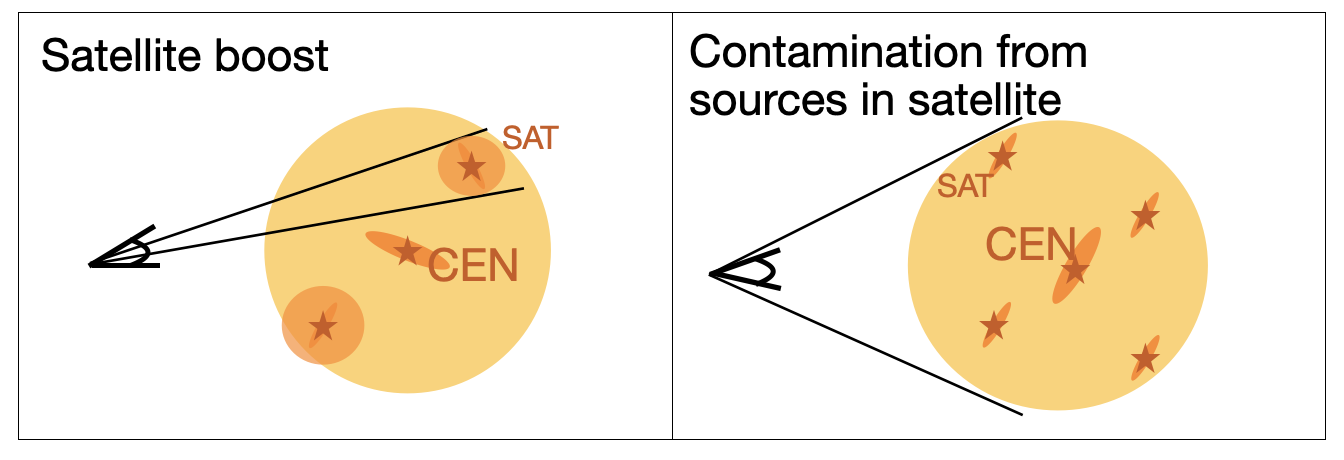
- RQ2How do unresolved AGN/XRB contamination and satellite galaxies bias stacking measurements, and how can they be mitigated?
- RQ3What are the best-fit beta-model parameters describing the hot CGM, and what do they imply about its structure?
- RQ4What is the inferred baryon budget of the hot CGM for MW-mass and more massive systems, and how does it compare to ΛCDM predictions?
Key findings
- Significant detection of extended X-ray emission from the hot CGM around MW-mass and more massive central galaxies out to the virial radius (R_vir).
- MW-mass galaxy: S_X,0 ≈ 3.1×10^35 erg s^-1 kpc^-2, β ≈ 0.42; M31-mass galaxy: S_X,0 ≈ 1.3×10^36 erg s^-1 kpc^-2, β ≈ 0.37; higher-mass bin (log M_* = 11.25–11.50): S_X,0 ≈ 6.3×10^36 erg s^-1 kpc^-2, β ≈ 0.35.
- Significance levels: ≈12.3σ for M31-mass and ≈8.1σ for MW-mass within R_vir; ≈4.5σ (MW) and ≈3.1σ (M31) within 0.5–1 R_vir.
- Extended emission detected out to R_vir, providing a firm footing for the presence of hot CGM around MW-mass and more massive galaxies.
- Isolated galaxies show no strong differences in surface brightness profiles compared to central galaxies after accounting for environment.

Read this paper
Open the full text in the Nubint reader and ask about any passage as you read.
Read this paper on NubintThis review was generated by AI from the original paper. Please check the paper before citing it.