
[Paper Review] The interstellar medium conditions of a strong Lya emitter at z = 8.279 revealed by JWST: a robust LyC leaker candidate at the Epoch of Reionization
Using JWST NIRSpec and NIRCam data, this study analyzes GN-z8-LAE, a strong Lyα emitter at z = 8.279, revealing it as a robust Lyman continuum (LyC) leaker candidate with f_esc > 14%. The galaxy exhibits extreme star formation and stellar mass surface densities, a hard ionization field, and a rare NIII] emission line, indicating super-solar nitrogen abundance and supporting its role as a prime early reionizer at the Epoch of Reionization.
Making use of JWST NIRSpec and NIRCam data, we conduct a detailed analysis of the spectroscopic and photometric properties of GN-z8-LAE, a strong Lya emitter at z=8.279. Our goal is to investigate the interstellar medium (ISM) physical conditions that enable the Lya detection in this source at the Epoch of Reionization (EoR) and scrutinize GN-z8-LAE as an early reionizer. In broad agreement with previous results, we find that GN-z8-LAE is a young galaxy (age ~ 10 Myr) with a low stellar mass (M* ~ 10^7.66 Msun), significantly lower than those of most Lya emitters known at similarly high redshifts. The derived stellar mass and star formation rate surface densities are 355 Msun/pc^2 and 88 Msun/yr/kpc^2, respectively. Our spectral analysis indicates that: the Lya line peak has a small velocity offset 133+-72 km/s with respect to the galaxy systemic redshift; CIV] / CIII] ~ 3.3; the ISM is characterized by a hard ionization field, although no signature of AGN is present. Moreover, we report the presence of NIII]1750 emission with super-solar N abundance, which makes GN-z8-LAE one of the first known cases of a simultaneous strong Lya and nitrogen emitter at the EoR. Based on all these properties, we apply a wide range of methods to constrain the absolute Lyman continuum escape fraction of GN-z8-LAE, and find that it is >14% in all cases. Therefore, we conclude that GN-z8-LAE is a robust candidate for a Lyman continuum (LyC) leaker at the EoR which is being caught at the moment of efficiently reionizing its surrounding medium.
Motivation & Objective
- To investigate the interstellar medium (ISM) conditions enabling Lyα emission in a high-redshift galaxy during the Epoch of Reionization (EoR).
- To assess whether GN-z8-LAE is a strong candidate for Lyman continuum (LyC) escape, a key requirement for driving cosmic reionization.
- To characterize the physical properties of GN-z8-LAE, including its stellar mass, star formation rate surface density, and ionization field hardness.
- To explore the origin of rare NIII] λ1749–1753 emission in a high-redshift galaxy and its implications for metallicity and stellar feedback.
- To determine the LyC escape fraction (f_esc) using multiple indirect methods, establishing a robust constraint on its reionization potential.
Proposed method
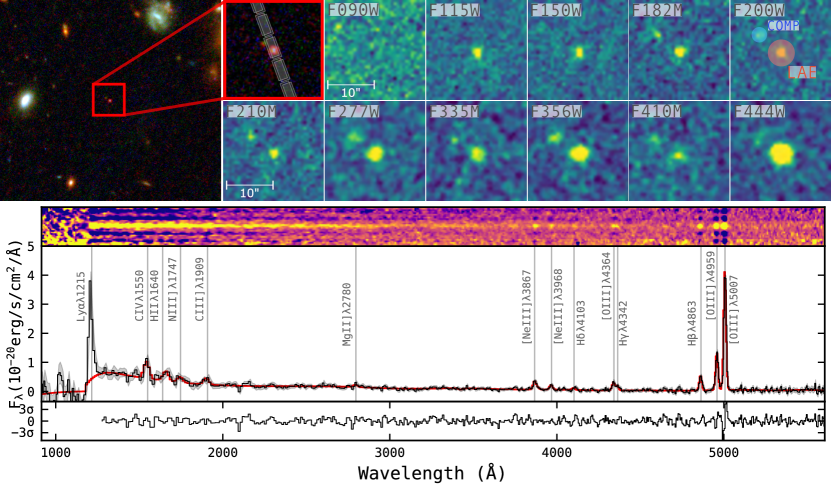
- Conducted deep spectroscopic analysis using JWST NIRSpec and NIRCam data to measure emission line properties, including Lyα, CIV, CIII], and NIII] lines.
- Calculated the Lyα line velocity offset (Δv = 133 ± 72 km/s) relative to the systemic redshift to assess resonant scattering and ISM geometry.
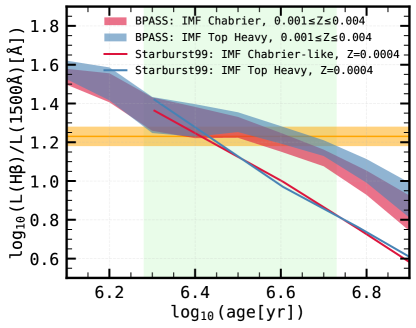
- Estimated stellar mass (M* ≈ 10^7.66 M☉) and star formation rate (SFR) using SED fitting with the BAGPIPES code and dust extinction modeling.
- Computed surface densities: Σ_M* ≈ 355 M☉/pc² and Σ_SFR ≈ 88 M☉ yr⁻¹ kpc⁻² to evaluate compactness and star formation intensity.
- Used multiple indirect indicators—CIV/CIII] ratio, [OIII]/[OII] ratio, Lyα line width, and UV slope (β ≈ -2.2 to -2.7)—to constrain f_esc.
- Applied the CIV/CIII] ratio (≈3.3) and NIII] detection to infer ionization field hardness and nitrogen overabundance, respectively.
Experimental results
Research questions
- RQ1What are the interstellar medium conditions in GN-z8-LAE that allow for strong Lyα emission at z = 8.279?
- RQ2What is the LyC escape fraction (f_esc) in GN-z8-LAE, and does it exceed the threshold required for driving reionization?
- RQ3What causes the detection of the NIII] λ1749–1753 emission line in this high-redshift galaxy, and what does it imply about its metallicity and ionization state?
- RQ4How do the extreme surface densities of stellar mass and star formation rate in GN-z8-LAE relate to its LyC leaker status?
- RQ5Can multiple indirect indicators consistently support GN-z8-LAE as a robust LyC leaker candidate at the Epoch of Reionization?
Key findings
- GN-z8-LAE is a young galaxy with an age of approximately 10 Myr and a low stellar mass of M* ≈ 10^7.66 M☉, making it less massive than most Lyα emitters at similar redshifts.
- The galaxy exhibits high surface densities: Σ_M* ≈ 355 M☉/pc² and Σ_SFR ≈ 88 M☉ yr⁻¹ kpc⁻², placing it among the most compact and intense star-forming systems at z ≈ 8.
- The Lyα line peak is offset by only Δv = 133 ± 72 km/s from the systemic redshift, indicating minimal resonant scattering and favorable geometry for LyC escape.
- The CIV/CIII] line ratio is ≈3.3, indicating a hard ionization field consistent with LyC leaker candidates, despite the absence of AGN signatures.
- The detection of NIII] λ1749–1753 emission implies a super-solar nitrogen abundance, which is inconsistent with the derived sub-solar metallicity and may be linked to extreme surface densities or Wolf-Rayet stars.
- All methods applied yield a LyC escape fraction f_esc > 14%, establishing GN-z8-LAE as the most robust LyC leaker candidate identified to date at the Epoch of Reionization.
Read this paper
Open the full text in the Nubint reader and ask about any passage as you read.
Read this paper on NubintThis review was generated by AI from the original paper. Please check the paper before citing it.