
[Paper Review] The JWST Early Release Science Program for Direct Observations of Exoplanetary Systems II: A 1 to 20 Micron Spectrum of the Planetary-Mass Companion VHS 1256-1257 b
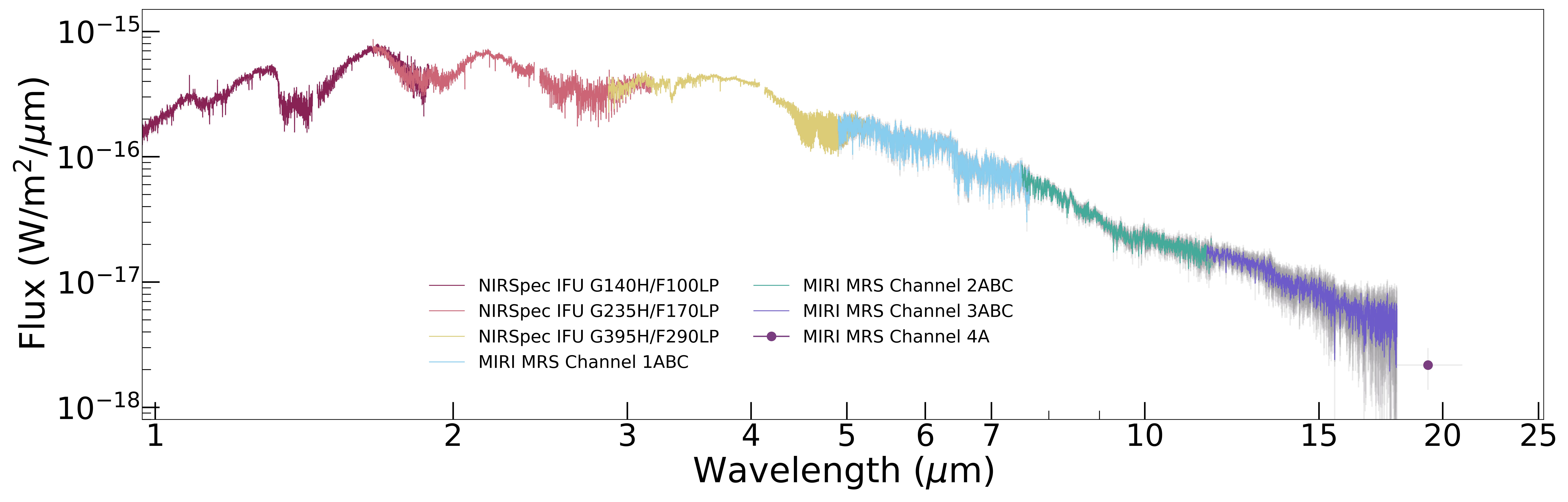
This paper presents the first medium-resolution 1–20 μm spectrum of the planetary-mass companion VHS 1256-1257 b, obtained via JWST's NIRSpec IFU and MIRI MRS instruments during the Early Release Science program. The data reveal molecular features of water, methane, carbon monoxide, carbon dioxide, and a prominent silicate feature, indicating patchy silicate clouds and strong atmospheric mixing, with a best-fit model requiring two thick cloud decks, low surface gravity (log g = 4.5), and effective temperature of 1100 K.
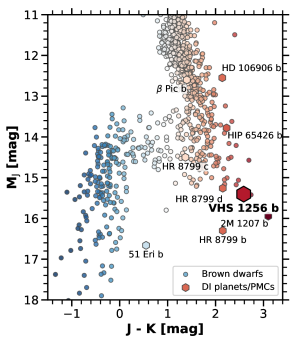
We present the highest fidelity spectrum to date of a planetary-mass object. VHS 1256 b is a $<$20 M$_\mathrm{Jup}$ widely separated ($\sim$8\arcsec, a = 150 au), young, planetary-mass companion that shares photometric colors and spectroscopic features with the directly imaged exoplanets HR 8799 c, d, and e. As an L-to-T transition object, VHS 1256 b exists along the region of the color-magnitude diagram where substellar atmospheres transition from cloudy to clear. We observed VHS 1256~b with extit{JWST}'s NIRSpec IFU and MIRI MRS modes for coverage from 1 $μ$m to 20 $μ$m at resolutions of $\sim$1,000 - 3,700. Water, methane, carbon monoxide, carbon dioxide, sodium, and potassium are observed in several portions of the extit{JWST} spectrum based on comparisons from template brown dwarf spectra, molecular opacities, and atmospheric models. The spectral shape of VHS 1256 b is influenced by disequilibrium chemistry and clouds. We directly detect silicate clouds, the first such detection reported for a planetary-mass companion.
Motivation & Objective
- To obtain a high-sensitivity, medium-resolution spectrum of VHS 1256-1257 b across 1–20 μm using JWST’s NIRSpec and MIRI instruments.
- To characterize the atmospheric composition, cloud structure, and vertical mixing in a planetary-mass companion via spectral analysis.
- To determine the bolometric luminosity and mass limit of VHS 1256-1257 b with high precision.
- To test atmospheric models that include disequilibrium chemistry and turbulent vertical mixing in young, low-gravity brown dwarfs and exoplanets.
- To establish a benchmark for future JWST observations of similar objects by demonstrating the feasibility of detailed atmospheric modeling from 0.97 μm to 19.8 μm.
Proposed method
- Acquired medium-resolution spectroscopy using JWST’s NIRSpec Integral Field Unit (IFU) and MIRI Mid-Infrared Instrument (MRS) across 0.97–19.8 μm.
- Performed data reduction and flux calibration using standard JWST pipeline procedures and specialized calibration for extended sources.
- Conducted forward modeling of the observed spectrum using atmospheric models with variable cloud decks, mixing coefficients (Kzz), and chemical abundances.
- Fitted the observed spectrum with a two-layer cloud model (f_sed = 0.6 and f_sed = 1.0) to reproduce the silicate feature and spectral shape.
- Used radiative transfer and atmospheric structure models to derive effective temperature, surface gravity, and luminosity from the best-fit spectrum.
- Quantified uncertainties in luminosity (log(L_bol/L_sun) = -4.55 ± 0.009) and derived an upper mass limit of 20 M_Jup.
Experimental results
Research questions
- RQ1What is the atmospheric composition of VHS 1256-1257 b across the 1–20 μm range, and which molecular species are detectable?
- RQ2What is the cloud structure of VHS 1256-1257 b, and how do multiple cloud decks affect the observed spectrum?
- RQ3To what extent does turbulent vertical mixing (Kzz) influence the atmospheric chemistry and spectral features of this young, low-gravity object?
- RQ4How accurately can the bolometric luminosity and mass limit of VHS 1256-1257 b be constrained from JWST observations?
- RQ5Can the observed spectral features be explained by models that include disequilibrium chemistry and patchy cloud formation?
Key findings
- The spectrum reveals strong absorption features of water, methane, carbon monoxide, carbon dioxide, and a prominent 10 μm silicate feature indicative of small cloud particles.
- The best-fit atmospheric model requires two thick cloud decks with surface pressures f_sed = 0.6 (90%) and f_sed = 1.0 (10%), indicating heterogeneous cloud coverage.
- The derived effective temperature is 1100 K, surface gravity is log(g) = 4.5, and radius is 1.27 R_Jup, consistent with a young, low-gravity object.
- The vertical mixing coefficient Kzz ranges from 10^8 to 10^9 cm² s⁻¹, with stronger mixing occurring deeper in the atmosphere, supporting turbulent convection.
- The bolometric luminosity is measured with high precision at log(L_bol/L_sun) = -4.55 ± 0.009, enabling an upper mass limit of 20 M_Jup for VHS 1256-1257 b.
- The model captures the overall spectral shape but underestimates the depth of molecular absorption features, suggesting limitations in current forward modeling of disequilibrium chemistry.
Read this paper
Open the full text in the Nubint reader and ask about any passage as you read.
Read this paper on NubintThis review was generated by AI from the original paper. Please check the paper before citing it.