
[Paper Review] The JWST-PRIMAL Legacy Survey. A JWST/NIRSpec reference sample for the physical properties and Lyman-$α$ absorption and emission of $\sim 500$ galaxies at $z=5.5-13.4$
The paper presents the JWST-PRIMAL legacy survey, assembling a spectroscopically confirmed sample of about 494 galaxies at z=5.5–13.4 observed with JWST/NIRSpec Prism, to quantify Lyman-α damping, emission, and associated HI gas properties during reionization, using a unified data reduction pipeline and a new damping diagnostic D_Lyα.
One of the surprising early findings with JWST has been the discovery of a strong "roll-over" or a softening of the absorption edge of Ly$α$ in a large number of galaxies at ($z\gtrsim 6$), in addition to systematic offsets from photometric redshift estimates and fundamental galaxy scaling relations. This has been interpreted as damped Ly$α$ absorption (DLA) wings from high column densities of neutral atomic hydrogen (HI), signifying major gas accretion events in the formation of these galaxies. To explore this new phenomenon systematically, we assemble the JWST/NIRSpec PRImordial gas Mass AssembLy (PRIMAL) legacy survey of 494 galaxies at $z=5.5-13.4$. We characterize this benchmark sample in full and spectroscopically derive the galaxy redshifts, metallicities, star-formation rates, and ultraviolet slopes. We define a new diagnostic, the Ly$α$ damping parameter $D_{ m Lyα}$ to measure and quantify the Ly$α$ emission strength, HI fraction in the IGM, or local HI column density for each source. The JWST-PRIMAL survey is based on the spectroscopic DAWN JWST Archive (DJA-Spec). All the software, reduced spectra, and spectroscopically derived quantities and catalogs are made publicly available in dedicated repositories. The fraction of strong galaxy DLAs are found to be in the range $65-95\%$ at $z>5.5$. The fraction of strong Ly$α$ emitters (LAEs) is found to increase with decreasing redshift, in qualitative agreement with previous observational results, and are predominantly associated with low-metallicity and UV faint galaxies. By contrast, strong DLAs are observed in galaxies with a variety of intrinsic physical properties. Our results indicate that strong DLAs likely reflect a particular early assembly phase of reionization-era galaxies, at which point they are largely dominated by pristine HI gas accretion. [abridged]
Motivation & Objective
- Characterize the physical properties (redshift, metallicity, SFR, UV slope) of a large sample of high-redshift galaxies.
- Quantify Lyman-α absorption and emission features to diagnose HI in ISM/CGM and the IGM during reionization.
- Develop and apply a new Lyα damping parameter D_Lyα to distinguish DLA, LAE, and IGM attenuation effects.
- Publicly release reduced spectra, measurements, and catalogs to enable reproducible analyses of reionization-era gas.
Proposed method
- Compile a sample of 494 galaxies from the DAWN JWST Archive (DJA-Spec) that meet z_spec>5.5, S/N>3 near Lyα, and full 0.6–5.3 μm NIRSpec Prism coverage.
- Reduce and extract spectra with a standardized DJA-Spec pipeline using Grizli and MSAExp, including 2D+1D extraction and optimal weighting.
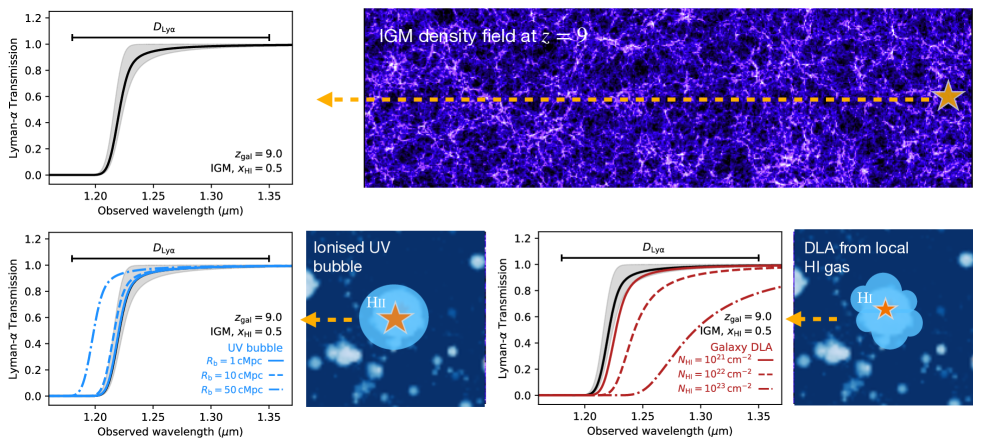
- Define and compute the Lyα damping parameter D_Lyα as an EW-like measure over 1180–1350 Å (rest-frame) normalized by (1+z_spec).
- Model Lyα transmission with IGM bubble sizes and DLA HI column densities to interpret D_Lyα under different physical scenarios.
- Measure nebular emission line fluxes and redshifts from lines such as [O II], [O III], Hβ, Hα, and others to derive physical properties.
- Provide public data products and catalogs via dedicated repositories and project webpages.

Experimental results
Research questions
- RQ1How does the incidence and strength of Lyα damping wings evolve in galaxies from z≈5.5 to z>13.4?
- RQ2What is the prevalence of strong DLAs (N_HI>10^21 cm^-2) in reionization-era galaxies and how does it correlate with galaxy properties?
- RQ3How does Lyα emission correlate with metallicity, UV slope, and other intrinsic galaxy properties across z=5.5–13.4?
- RQ4Can a unified Lyα damping parameter D_Lyα disentangle the effects of ISM/CGM HI, ionized bubbles, and neutral IGM on observed Lyα profiles?
Key findings
- The fraction of galaxies with strong integrated DLAs (N_HI>10^21 cm^-2) increases only slightly with redshift, from ~60% at z≈6 to ~65–90% at z>8.
- The prevalence and prominence of Lyα emission increases with decreasing redshift, qualitatively aligning with prior observations.
- Strong Lyα emitters tend to be low-metallicity and UV-faint galaxies, while strong DLAs occur in varied intrinsic properties but are more common at high redshift and low metallicity.
- DLAs are interpreted as marking an early assembly phase with pristine HI gas accretion, while later stages see gas cooling and star formation that ionizes surroundings and enables strong Lyα at z<8.
- The D_Lyα diagnostic successfully identifies extreme cases of strong LAEs (D_Lyα < 0 Å) and DLAs (D_Lyα > 50 Å), within the instrument’s resolution limits.
- All reduced spectra, measurements, and catalogs are made publicly available via dedicated repositories.
Read this paper
Open the full text in the Nubint reader and ask about any passage as you read.
Read this paper on NubintThis review was generated by AI from the original paper. Please check the paper before citing it.