
[Paper Review] The Landscape of Compute-near-memory and Compute-in-memory: A Research and Commercial Overview
This survey reviews CNM and CIM architectures, technologies, and the evolving commercial landscape, discussing benefits, challenges, and market trends.
In today's data-centric world, where data fuels numerous application domains, with machine learning at the forefront, handling the enormous volume of data efficiently in terms of time and energy presents a formidable challenge. Conventional computing systems and accelerators are continually being pushed to their limits to stay competitive. In this context, computing near-memory (CNM) and computing-in-memory (CIM) have emerged as potentially game-changing paradigms. This survey introduces the basics of CNM and CIM architectures, including their underlying technologies and working principles. We focus particularly on CIM and CNM architectures that have either been prototyped or commercialized. While surveying the evolving CIM and CNM landscape in academia and industry, we discuss the potential benefits in terms of performance, energy, and cost, along with the challenges associated with these cutting-edge computing paradigms.
Motivation & Objective
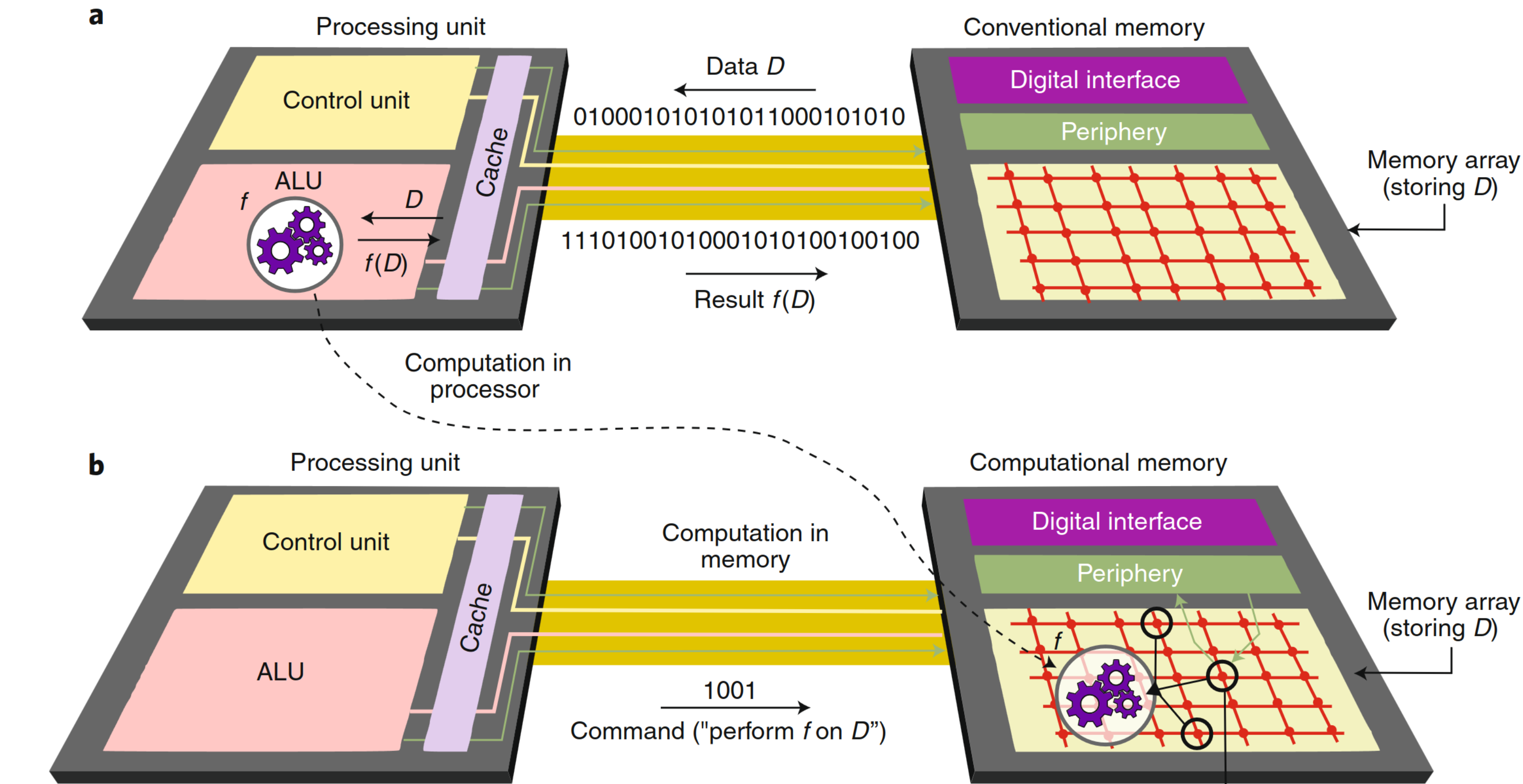
- Clarify CNM and CIM terminology and concepts and contrast with Von Neumann computing.
- Survey memory technologies (SRAM, DRAM, PCM, RRAM, MRAM, FeFET) and their suitability for CIM/CNM.
- Present representative CNM and CIM architectures (academic and commercial).
- Analyze the commercial landscape, market size, and funding dynamics for CIM/CNM startups.
- Identify key challenges and barriers to practical adoption and ecosystem development.
Proposed method
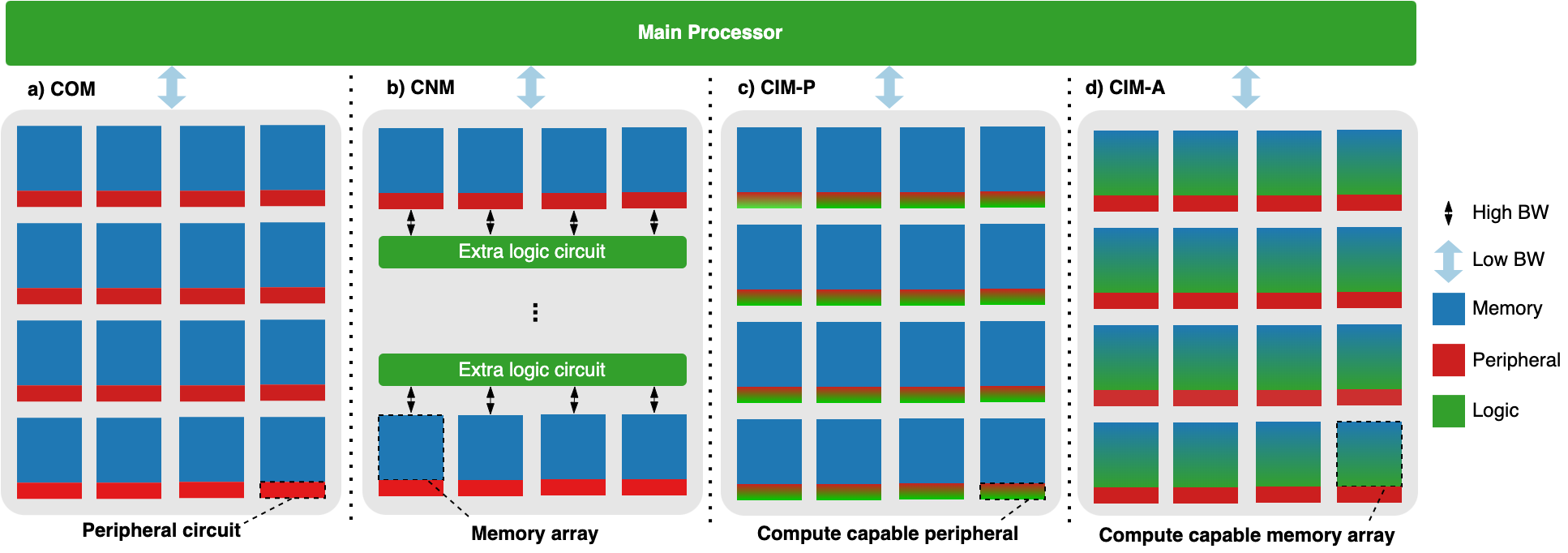
- Provide foundational definitions of CNM and CIM and classify system architectures (CIM-A, CIM-P, CNM, etc.).
- Review memory technologies and their physics, performance, energy, and reliability trade-offs for CIM/CNM.
- Survey selected architectures (UPMEM, McDRAM, MViD, Samsung PIM-HBM) and their programmability and integration models.
- Synthesize the commercial landscape, market values, growth projections, and funding activity for CIM/CNM startups.
- Discuss challenges such as programmability, reliability, and tooling, and propose future directions.
Experimental results
Research questions
- RQ1What are the core CNM and CIM architectures and their operating principles?
- RQ2What memory technologies enable CIM/CNM, and what are their trade-offs for ML workloads?
- RQ3What is the current commercial landscape for CIM/CNM, including players, products, and funding?
- RQ4What barriers hinder widespread adoption and what tooling or ecosystem advances are needed?
Key findings
- CNM and CIM aim to reduce data movement by computing near or within memory, with various architectural realizations (A/CIM-P, CIM-A, CNM).
- The market for in-/near-memory computing was valued at USD 15.5 billion in 2022 with a projected CAGR of 17.5% over the next decade.
- Analog in-memory operations like dot-products enable efficient ML, while different memory technologies offer varying performance, endurance, and energy profiles.
- SRAM currently dominates commercial CNM/CIM solutions, but non-volatile memories (PCM, RRAM, MRAM, FeFET) are expected to complement or replace SRAM as designs mature.
- Notable CNM architectures include UPMEM, McDRAM, MViD, and Samsung’s PIM-HBM (FIMDRAM), illustrating a spectrum from general-purpose PUs to fixed-function accelerators.
- A major adoption challenge is the lack of a robust software ecosystem, complicating programmability, modeling, profiling, and optimization.
Read this paper
Open the full text in the Nubint reader and ask about any passage as you read.
Read this paper on NubintThis review was generated by AI from the original paper. Please check the paper before citing it.