
[Paper Review] The Machine Psychology of Cooperation: Can GPT models operationalise prompts for altruism, cooperation, competitiveness and selfishness in economic games?
The paper tests whether GPT-3.5 can translate natural-language prompts describing altruism, selfishness, and related traits into cooperative or competitive behavior in iterated Prisoner’s Dilemma simulations.
We investigated the capability of the GPT-3.5 large language model (LLM) to operationalize natural language descriptions of cooperative, competitive, altruistic, and self-interested behavior in two social dilemmas: the repeated Prisoners Dilemma and the one-shot Dictator Game. Using a within-subject experimental design, we used a prompt to describe the task environment using a similar protocol to that used in experimental psychology studies with human subjects. We tested our research question by manipulating the part of our prompt which was used to create a simulated persona with different cooperative and competitive stances. We then assessed the resulting simulacras' level of cooperation in each social dilemma, taking into account the effect of different partner conditions for the repeated game. Our results provide evidence that LLMs can, to some extent, translate natural language descriptions of different cooperative stances into corresponding descriptions of appropriate task behaviour, particularly in the one-shot game. There is some evidence of behaviour resembling conditional reciprocity for the cooperative simulacra in the repeated game, and for the later version of the model there is evidence of altruistic behaviour. Our study has potential implications for using LLM chatbots in task environments that involve cooperation, e.g. using chatbots as mediators and facilitators in public-goods negotiations.
Motivation & Objective
- Investigate if LLMs can translate natural-language descriptions of altruism and selfishness into action policies in social dilemmas.
- Assess cooperation in iterated Prisoner’s D dilemma when LLM simulacra are instantiated with different prompts.
- Examine how prompt-based personas and partner strategies influence emergent cooperative behavior in multi-agent settings.
Proposed method
- Automated within-subject design using GPT-3.5-turbo to simulate 15 simulacra across five motivation groups (Competitive, Altruistic, Self-interested, Mixed, Control).
- Participants engaged in six rounds of iterated Prisoner’s Dilemma with predefined payoff matrix (T=7, R=5, P=3, S=0; 2R>T+S).
- Three partner conditions (unconditional defect, unconditional cooperate, Tit-for-tat variants) and three prompt variants per group were employed.
- Data collected from 1800 PD rounds, extracting choices via regex and computing total scores and cooperation frequencies.
- Prompts and transcripts are provided in appendices; code available in a repository.
Experimental results
Research questions
- RQ1Can LLMs operationalize natural-language prompts describing altruism or selfishness into corresponding cooperative or competitive behaviors?
- RQ2How do different prompt-induced personas (altruistic, competitive, self-interested, mixed) affect cooperation in an iterated non-zero-sum game?
- RQ3Do LLM-generated agents adapt cooperation based on partner behavior (reciprocity) or primarily reflect their initial prompts?
- RQ4What role do partner strategies (unconditional, tit-for-tat) play in shaping emergent behavior of prompt-instantiated agents?
Key findings
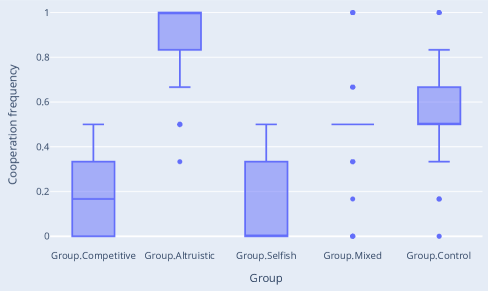
- Prompts encoding cooperative and competitive traits yield distinct cooperation levels in the iterated Prisoner’s Dilemma.
- Altruistic, competitive, mixed, and self-interested simulacra show different cooperation patterns, indicating partial translation of prompts into behavior.
- The control group sometimes aligns with human-like PD behavior, but overall LLMs struggle to adapt strategies based on partner reciprocity.
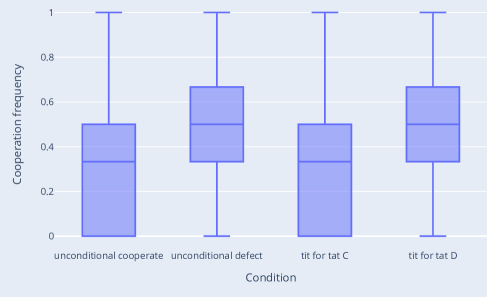
- Some results show increased cooperation with defectors and decreased cooperation with cooperators, suggesting limitations in generalizing human social norms.
- GPT-3.5 can operationalize altruism/selfishness to an extent, but nuanced adaptation to reciprocity is limited.
Read this paper
Open the full text in the Nubint reader and ask about any passage as you read.
Read this paper on NubintThis review was generated by AI from the original paper. Please check the paper before citing it.