
[Paper Review] The more the merrier: SRG/eROSITA discovers two further galaxies showing X-ray quasi-periodic eruptions
This paper reports the discovery of two new galaxies, eRO-QPE3 and eRO-QPE4, exhibiting X-ray quasi-periodic eruptions (QPEs) using the eROSITA X-ray telescope on board the SRG observatory. The findings reveal new properties—such as a decaying quiescence flux in eRO-QPE3, the longest recurrence times and faintest peak luminosity among QPEs, and a transient, harder X-ray component in eRO-QPE4—supporting models linking QPEs to extreme mass-ratio inspirals and highlighting the need for larger samples to understand their origin.
X-ray quasi-periodic eruptions (QPEs) are a novel addition to the group of extragalactic transients. In this work, we report the discovery of two further galaxies showing QPEs, eRO-QPE3 and eRO-QPE4, with the eROSITA X-ray telescope on board the Spectrum Roentgen Gamma observatory. Among the properties in common with those of known QPEs are: the thermal-like spectral shape in eruption (up to $kT\sim110-120$ eV) and quiescence ($kT\sim50-90$ eV) and its evolution during the eruptions (with a harder rise than decay); the lack of strong canonical signatures of active nuclei (from current optical, UV, infrared and radio data); and the low-mass nature of the host galaxies ($\log M_*\approx 9-10$) and their massive central black holes ($\log M_{ m BH}\approx 5-7$). These discoveries also bring several new insights into the QPE population: i) eRO-QPE3 shows eruptions on top of a decaying quiescence flux, providing further evidence for a connection between QPEs and a preceding tidal disruption event; ii) eRO-QPE3 exhibits the longest recurrence times and faintest peak luminosity of QPEs, compared to the known QPE population, excluding a correlation between the two; iii) we find evidence, for the first time, of a transient component that is harder, albeit much fainter, than the thermal QPE spectrum in eRO-QPE4; and iv) eRO-QPE4 displays the appearance (or significant brightening) of the quiescence disk component after the detection of QPEs, supporting its short-lived nature against a preexisting active galactic nucleus. Overall, the newly discovered properties (e.g., recent origin and/or transient nature of the quiescent accretion disk; lack of correlation between eruption recurrence timescales and luminosity) are qualitatively consistent with recent models that identify QPEs as extreme mass-ratio inspirals.
Motivation & Objective
- To expand the known population of X-ray quasi-periodic eruption (QPE) sources beyond the initial few discoveries.
- To investigate the physical properties and variability patterns of newly detected QPEs in order to constrain formation models.
- To examine whether QPEs are linked to tidal disruption events or transient accretion processes in low-mass galaxies.
- To assess the role of quiescent accretion disk components and their evolution in QPE-hosting galaxies.
- To evaluate the statistical significance of recurrence timescales and luminosities in the broader QPE population.
Proposed method
- Utilized deep, wide-field X-ray surveys from the eROSITA telescope aboard the SRG observatory to detect periodic X-ray eruptions in quiescent galactic nuclei.
- Performed follow-up observations with XMM-Newton, NICER, Swift-XRT, SALT, and ATCA to confirm and characterize the X-ray light curves and spectral properties.
- Analyzed X-ray light curves to measure recurrence timescales, peak luminosities, and spectral evolution during eruptions and quiescence.
- Compared spectral energy distributions in X-ray, optical, UV, infrared, and radio bands to rule out active galactic nucleus (AGN) signatures and identify transient components.
- Used redshift and host galaxy stellar mass estimates to infer black hole masses and assess the low-mass galaxy environment of QPE sources.
- Applied statistical modeling to assess the recurrence pattern and variability morphology of the QPEs, including irregular and intermediate behaviors.
Experimental results
Research questions
- RQ1Do the newly discovered QPE sources exhibit spectral and temporal properties consistent with previously known QPEs?
- RQ2Is there evidence for a connection between QPEs and prior tidal disruption events, as suggested by the decaying quiescence flux in eRO-QPE3?
- RQ3Do the recurrence timescales and peak luminosities of QPEs correlate, or is there a lack of such a relationship as indicated by eRO-QPE3?
- RQ4Can a transient, harder X-ray component be identified in QPE sources, as observed in eRO-QPE4?
- RQ5Does the appearance or brightening of the quiescent disk component after QPE detection support a transient nature of the accretion flow?
Key findings
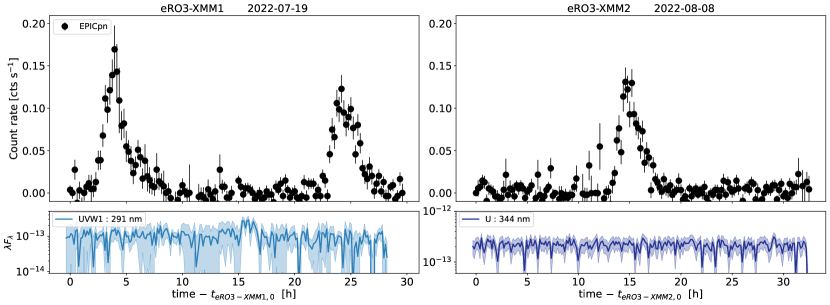
- eRO-QPE3 exhibits a decaying quiescence flux, providing strong evidence for a prior tidal disruption event preceding the onset of QPEs.
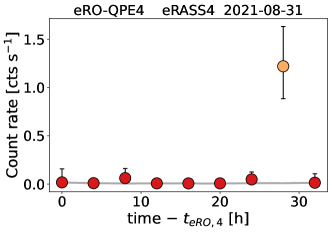
- eRO-QPE3 has the longest recurrence timescale (approximately 1.5 days) and faintest peak luminosity (L_X ~ 1.5 × 10^42 erg s⁻¹) among known QPEs, indicating no correlation between recurrence time and luminosity.
- eRO-QPE4 shows a faint, harder X-ray component during eruptions, distinct from the soft thermal spectrum, suggesting a non-thermal or distinct emission mechanism.
- The quiescent accretion disk in eRO-QPE4 significantly brightens after QPE activity is detected, supporting a transient origin of the accretion flow rather than a persistent AGN.
- The recurrence pattern of eRO-QPE4 appears intermediate between regular and irregular, suggesting a continuum of variability rather than a strict dichotomy in QPE behavior.
- The discovery of two new QPE sources increases the sample size and strengthens the case that QPEs are linked to extreme mass-ratio inspirals, consistent with current theoretical models.
Read this paper
Open the full text in the Nubint reader and ask about any passage as you read.
Read this paper on NubintThis review was generated by AI from the original paper. Please check the paper before citing it.