
[Paper Review] The Positive Mass Theorem with Arbitrary Ends
This paper establishes a generalized Riemannian positive mass theorem for 3–7 dimensional manifolds with one asymptotically flat end and arbitrary, possibly incomplete or negatively curved other ends. By constructing a weighted $μ$-bubble functional to constrain minimal hypersurfaces away from problematic ends, the authors prove the mass of the asymptotically flat end is nonnegative, confirming a long-standing conjecture by Schoen and Yau under nonnegative scalar curvature.
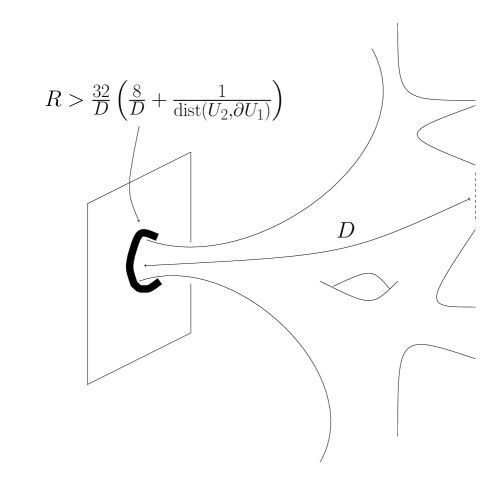
We prove a Riemannian positive mass theorem for manifolds with a single asymptotically flat end, but otherwise arbitrary other ends, which can be incomplete and contain negative scalar curvature. The incompleteness and negativity is compensated for by large positive scalar curvature on an annulus, in a quantitative fashion. In the complete noncompact case with nonnegative scalar curvature, we have no extra assumption and hence prove a long-standing conjecture of Schoen and Yau.
Motivation & Objective
- To resolve a long-standing conjecture by Schoen and Yau on the nonnegativity of mass in manifolds with one asymptotically flat end and arbitrary other ends.
- To overcome the failure of standard methods—such as density theorems, spinor techniques, and Lohkamp-type compactifications—due to lack of control over geometry in arbitrary non-compact ends.
- To develop a new geometric-analytic framework using Gromov's $μ$-bubble functional to prevent minimal hypersurfaces from escaping into problematic ends.
- To establish a quantitative version of the positive mass theorem that accounts for incomplete geometry and negative scalar curvature in non-asymptotically flat regions.
- To prove the mass of the asymptotically flat end is nonnegative even when other ends are incomplete or contain negative scalar curvature, provided a large positive scalar curvature barrier is present on an annulus.
Proposed method
- Construct a weighted $μ$-bubble functional that penalizes solutions from entering regions with incomplete geometry or negative scalar curvature.
- Use the functional to define a minimization problem over Caccioppoli sets, ensuring stable $μ$-bubbles with prescribed mean curvature $h$.
- Introduce a weight function $h$ that tends to $+\infty$ at finite distance from the asymptotically flat end, creating a barrier effect.
- Apply a monotonicity formula and curvature estimates in homogeneously regular manifolds to control the second fundamental form of minimal hypersurfaces.
- Use rescaling arguments and varifold convergence to derive a contradiction from blow-up of second fundamental form, proving the hypersurface must be flat in the limit.
- Leverage Schauder theory and $C^{2,\alpha}_{\mathrm{loc}}$ convergence of rescaled hypersurfaces to show the limit is a smooth minimal hypersurface in $\mathbb{R}^n$, leading to a contradiction if curvature is too large.
Experimental results
Research questions
- RQ1Can the positive mass theorem be extended to manifolds with one asymptotically flat end and arbitrary, possibly incomplete or negatively curved other ends?
- RQ2Is it possible to construct a geometric functional that prevents minimal hypersurfaces from exploring non-asymptotically flat ends while preserving the mass estimate?
- RQ3Does the nonnegativity of mass in asymptotically flat ends hold under only nonnegative scalar curvature, without requiring global asymptotic control?
- RQ4Can a quantitative version of the positive mass theorem be established when other ends contain negative scalar curvature, provided a positive curvature barrier is present?
- RQ5What is the role of the $μ$-bubble functional in overcoming the failure of classical methods like density theorems and spinor techniques in this setting?
Key findings
- The mass of the asymptotically flat end in a complete, non-compact $n$-dimensional manifold with $3\leq n\leq 7$ and nonnegative scalar curvature is nonnegative, confirming the Schoen–Yau conjecture.
- The theorem holds even when other ends are incomplete or contain negative scalar curvature, provided a large positive scalar curvature barrier is present on an annular region.
- The $μ$-bubble functional successfully prevents minimal hypersurfaces from escaping into problematic ends, enabling a new proof strategy based on minimizing the functional.
- A contradiction is derived by rescaling a sequence of hypersurfaces with blow-up second fundamental form, showing the limit must be a flat hyperplane, contradicting $|A(0)|=1$.
- The curvature estimates in homogeneously regular manifolds allow control of the second fundamental form via monotonicity and varifold convergence, ensuring the limit is smooth and minimal.
- The proof establishes a quantitative version of the positive mass theorem (Theorem 1.6), where the mass is bounded below by a term depending on the size of the positive scalar curvature barrier.

Read this paper
Open the full text in the Nubint reader and ask about any passage as you read.
Read this paper on NubintThis review was generated by AI from the original paper. Please check the paper before citing it.