
[Paper Review] The reionising bubble size distribution around galaxies
This study uses large-scale (1.6 Gpc³) cosmological simulations to model the size distribution of ionised bubbles around high-redshift galaxies and overdensities during cosmic reionisation. It finds that UV-bright galaxies and strong overdensities are far more likely to reside in large ionised bubbles (>1 proper Mpc), with high probabilities at z ≈ 7–8, but low probabilities at z ≈ 8.7, suggesting Lyα detections at z > 8 may require lower IGM neutral fractions, brighter sources, or enhanced intrinsic Lyα emission.
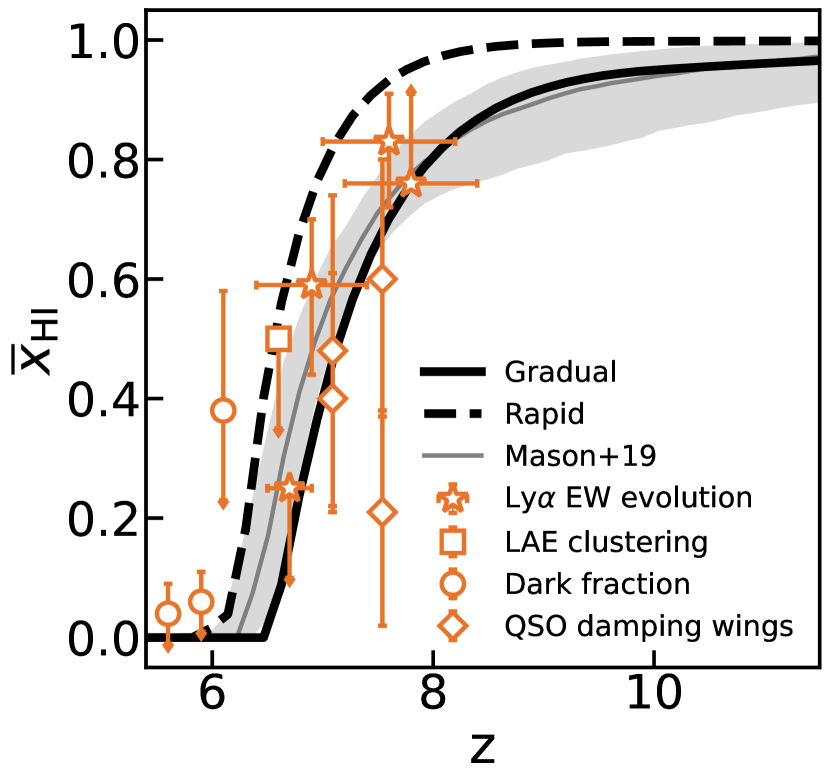
Constraining when and how reionisation began is pivotal for understanding when the first galaxies formed. Lyman-alpha (Ly$α$) emission from galaxies is currently our most promising probe of these early stages. At z>7 the majority of galaxies detected with Ly$α$ are in candidate overdensities. Here we quantify the probability of these galaxies residing in large ionised bubbles. We create (1.6 Gpc)$^3$ reionising intergalactic medium (IGM) simulations, providing sufficient volume to robustly measure bubble size distributions around UV-bright galaxies and rare overdensities. We find $M_{ m UV} \lesssim -16$ galaxies and overdensities are $\gtrsim$10-1000x more likely to trace ionised bubbles compared to randomly selected positions. The brightest galaxies and strongest overdensities have bubble size distributions with highest characteristic size and least scatter. We compare two models: gradual reionisation driven by numerous UV-faint galaxies versus more rapid reionisation by rarer brighter galaxies, producing larger bubbles at fixed neutral fraction. We demonstrate that recently observed z~7 overdensities are highly likely to trace large ionised bubbles, corroborated by their high Ly$α$ detection rates. However, the z~8.7 association of Ly$α$ emitters in EGS and GN-z11, with Ly$α$ at z=10.6, are unlikely to trace large bubbles in our fiducial model -- 11% and 7% probability of >1 proper Mpc bubbles, respectively. Ly$α$ detections at such high redshifts could be explained by: a less neutral IGM than previously expected; larger ionised regions at fixed neutral fraction; or if intrinsic Ly$α$ flux is unusually strong in these galaxies. We discuss how to test these scenarios with JWST and the prospects for using upcoming wide-area surveys to distinguish between reionisation models.
Motivation & Objective
- To quantify the likelihood of high-redshift galaxies and overdensities residing in large ionised bubbles during cosmic reionisation.
- To distinguish between reionisation models driven by numerous faint galaxies versus rare bright galaxies using bubble size distributions.
- To interpret recent high-redshift Lyα detections (e.g., at z ≈ 7–8 and z ≈ 10.6) in terms of ionised bubble size and IGM neutral fraction.
- To forecast detectability of ionised bubbles in upcoming JWST and Euclid surveys, assessing their power to constrain reionisation models.
Proposed method
- Performs (1.6 Gpc)³ cosmological simulations of the intergalactic medium (IGM) during reionisation, including radiative transfer and source feedback.
- Tracks ionised bubble sizes around UV-bright galaxies and galaxy overdensities across different redshifts and IGM neutral fractions.
- Compares two reionisation models: gradual reionisation by faint galaxies (low escape fraction) and rapid reionisation by bright galaxies (high escape fraction).
- Uses bubble size distributions to compute the probability of hosting a bubble >1 proper Mpc at fixed neutral fraction and source luminosity.
- Forecasts bubble number densities in upcoming surveys (JWST COSMOS-Web, Euclid Deep, Roman Wide) based on fiducial model predictions.
- Analyzes the impact of cosmic variance and survey volume on detecting large ionised regions.

Experimental results
Research questions
- RQ1What is the probability that UV-bright galaxies and overdensities at z ≈ 7–8 reside in large ionised bubbles (>1 proper Mpc)?
- RQ2How do bubble size distributions differ between reionisation models driven by faint galaxies versus bright galaxies?
- RQ3Why are Lyα detections observed at z ≈ 8.7 (e.g., EGS and GN-z11) unlikely to be in large ionised bubbles under the fiducial model?
- RQ4What conditions (e.g., lower neutral fraction, higher intrinsic Lyα emission, or brighter sources) could explain high-redshift Lyα detections?
- RQ5Can upcoming wide-area surveys like Euclid and Roman detect the size distribution of ionised bubbles and constrain reionisation models?
Key findings
- Galaxies with M_UV < -16 and overdensities are 10–1000× more likely to reside in large ionised bubbles than random positions.
- The characteristic bubble size increases and scatter decreases with higher UV luminosity and overdensity, indicating stronger bias toward large regions.
- At z ≈ 7–8, overdensities have a >40–93% probability of hosting a bubble >1 proper Mpc, consistent with high Lyα detection rates.
- At z ≈ 8.7, the probability of large bubbles (>1 proper Mpc) is only ~11% for EGS and ~7% for GN-z11, indicating these detections likely require non-standard conditions.
- High-redshift Lyα detections may require a lower IGM neutral fraction (x_HI < 0.8), larger bubbles at fixed x_HI, or unusually strong intrinsic Lyα emission.
- The JWST COSMOS-Web survey is unlikely to detect bubbles >10 cMpc unless x_HI < 0.9, but Euclid and Roman surveys will have sufficient volume to measure bubble size distributions with low cosmic variance.
Read this paper
Open the full text in the Nubint reader and ask about any passage as you read.
Read this paper on NubintThis review was generated by AI from the original paper. Please check the paper before citing it.