
[Paper Review] The Rise of Faint, Red AGN at $z>4$: A Sample of Little Red Dots in the JWST Extragalactic Legacy Fields
The paper presents a large JWST-based sample of 341 faint, red AGN candidates (Little Red Dots, LRDs) across z~2–11, detailing their continuum slopes, compact morphologies, and obscured AGN nature. It analyzes redshift distribution, number densities, X-ray and NIRSpec confirmations, and compares to prior LRD samples.
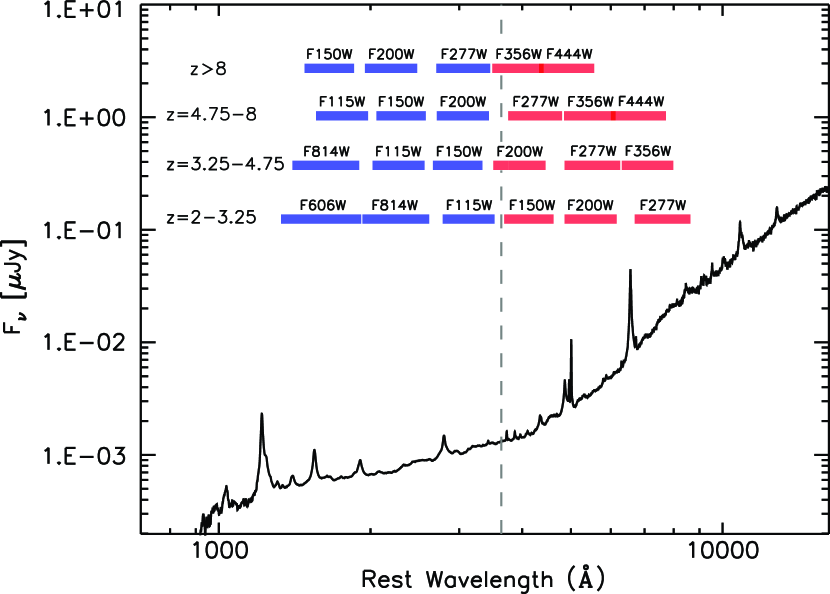
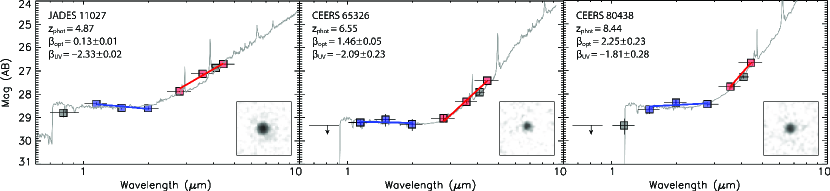
We present a sample of 341 "little red dots" (LRDs) spanning the redshift range $z\sim2-11$ using data from the CEERS, PRIMER, JADES, UNCOVER and NGDEEP surveys. Unlike past use of color indices to identify LRDs, we employ continuum slope fitting using shifting bandpasses to sample the same rest-frame emission blueward and redward of the Balmer break. This enables the detection of LRDs over a wider redshift range and with less contamination from galaxies with strong breaks that otherwise lack a rising red continuum. The redshift distribution of our sample increases at $z<8$ and then undergoes a rapid decline at $z\sim4.5$, which may tie the emergence of these sources to the inside-out growth that galaxies experience during this epoch. We find that LRDs are $\sim1$ dex more numerous than X-ray and UV selected AGN at z~5-7. Within our sample, we have identified the first two X-ray detected LRDs. An X-ray spectral analysis confirms that these AGN are moderately obscured with $\log\,(N_{ m H}/{ m cm}^{2}$) of $23.3^{+0.4}_{-1.3}$ and $22.72^{+0.13}_{-0.16}$. Our analysis reveals that reddened AGN emission dominates their rest-optical light, while the rest-UV originates from their host galaxies. We also present NIRSpec observations from the RUBIES survey of 17 LRDs that show broad emission lines consistent with AGN activity. The confirmed AGN fraction of our sample is 71\% for sources with F444W<26.5. In addition, we find three LRDs with blue-shifted Balmer absorption features in their spectra, suggesting an outflow of high-density, low-ionization gas from near the central engine of these faint, red AGN.
Motivation & Objective
- Identify a wide, photometrically selected population of compact, red-optical/blue-UV sources as potential heavily reddened AGN at high redshift.
- Quantify redshift distribution, space densities, and comparison to bright quasars and other AGN selections in JWST deep fields.
- Characterize confirmed AGN nature via X-ray detections and NIRSpec spectroscopy to understand obscuration and host-galaxy contribution.
- Assess how LRD incidence relates to galaxy growth and AGN fueling during early cosmic epochs.
Proposed method
- Compute rest-frame UV and optical continuum slopes (β_UV and β_opt) by fitting photometry across bands blueward and redward of the Balmer break using shifting bandpasses (Equation m_i relation).
- Apply SNR>12 in F444W, a positive β_opt, and β_UV between -2.8 and -0.37 to select red-optical/blue-UV compact sources.
- Impose a compact morphology cut with half-light radius r_h < 1.5 × r_{h,stars} to remove extended contaminants.
- Exclude potential brown dwarfs with β_UV < -2.8 and remove sources whose β_opt may be boosted by strong line emission using β_F277W-F356W and β_F277W-F410M cuts.
- Perform SED fitting with galaxy+AGN components using a χ^2-minimization and hybrid models (galaxy + reddened AGN) for visualization (not used in sample selection).
- Validate redshifts with EAZY photometric redshifts and NIRSpec RUBIES spectroscopy for a subset (GO-4233) to identify broad emission lines and obscured AGN signatures.
Experimental results
Research questions
- RQ1What is the incidence and redshift distribution of faint, red AGN (LRDs) in JWST deep fields up to z~11?
- RQ2How do LRDs compare in number density to bright quasars and to X-ray/UV-selected AGN at high redshift?
- RQ3Are LRDs predominantly obscured AGN, and what are their contributions to rest-frame optical/UV light and host-galaxy emission?
- RQ4What spectral features (broad lines, absorption outflows) reveal AGN activity and feedback in LRDs?
- RQ5How do the LRD demographics inform models of early black hole growth and galaxy coevolution?
Key findings
- A sample of 341 LRDs is identified across PRIMER-UDS, PRIMER-COSMOS, CEERS, JADES, UNCOVER, and NGDEEP with redshift z~2–11.
- LRDs are 2–3 dex more numerous than bright quasars at z~5–7, but their number density is only 0.6–1 dex higher than X-ray and UV-selected AGN at these redshifts.
- First X-ray detections of LRDs are found at z=3.1 and z=4.66, with moderate obscuration: log(N_H/cm^2) = 23.3^{+0.4}_{-1.3} and 22.72^{+0.13}_{-0.16}.
- X-ray spectral analysis shows reddened AGN emission dominates rest-optical light, while rest-UV is largely host-galaxy emission.
- NIRSpec RUBIES observations of 17 LRDs reveal broad emission lines consistent with AGN activity.
- The confirmed AGN fraction is 71% for sources with F444W < 26.5 mag; three LRDs show narrow blue-shifted Balmer absorption indicating outflows.
Read this paper
Open the full text in the Nubint reader and ask about any passage as you read.
Read this paper on NubintThis review was generated by AI from the original paper. Please check the paper before citing it.