
[Paper Review] The role of turbulence and winding in the development of large-scale, strong magnetic fields in long-lived remnants of binary neutron star mergers
This study uses high-resolution large-eddy simulations (LES) with a gradient subgrid-scale model to investigate magnetic field evolution in long-lived binary neutron star merger remnants. It finds that toroidal fields grow linearly after ~30 ms due to magnetic winding, while poloidal fields only begin growing at small scales after ~90 ms, indicating that large-scale poloidal fields or jets do not form within the simulated timescale, and initial strong dipolar fields are inconsistent with realistic post-merger topology.
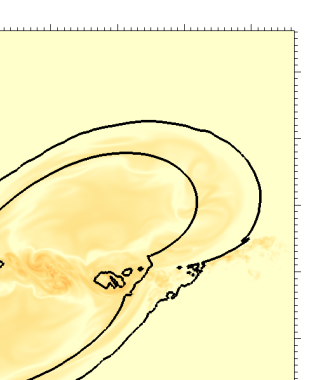
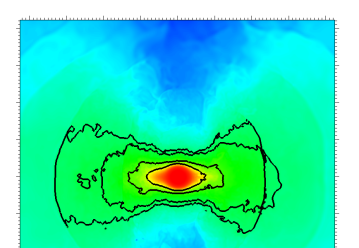
We perform a long and accurate Large-Eddy Simulation of a binary neutron star merger, following the newly formed remnant up to 110 milliseconds. The combination of high-order schemes, high-resolution and the gradient subgrid-scale model allow us to have among the highest effective resolutions ever achieved. Our results show that, although the magnetic fields are strongly amplified by the Kelvin-Helmholtz instability, they are coherent only over very short spatial scales until t \gtrsim 30 ms. Around that time, magnetic winding becomes more efficient leading to a linear growth of the toroidal component and slowly ordering the field to more axisymmetric, large scales. The poloidal component only starts to grow at small scales at much later times t \gtrsim 90 ms, in a way compatible with the magneto-rotational instability. No strong large-scale poloidal field or jet is produced in the timescales spanned by our simulation, although there is an helicoidal structure gradually developing at late times. We highlight that soon after the merger the topology is always strongly dominated by toroidal structures, with a complex distribution in the meridional plane and highly turbulent perturbations. Thus, starting with strong purely dipolar fields before the merger is largely inconsistent with the outcomes of a realistic evolution. Finally, we confirm the universality of the evolved topology, even when starting with very different magnetic fields confined to the outermost layers of each neutron star.
Motivation & Objective
- To investigate the development of large-scale, strong magnetic fields in long-lived remnants of binary neutron star mergers.
- To assess the role of turbulence and magnetic winding in shaping the magnetic field topology post-merger.
- To evaluate whether initial strong, large-scale poloidal magnetic fields are physically consistent with realistic merger dynamics.
- To test the robustness of magnetic field evolution under different initial field configurations and numerical resolutions.
- To determine if high-resolution LES with gradient SGS modeling can capture key MHD instabilities and field evolution despite unresolved small-scale turbulence.
Proposed method
- Performing long, accurate large-eddy simulations (LES) of a binary neutron star merger up to 110 ms.
- Using high-order numerical schemes and a gradient subgrid-scale (SGS) model to enhance effective resolution and capture unresolved MHD dynamics.
- Simulating the merger with a realistic equation of state and including magnetic fields from initial configurations confined to outer layers or distributed throughout the stars.
- Tracking the evolution of poloidal and toroidal magnetic field components, focusing on coherence, growth rates, and topology.
- Analyzing the interplay between Kelvin-Helmholtz instability (KHI), magnetic winding, and magneto-rotational instability (MRI).
- Comparing results across different initial magnetic field configurations and numerical resolutions to assess convergence and robustness.
Experimental results
Research questions
- RQ1How do turbulence and magnetic winding influence the growth and coherence of large-scale magnetic fields in long-lived binary neutron star merger remnants?
- RQ2To what extent does the initial magnetic field configuration (e.g., dipolar vs. surface-confined) affect the final field topology and evolution?
- RQ3Can the gradient SGS model in LES accurately capture the essential dynamics of unresolved MHD instabilities like KHI and MRI?
- RQ4Why do simulations with strong initial poloidal fields fail to reproduce the observed toroidal dominance in realistic merger remnants?
- RQ5At what timescale do large-scale poloidal fields begin to grow, and is this compatible with jet formation mechanisms?
Key findings
- Magnetic fields are strongly amplified by the Kelvin-Helmholtz instability, but coherence is limited to scales of a few kilometers until t ≳ 30 ms.
- Magnetic winding becomes dominant after ~30 ms, driving a linear-in-time growth of the toroidal magnetic field component and promoting axisymmetric, large-scale ordering.
- The poloidal magnetic field component remains largely constant in intensity until t ≳ 90 ms, when it begins to grow at small scales, consistent with the magneto-rotational instability (MRI).
- No strong large-scale poloidal field or relativistic jet forms within the 110 ms simulation timescale, though a helicoidal structure gradually develops.
- Initial purely dipolar magnetic fields are inconsistent with the post-merger topology, which is dominated by turbulent, toroidal structures regardless of initial configuration.
- The magnetic field amplification and evolution are robust across different initial field distributions—whether confined to outer layers or spread throughout the stars—indicating universal topology evolution.
Read this paper
Open the full text in the Nubint reader and ask about any passage as you read.
Read this paper on NubintThis review was generated by AI from the original paper. Please check the paper before citing it.