
[Paper Review] Gravitational Waves from SMBH Binaries in Light of the NANOGrav 15-Year Data
The paper fits the NANOGrav 15-year data with a model in which SMBH binaries lose energy not only by gravitational waves but also via environmental effects (gas, stars, dark matter), finding a better fit than GW-only evolution and indicating a high SMBH merger efficiency.
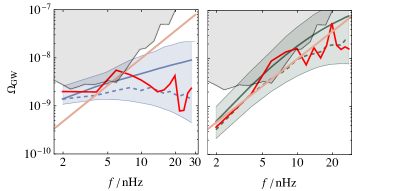
The NANOGrav Collaboration has recently announced evidence for nHz gravitational waves (GWs), in the form of a Hellings-Downs angular correlation in the common-spectrum process that had been observed previously by them and other Pulsar Timing Arrays (PTAs). We analyze the possibility that these GWs originate from binary supermassive black holes (SMBHs) with total masses $\gtrsim 10^9\, M_{\odot}$. The spectral index of the GW signal differs at 95 % CL from that predicted for binary evolution by GW emission alone, and we find $> 3 σ$ evidence that environmental effects such as dynamical friction with gas, stars, and dark matter may be affecting the binary evolution. We estimate the required magnitude and spectrum of such environmental effects and comment on their possible implications for measurements of GWs at higher frequencies.
Motivation & Objective
- Motivate the interpretation of the NG15 nanohertz GW signal as arising from SMBH binaries within galactic environments.
- Extend previous SMBH binary population modeling by incorporating scatter in the SMBH–halo mass relation and environmental energy loss.
- Quantify how environmental effects alter the GW spectrum and assess their impact on PTA observations and higher-frequency GW prospects.
Proposed method
- Use Extended Press-Schechter formalism to estimate SMBH binary formation and merger rates.
- Model the SMBH mass function with a log-normal occupancy distribution p_occ(m|M,z) and a constant merger efficiency p_BH.
- Incorporate environmental energy loss with a power-law dependence f_GW( M, η, z ) = f_ref (M/10^9 M_sun)^{-β}, fix β=0.4, and parameterize t_env/t_GW via α and f_ref.
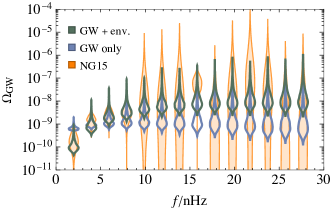
- Compute the GW energy density spectrum Omega_GW(f) from the merger population and its evolution including environmental effects, and generate full likelihoods using the frequency-bin distributions P_data(Omega|f_i).
- Perform Monte-Carlo-style realizations of the strongest sources and model the rest as a narrow Gaussian, capturing long-tailed fluctuations in Omega_GW(f).
- Compare GW-only vs GW+environment fits via a likelihood ratio ell_max and report posterior constraints on (p_BH, α, f_ref).
Experimental results
Research questions
- RQ1Does including environmental energy loss improve the fit of SMBH binary GW backgrounds to NG15 data compared to GW-only evolution?
- RQ2What are the inferred values and correlations of the SMBH merger efficiency p_BH, environmental parameters f_ref and α, and how do they affect the predicted GW spectrum?
- RQ3How do environmental effects influence the low-frequency dip and the overall spectral shape of Omega_GW(f) in PTA data?
- RQ4What are the implications for observing lower-mass BH mergers with LISA, AEDGE, or atom interferometers in higher-frequency GW bands?
Key findings
- The GW-only model has p_BH = 0.07_{-0.07}^{+0.05} at 68% CL, while environmental effects prefer larger p_BH values.
- Best-fit parameters with environmental effects: p_BH = 0.84, α = 2.0, f_ref ≈ 34 nHz.
- The environmental model yields a likelihood improvement corresponding to Δχ^2 ≈ 11 over the GW-only model, favoring the environmental model at about 2σ in a Gaussian approximation.
- The analysis shows the mean Omega_GW and its fluctuations are better captured with environmental energy loss, including a dip at f = 2 nHz that GW-only models struggle to reproduce.
- The framework predicts a potentially observable rate of lower-mass BH mergers for higher-frequency GW detectors and discusses implications for LISA and quantum/atom-interferometer based detectors.
Read this paper
Open the full text in the Nubint reader and ask about any passage as you read.
Read this paper on NubintThis review was generated by AI from the original paper. Please check the paper before citing it.