
[Paper Review] The SOPHIE search for northern extrasolar planets IX. Populating the brown dwarf desert
This study presents radial velocity measurements from the SOPHIE spectrograph at Haute-Provence Observatory to characterize 15 companions around solar-type stars, with nine confirmed as brown dwarfs or massive planets (13–70 M_Jup), significantly populating the 'brown dwarf desert'—the observed deficit of brown dwarfs within ~5 AU of Sun-like stars. The work improves orbital parameters and constrains true masses using Hipparcos astrometry, offering critical data for understanding formation mechanisms in the planet–brown dwarf transition regime.
Radial velocity planet search surveys of nearby Solar-type stars have shown a strong deficit of brown dwarf companions within $\sim5\,\mathrm{AU}$. There is presently no comprehensive explanation of this lack of brown dwarf companions, therefore, increasing the sample of such objects is crucial to understand their formation and evolution. Based on precise radial velocities obtained using the SOPHIE spectrograph at Observatoire de Haute-Provence we characterise the orbital parameters of $15$ companions to solar-type stars and constrain their true mass using astrometric data from the Hipparcos space mission. The nine companions not shown to be stellar in nature have minimum masses ranging from ~$13$ to $70\,\mathrm{M}_{\mathrm{Jup}}$, and are well distributed across the planet/brown dwarf mass regime, making them an important contribution to the known population of massive companions around solar-type stars. We characterise six companions as stellar in nature with masses ranging from a minimum mass of $76 \pm 4\,\mathrm{M}_{\mathrm{Jup}}$ to a mass of $0.35 \pm 0.03\,\mathrm{M_\odot}$. The orbital parameters of two previously known sub-stellar candidates are improved.
Motivation & Objective
- To address the observational deficit of brown dwarf companions within ~5 AU of solar-type stars, known as the 'brown dwarf desert'.
- To improve orbital parameters and determine true masses of 15 companions detected via radial velocity surveys.
- To constrain the nature of sub-stellar companions (planets vs. brown dwarfs) using radial velocity data and astrometric constraints from Hipparcos.
- To contribute to the debate on formation mechanisms by distinguishing between core accretion and gravitational collapse scenarios through mass and orbital characteristics.
Proposed method
- Radial velocity measurements were obtained using the SOPHIE spectrograph on the 1.93-m telescope at Observatoire de Haute-Provence.
- Orbital parameters were derived by fitting Keplerian orbits to radial velocity time series data.
- True masses of companions were constrained by combining radial velocity data with astrometric measurements from the Hipparcos space mission.
- Stellar and sub-stellar nature of companions was assessed using minimum mass estimates and comparison with evolutionary models.
- Spectral types and effective temperatures were used to classify host stars and inform mass-radius relationships.
- The deuterium burning limit (13 M_Jup) was used as a reference for sub-stellar mass classification, though formation mechanism was not directly inferred.
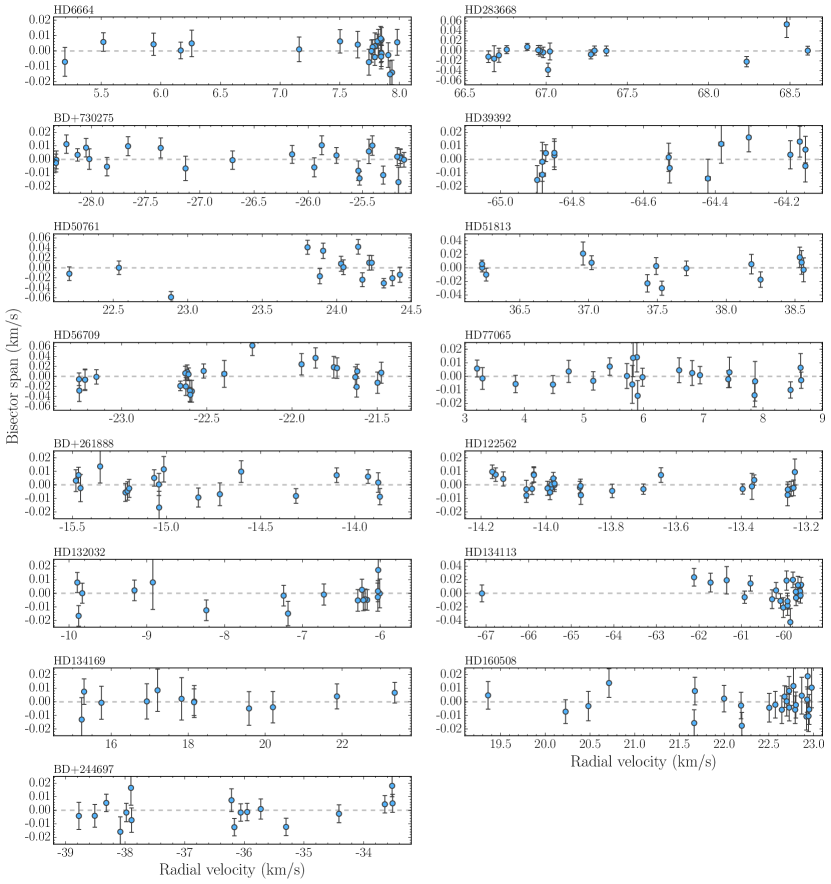
Experimental results
Research questions
- RQ1What is the distribution of true masses and orbital parameters for massive companions (13–70 M_Jup) around solar-type stars in the inner 5 AU?
- RQ2How do astrometric constraints from Hipparcos improve the mass determination of radial velocity detected companions?
- RQ3To what extent do the observed companions populate the 'brown dwarf desert' in the 13–70 M_Jup mass range?
- RQ4What fraction of the companions are consistent with being brown dwarfs versus low-mass stars based on mass and orbital characteristics?
- RQ5How do the orbital parameters of previously known sub-stellar candidates improve with new radial velocity data?
Key findings
- Nine companions were confirmed as sub-stellar objects with minimum masses ranging from 13 to 70 M_Jup, well distributed across the planet–brown dwarf mass regime.
- Six companions were classified as stellar in nature, with masses ranging from 76 ± 4 M_Jup to 0.35 ± 0.03 M_sun.
- The orbital parameters of two previously known sub-stellar candidates were significantly improved with new radial velocity data.
- True masses were constrained using a combination of radial velocity and Hipparcos astrometric data, reducing uncertainties in mass estimates.
- The sample contributes substantially to populating the 'brown dwarf desert', providing critical data for testing formation theories.
- The study confirms that the brown dwarf desert remains a significant feature in the orbital parameter space, with no strong evidence of a population of brown dwarfs in the 1–5 AU range.
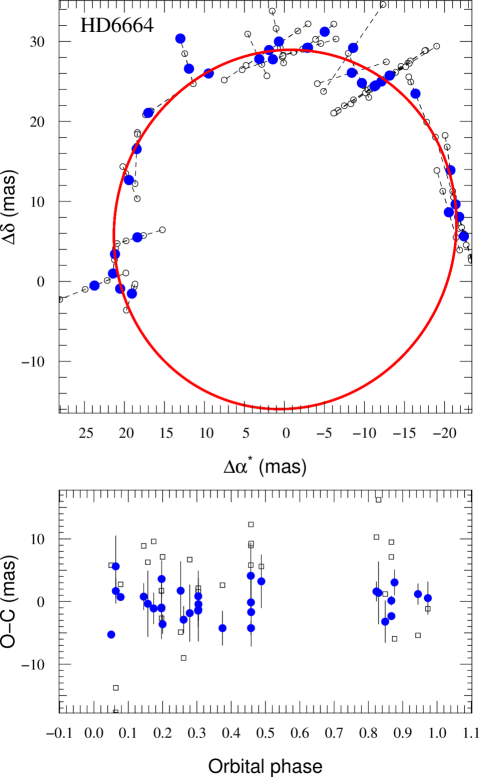
Read this paper
Open the full text in the Nubint reader and ask about any passage as you read.
Read this paper on NubintThis review was generated by AI from the original paper. Please check the paper before citing it.