
[Paper Review] The Star-Forming Main Sequence in JADES and CEERS at $z>1.4$: Investigating the Burstiness of Star Formation
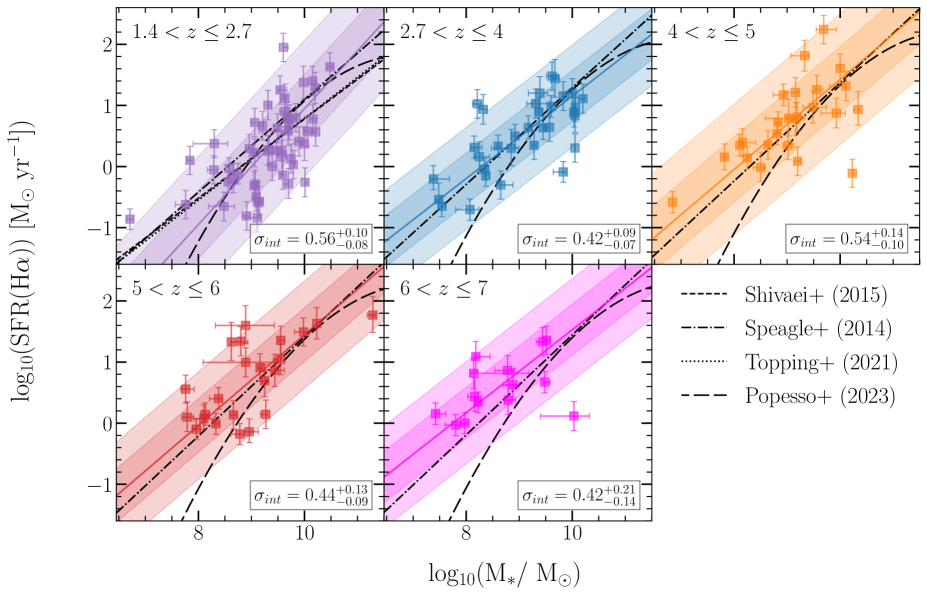
This study uses JWST/NIRSpec and NIRCam data from the CEERS and JADES surveys to analyze the star-forming main sequence (SFMS) at $z>1.4$, comparing SFRs from H$\alpha$, UV, and SED-fitting methods. It finds a $0.21 \pm 0.05$ dex larger intrinsic scatter in the H$\alpha$-based SFMS than in the UV-based SFMS, providing strong evidence for bursty star formation histories in early galaxies.
We have used public JWST/NIRSpec and JWST/NIRCam observations from the CEERS and JADES surveys in order to analyze the star-forming main sequence (SFMS) over the redshift range $1.4 \leq z < 7$. We calculate the star-formation rates (SFRs) of the galaxy sample using three approaches: Balmer line luminosity, spectral energy distribution (SED) fitting, and UV luminosity. We find a larger degree of scatter about the SFMS using the Balmer-based SFRs compared to the UV-based SFRs. Because these SFR indicators are sensitive to star formation on different time scales, the difference in scatter may be evidence of bursty star-formation histories in the early universe. We additionally compare the H$α$-to-UV luminosity ratio (L(H$α$)/$ν$L$_{ν,1600}$) for individual galaxies in the sample and find that 29\%$-$52\% of the ratios across the sample are poorly described by predictions from a smooth star-formation history. Measuring the burstiness of star formation in the early universe has multiple significant implications, such as deriving accurate physical parameters from SED fitting, explaining the evolution of the UV luminosity function, and providing constraints for sub-grid models of feedback in simulations of galaxy formation and evolution.
Motivation & Objective
- To investigate the burstiness of star formation in high-redshift galaxies ($z>1.4$) using multiple SFR indicators.
- To assess how different SFR indicators—H$\alpha$, UV, and SED-fitting—compare in measuring the star-forming main sequence (SFMS).
- To determine whether the intrinsic scatter in the SFMS varies with stellar mass and to test for mass-dependent burstiness.
- To evaluate the implications of bursty SFHs for SED fitting, UV luminosity function evolution, and feedback modeling in galaxy formation simulations.
Proposed method
- Utilized public JWST/NIRSpec and NIRCam observations from the CEERS and JADES surveys to obtain spectroscopic redshifts and emission-line fluxes for $z>1.4$ galaxies.
- Calculated star-formation rates (SFRs) using three independent methods: H$\alpha$ luminosity (sensitive to ~5 Myr timescale), UV luminosity (sensitive to ~100 Myr timescale), and SED fitting (integrated over longer timescales).
- Measured the intrinsic scatter of the SFMS for each SFR indicator to quantify burstiness, with the H$\alpha$-based scatter expected to be larger if star formation is stochastic.
- Computed the H$\alpha$-to-UV luminosity ratio (L(H$\alpha$)/$\nu$ L$_{\nu,1600}$) for individual galaxies and compared it to predictions from constant SFR models over 100 Myr.
- Applied statistical methods including error propagation and scatter decomposition to isolate intrinsic scatter from measurement noise.
- Assessed potential systematics such as dust attenuation, IMF variations, and nebular emission incompleteness, concluding they are unlikely to significantly affect the main results.

Experimental results
Research questions
- RQ1Does the intrinsic scatter in the SFMS differ between short-timescale (H$\alpha$) and long-timescale (UV) SFR indicators at $z>1.4$?
- RQ2To what extent do the H$\alpha$-to-UV luminosity ratios of high-redshift galaxies deviate from predictions of constant star-formation histories?
- RQ3Is there a mass dependence in the intrinsic scatter of the SFMS for galaxies at $z>1.4$?
- RQ4How do bursty star formation histories affect SED-based stellar mass estimates and UV luminosity function evolution?
Key findings
- The intrinsic scatter in the H$\alpha$-based SFMS is $0.21 \pm 0.05$ dex larger than in the UV-based SFMS, indicating that short-timescale SFR indicators are more sensitive to bursty star formation.
- Approximately 29% to 52% of galaxies in the sample have H$\alpha$-to-UV luminosity ratios inconsistent with predictions from a constant SFR over 100 Myr, suggesting significant burstiness in their SFHs.
- No significant mass dependence in the intrinsic scatter of the SFMS is observed within the current sample, though a larger dynamic range in stellar mass is needed to confirm this conclusively.
- The observed scatter in the H$\alpha$-to-UV ratio further supports the presence of stochastic star formation, with deviations indicating recent or episodic star formation episodes.
- The results imply that assuming smooth or constant SFHs during SED fitting may lead to systematic biases in stellar mass estimates, with underestimates of up to 0.8 dex possible in bursty systems.
- These findings provide observational constraints for sub-grid feedback and star formation models in galaxy formation simulations, particularly for reproducing the bright-end excess in the high-redshift UV luminosity function.
Read this paper
Open the full text in the Nubint reader and ask about any passage as you read.
Read this paper on NubintThis review was generated by AI from the original paper. Please check the paper before citing it.