
[Paper Review] The Unintended Consequences of Censoring Digital Technology -- Evidence from Italy's ChatGPT Ban
This study examines Italy's sudden ban of OpenAI's ChatGPT and finds a 50% drop in coding output among Italian GitHub developers in the first two business days, followed by recovery. Using high-frequency activity data and synthetic control models on Google searches and Tor usage, it shows users rapidly bypassed the ban via VPNs and Tor bridges, with productivity losses likely due to time spent circumventing restrictions rather than direct access loss.
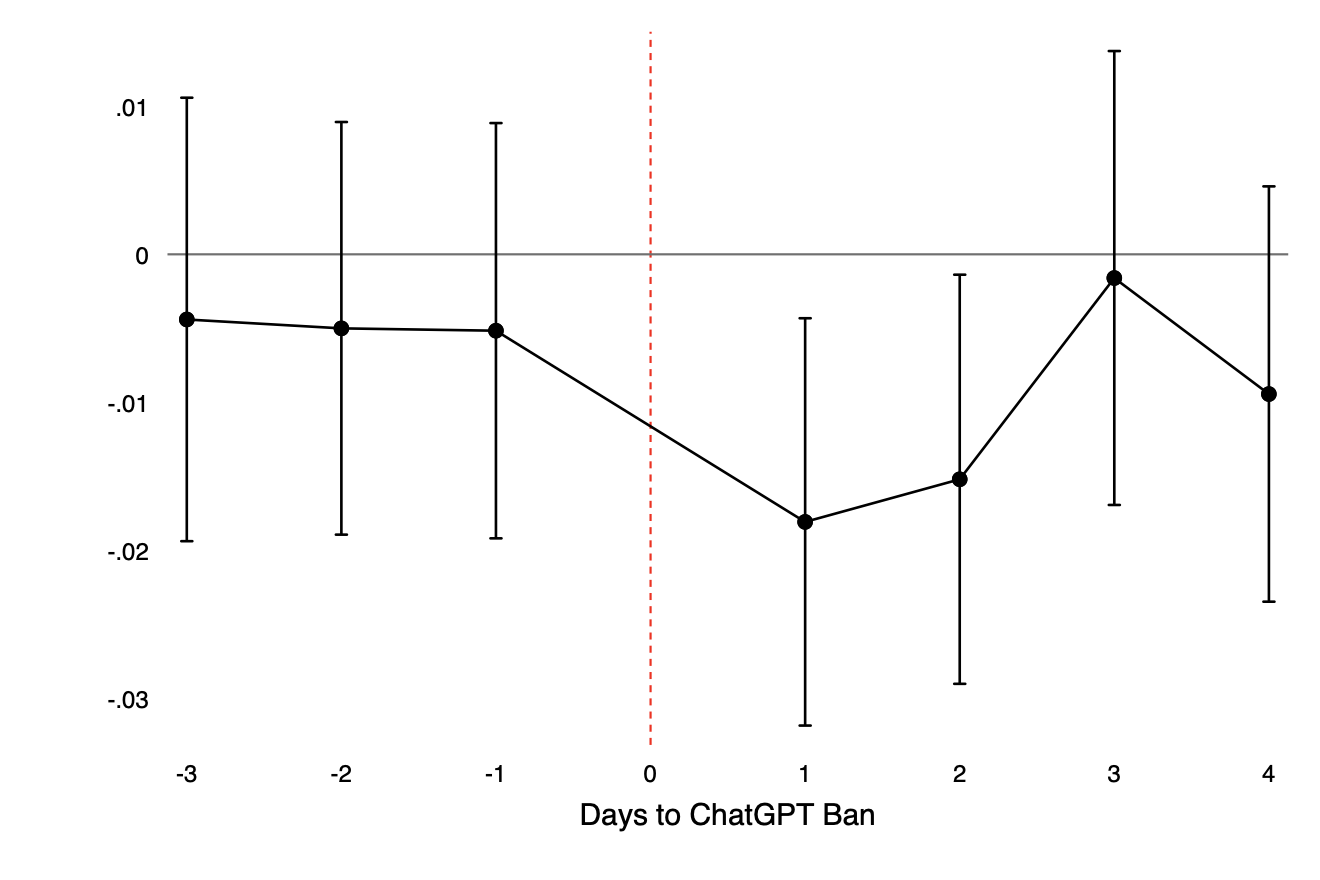
We analyse the effects of the ban of ChatGPT, a generative pre-trained transformer chatbot, on individual productivity. We first compile data on the hourly coding output of over 8,000 professional GitHub users in Italy and other European countries to analyse the impact of the ban on individual productivity. Combining the high-frequency data with the sudden announcement of the ban in a difference-in-differences framework, we find that the output of Italian developers decreased by around 50% in the first two business days after the ban and recovered after that. Applying a synthetic control approach to daily Google search and Tor usage data shows that the ban led to a significant increase in the use of censorship bypassing tools. Our findings show that users swiftly implement strategies to bypass Internet restrictions but this adaptation activity creates short-term disruptions and hampers productivity.
Motivation & Objective
- To assess the short-term impact of a government-imposed ban on a generative AI tool (ChatGPT) on individual productivity in a Western democratic country.
- To investigate whether users adapt to digital technology censorship by adopting circumvention tools such as VPNs and Tor.
- To evaluate whether the observed productivity decline is driven by adaptation behavior rather than direct loss of access to the banned technology.
- To contribute empirical evidence on the economic costs of digital technology censorship in high-skilled, knowledge-based labor markets.
- To examine the effectiveness and behavioral responses to internet restrictions in a context where such bans are relatively rare among liberal democracies.
Proposed method
- Employed a difference-in-differences (DiD) framework using high-frequency hourly coding output data from over 8,000 professional GitHub users across Italy and other European countries.
- Applied a synthetic control method with interactive fixed effects to estimate counterfactual outcomes for Italy, using data on Google search trends for 'VPN' and Tor relay/bridge usage.
- Used parametric bootstrap procedures (Xu, 2017) to ensure robust inference in settings with a small number of treated units.
- Tracked dynamic treatment effects over time to assess the temporal pattern of behavioral and productivity responses post-ban.
- Incorporated time fixed effects in the interactive fixed effects (IFE) model to control for common time trends across countries.
- Analyzed both general search behavior (Google) and anonymized network traffic (Tor) to triangulate evidence on user adaptation strategies.
Experimental results
Research questions
- RQ1What is the short-term impact of a sudden government ban on a generative AI tool like ChatGPT on individual productivity among software developers?
- RQ2How do users in a democratic country respond to digital technology censorship in terms of adopting circumvention tools such as VPNs and Tor?
- RQ3To what extent is the observed decline in productivity attributable to users' time spent bypassing the ban rather than direct loss of access to the technology?
- RQ4Does the ban lead to measurable increases in the use of censorship-resisting technologies like Tor bridges and VPNs in the days following the restriction?
- RQ5Are the economic costs of such bans—particularly in terms of temporary productivity disruption—significant and short-lived?
Key findings
- The ban of ChatGPT led to a 50% decline in hourly coding output among Italian GitHub developers in the first two business days after the announcement.
- Productivity levels returned to pre-ban levels within a week, indicating a short-lived but substantial disruption.
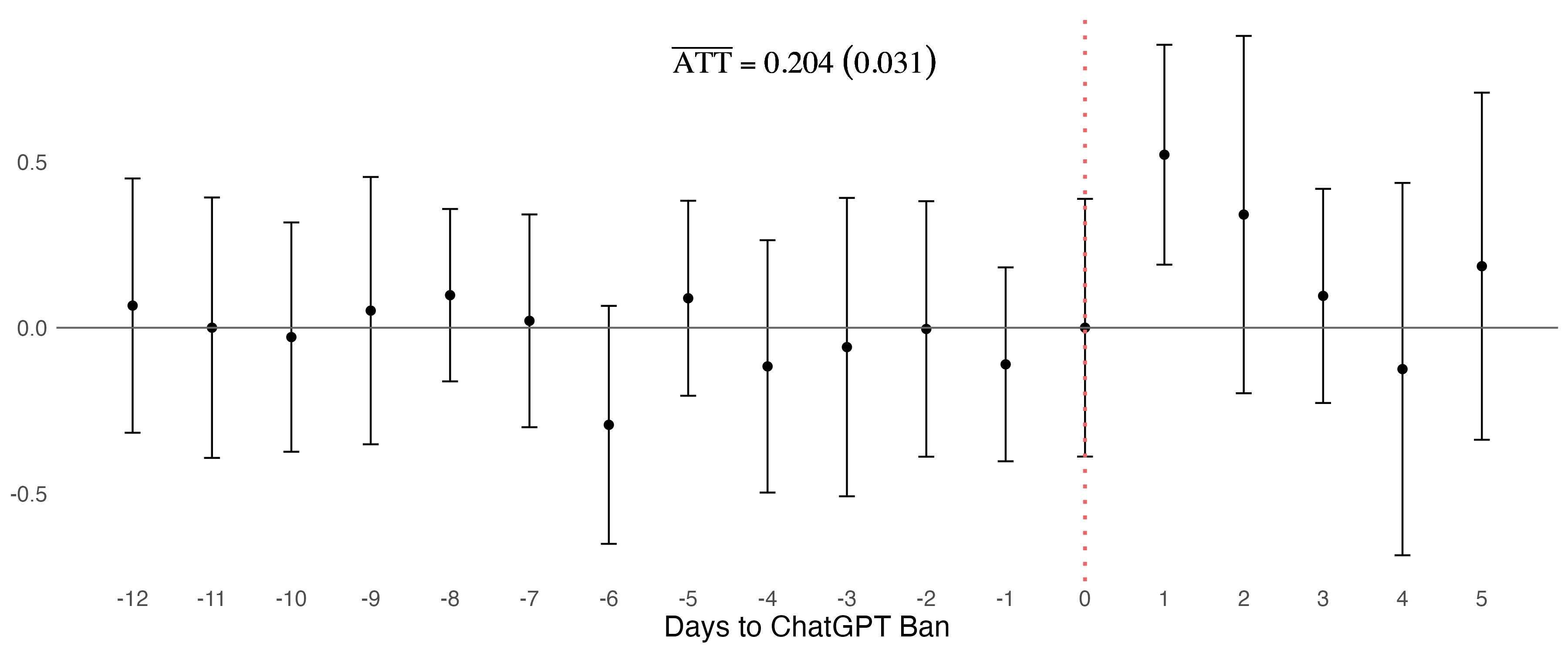
- Google search data showed a 52.2 percentage point increase in searches for 'VPN' on the first working day after the ban, with an average 20.6 percentage point increase over the workweek.
- Tor bridge usage in Italy increased by an average of 9.4 percentage points after the ban, with a statistically significant and sustained rise over the workweek.
- The use of standard Tor relays showed only a minor increase, suggesting users preferred bridges to avoid detection by firewalls.
- The results indicate that the productivity drop is likely driven by time spent searching for and implementing circumvention strategies, not by the absence of the tool itself.
Read this paper
Open the full text in the Nubint reader and ask about any passage as you read.
Read this paper on NubintThis review was generated by AI from the original paper. Please check the paper before citing it.