
[Paper Review] The vertical structure of T Tauri accretion disks II. Physical conditions in the disk
This paper presents a self-consistent analytical model for computing physical conditions in T Tauri accretion disks using a thin disk approximation with vertical radiative transfer treated as plane-parallel. It derives analytical formulae for temperature, pressure, and density by incorporating multiple heating sources—viscous dissipation and stellar irradiation—enabling accurate spectral energy distributions and interferometric observables, with key results showing flatter SEDs due to disk flaring and improved physical constraints on inner disk structure.
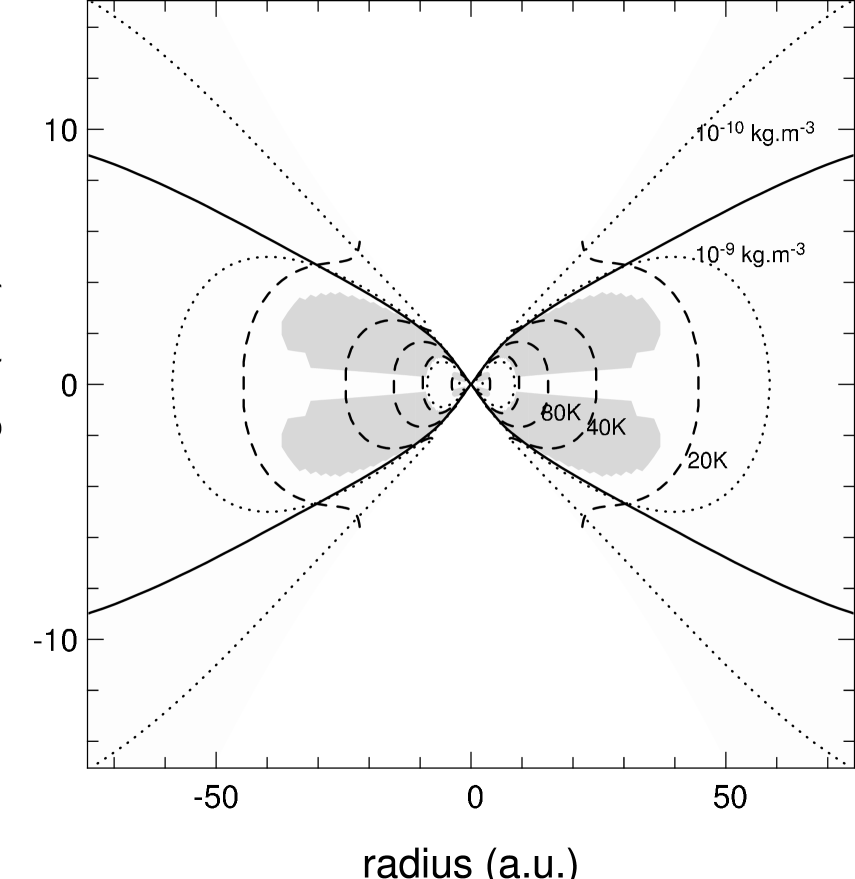
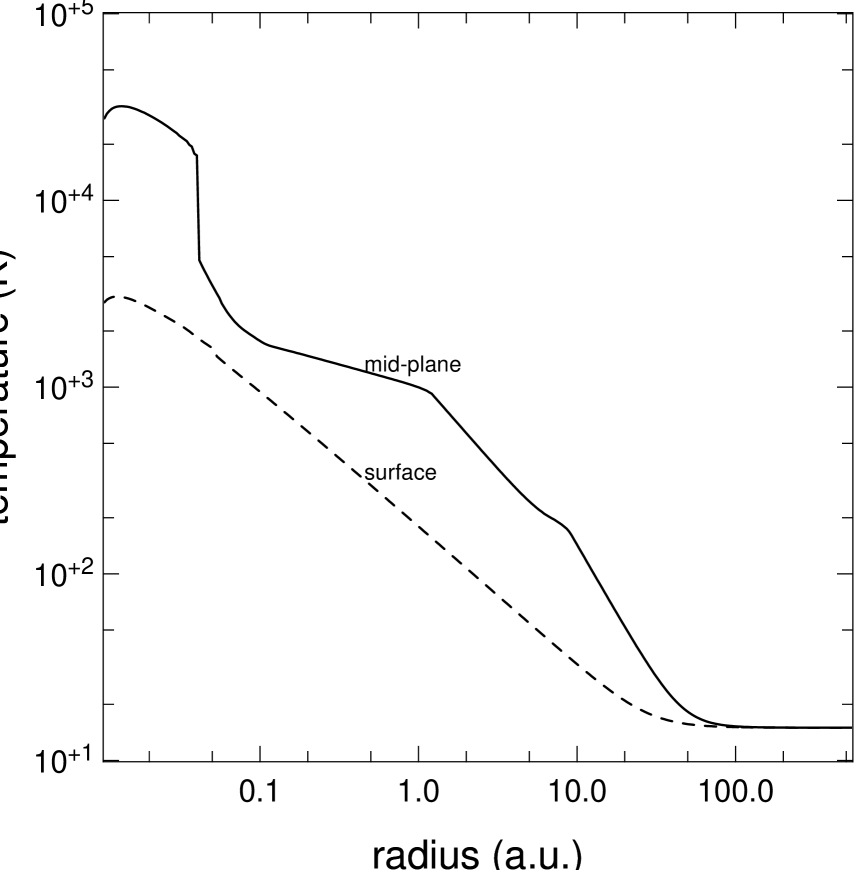
We present a self-consistent analytical model for the computation of the physical conditions in a steady quasi-Keplerian accretion disk. The method, based on the thin disk approximation, considers the disk as concentric cylinders in which we treat the vertical transfer as in a plane-parallel medium. The formalism generalizes a work by Hubeny (1990), linking the disk temperature distribution to the local energy dissipation and leads to analytical formulae for the temperature distribution which help to understand the behaviour of the radiation propagated inside the disks. One of the main features of our new model is that it can take into account many heating sources. We apply the method first to two sources: viscous dissipation and stellar irradiation. We show that other heating sources like horizontal transfer or irradiation from the ambiant medium can also be taken into account. Using the analytical formulation in the case of a modified Shakura & Sunyaev radial distribution that allow the accretion rate to be partly self-similar in the inner region, and, for an alpha and beta prescription of the viscosity, we obtain two-dimensional maps of the temperature, pressure and density in the close environment of low mass young stars. We use these maps to derive the observational properties of the disks such as spectral energy distributions, high resolution spatial images or visibilities in order to underline their different behaviours under different input models.
Motivation & Objective
- To develop a physically self-consistent model for the vertical structure of T Tauri accretion disks that accounts for multiple heating sources.
- To derive analytical expressions for temperature, pressure, and density distributions in the disk using radiative transfer in a plane-parallel geometry.
- To improve the interpretation of observational data such as SEDs, high-resolution images, and interferometric visibilities by replacing ad-hoc power-law assumptions with physically grounded models.
- To lay the foundation for future models that include magnetic fields and viscous transport by using a modular formalism for energy sources.
Proposed method
- Uses the thin disk approximation and models vertical radiative transfer as in a plane-parallel medium, extending Hubeny (1990)’s formalism.
- Derives analytical formulae for the vertical temperature profile by linking local energy dissipation to emergent radiation, using the Eddington approximation.
- Incorporates multiple heating sources (e.g., viscous dissipation, stellar irradiation) via a weighted sum of individual source contributions, with energy fractions normalized to total dissipation.
- Applies a modified Shakura & Sunyaev radial viscosity profile allowing self-similar accretion in the inner disk region, with α and β viscosity prescriptions.
- Computes observable quantities such as spectral energy distributions (SEDs), spatial images, and interferometric visibilities from the derived physical maps.
- Uses a formalism that allows future extension to include magnetic fields or non-local energy transport by treating each source independently in the energy budget.
Experimental results
Research questions
- RQ1How does the inclusion of multiple heating sources—viscous dissipation and stellar irradiation—affect the vertical temperature structure of T Tauri disks?
- RQ2To what extent does disk flaring, driven by radial temperature and scale height variations, flatten the spectral energy distribution compared to standard thin-disk models?
- RQ3Can analytical formulae for temperature, pressure, and density in the disk be derived consistently from radiative transfer and energy balance, enabling direct comparison with observations?
- RQ4How do different viscosity prescriptions (α and β) influence the radial and vertical structure of the disk and its observable signatures?
- RQ5Can the model serve as a physically grounded initial condition for Monte Carlo scattering codes to predict polarization maps in circumstellar disks?
Key findings
- The model successfully reproduces flatter-than-expected SEDs in T Tauri stars by accounting for disk flaring due to radial temperature gradients and increased stellar irradiation at larger radii.
- Analytical formulae for the vertical temperature profile are derived, showing that the temperature rise in the disk photosphere is primarily driven by the combined effects of viscous heating and stellar irradiation.
- The formalism allows the inclusion of additional heating sources such as horizontal radiative transfer or ambient medium irradiation, enhancing model flexibility.
- Two-dimensional maps of temperature, pressure, and density are computed for low-mass pre-main sequence stars using self-similar accretion profiles and α/β viscosity laws.
- The model enables the direct computation of observable quantities such as SEDs, high-resolution images, and interferometric visibilities, which can be used to constrain disk parameters more accurately than ad-hoc power laws.
- The derived expressions for the effective temperature of individual energy sources (e.g., viscous or irradiative) allow decomposition of the total heating contribution, clarifying physical origins of disk emission.
Read this paper
Open the full text in the Nubint reader and ask about any passage as you read.
Read this paper on NubintThis review was generated by AI from the original paper. Please check the paper before citing it.