
[논문 리뷰] Time-Varying Graph Mode Decomposition
이 논문은 시간에 따라 변화하는 그래프 신호를 시간, 주파수, 구조적 구조에서 진동 성분을 포착하는 다수의 그래프 모드로 분해하기 위한 데이터 기반 변분 최적화 방법을 제안한다. ADMM 및 원시-이중 최적화를 통해 시간적, 스펙트럼적, 그래프 기반 제약 조건을 통합함으로써, 다중 척도 기능적 연결성과 신호 동역학의 통합 분석을 가능하게 하며, EEG, 에너지 소비 및 산업 공정 데이터에서 이를 입증하였다.
Time-varying graph signals are alternative representation of multivariate (or multichannel) signals in which a single time-series is associated with each of the nodes or vertex of a graph. Aided by the graph-theoretic tools, time-varying graph models have the ability to capture the underlying structure of the data associated with multiple nodes of a graph -- a feat that is hard to accomplish using standard signal processing approaches. The aim of this contribution is to propose a method for the decomposition of time-varying graph signals into a set of graph modes. The graph modes can be interpreted in terms of their temporal, spectral and topological characteristics. From the temporal (spectral) viewpoint, the graph modes represent the finite number of oscillatory signal components (output of multiple band-pass filters whose center frequencies and bandwidths are learned in a fully data-driven manner), similar in properties to those obtained from the empirical mode decomposition and related approaches. From the topological perspective, the graph modes quantify the functional connectivity of the graph vertices at multiple scales based on their signal content. In order to estimate the graph modes, a variational optimization formulation is designed that includes necessary temporal, spectral and topological requirements relevant to the graph modes. An efficient method to solve that problem is developed which is based on the alternating direction method of multipliers (ADMM) and the primal-dual optimization approach. Finally, the ability of the method to enable a joint analysis of the temporal and topological characteristics of time-varying graph signals, at multiple frequency bands/scales, is demonstrated on a series of synthetic and real time-varying graph data sets.
연구 동기 및 목표
- 동적 데이터에서 복잡한 채널 간 연결 패턴을 포착하는 데에 한계가 있는 기존 多변량 신호 분해 방법의 문제점을 해결하기 위해.
- 시간에 따라 변화하는 그래프 신호를 위한 그래프 신호 처리와 데이터 기반 히어르모닉 분석을 통합하기 위해.
- 시간 또는 그래프 도메인에서 사전 정의된 기저 함수가 없는 완전히 데이터 기반의 방법을 개발하기 위해.
- 다양한 주파수 척도에서 시간 역학과 구조적 구조를 동시에 분석할 수 있도록 하기 위해.
- 비정규적인 네트워크 데이터에서 진동 성분과 그 기능적 연결성을 식별하기 위한 프레임워크를 제공하기 위해.
제안 방법
- 그래프 모드에 시간 대역폭, 스펙트럼 국소화 및 구조적 스무쓰니스 제약 조건을 통합한 변분 최적화 문제를 수립한다.
- 비볼록 최적화 문제를 효율적으로 해결하기 위해 원시-이중 전진-후진-전진 알고리즘을 사용한다.
- 문제를 다루기 쉬운 부분문제로 분해하기 위해 분할 격자 방법의 다중승수(ADMM)를 적용한다.
- 모드의 지오데식을 따라 스무쓰니스를 강제하기 위해 그래프 라플라시안 및 인접 행렬을 통합한다.
- 데이터 기반 방식으로 완전한 신호 복원과 밴드제한된 진동 성분을 위한 제약 조건을 도입한다.
- 근접 연산자와 기울기 단계를 활용해 최적화 과정에서 원시 및 이중 변수를 반복적으로 갱신한다.
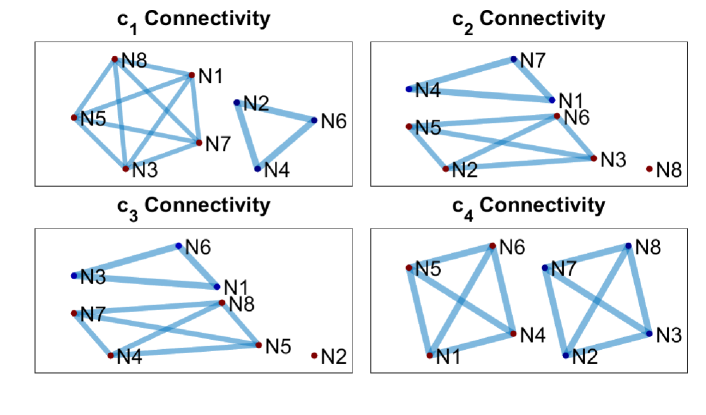
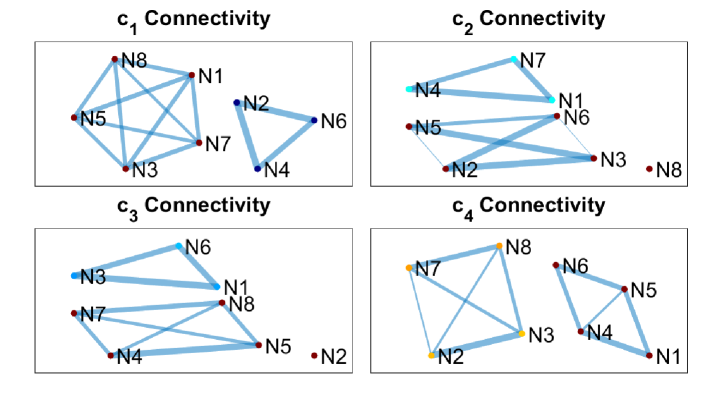
실험 결과
연구 질문
- RQ1데이터 기반 분해 방법은 시간에 따라 변화하는 그래프 신호에서 진동 성분을 추출하면서도 구조적 구조를 유지할 수 있는가?
- RQ2시간적, 스펙트럼적, 구조적 특성을 하나의 통합 프레임워크에서 어떻게 함께 모델링할 수 있는가?
- RQ3제안된 방법은 실제 데이터에서 다양한 주파수 대역에서 기능적 연결 패턴을 어느 정도 정밀하게 국소화할 수 있는가?
- RQ4그래프 기반 연결성을 사용하여 휴식 상태 EEG에서 알파 파동을 성공적으로 분리할 수 있는가?
- RQ5에너지 소비나 산업 공정과 같은 비정상 시스템에서 동적 연결 패턴을 식별하는 데에 이 방법은 얼마나 잘 성능을 발휘하는가?
주요 결과
- 이 방법은 휴식 상태 EEG 데이터에서 알파 리듬을 성공적으로 분리하였고, 후두부 및 편측 뇌 영역에서 그 기원을 정확히 국소화하였다.
- 전기 소비 데이터에서는 다중 척도 연결 패턴을 드러내어 다양한 시간 척도에서 사용자 수준의 에너지 사용을 분석할 수 있게 하였다.
- 플라우팅 플랜트 데이터 세트에 대해 의미 있는 연결 그래프를 생성하여 셀 그룹화를 통한 고장 진단을 지원하였다.
- 기저 함수에 대한 사전 가정 없이도 완전한 신호 복원과 밴드제한된 진동 성분의 분리가 이루어졌다.
- 원시-이중 ADMM 기반 솔버는 합성 및 실제 데이터 세트에서 안정적으로 수렴하여 강건성과 확장성을 입증하였다.
- 이 방법은 시간 역학과 구조적 상호작용을 동시에 포착함으로써 표준 다변량 분해 기법을 뛰어넘는 성능을 보였다.
더 나은 연구,지금 바로 시작하세요
논문 읽기부터 검토까지, 연구 시간을 획기적으로 줄여보세요.
카드 등록 없음 · 무료 플랜 제공
이 리뷰는 AI가 만들고, 인간 에디터가 검토했습니다.