
[Paper Review] Toward the Cure of Privacy Policy Reading Phobia: Automated Generation of Privacy Nutrition Labels From Privacy Policies
This paper proposes the first framework to automatically generate privacy nutrition labels from privacy policies using large language models and structured prompting. It achieves a 0.75 F1-score on first-party data collection and detects 90.1% of under-claimed practices, offering a scalable solution to combat 'Privacy Policy Reading Phobia' and improve user transparency.
Software applications have become an omnipresent part of modern society. The consequent privacy policies of these applications play a significant role in informing customers how their personal information is collected, stored, and used. However, customers rarely read and often fail to understand privacy policies because of the ``Privacy Policy Reading Phobia'' (PPRP). To tackle this emerging challenge, we propose the first framework that can automatically generate privacy nutrition labels from privacy policies. Based on our ground truth applications about the Data Safety Report from the Google Play app store, our framework achieves a 0.75 F1-score on generating first-party data collection practices and an average of 0.93 F1-score on general security practices. We also analyse the inconsistencies between ground truth and curated privacy nutrition labels on the market, and our framework can detect 90.1% under-claim issues. Our framework demonstrates decent generalizability across different privacy nutrition label formats, such as Google's Data Safety Report and Apple's App Privacy Details.
Motivation & Objective
- Address the widespread 'Privacy Policy Reading Phobia' (PPRP) where users fail to read or understand lengthy, complex privacy policies.
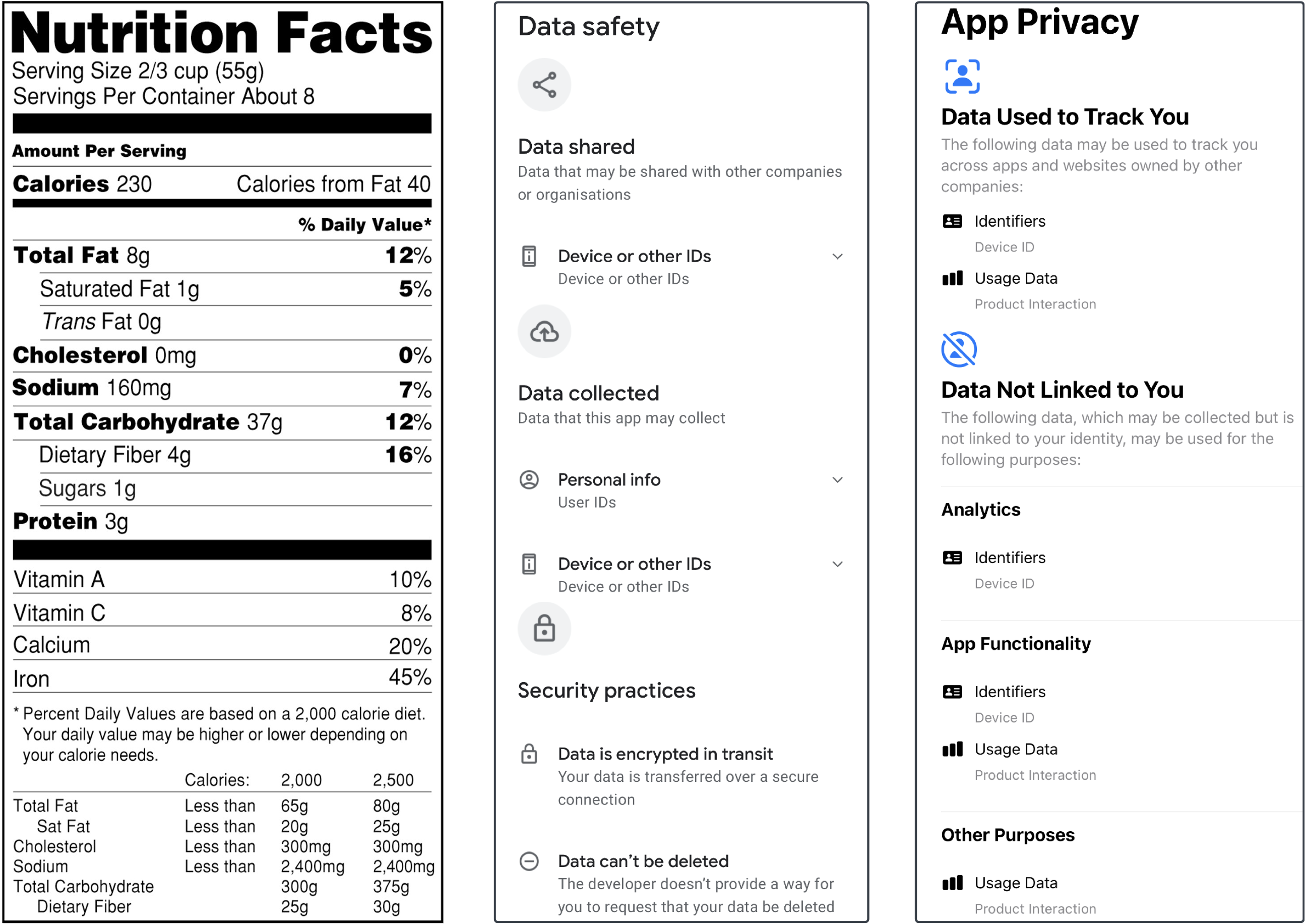
- Bridge the gap between existing privacy policies and the newly mandated privacy nutrition label formats on app stores like Google Play and Apple App Store.
- Develop an automated system that transforms unstructured privacy policies into structured, user-friendly privacy nutrition labels.
- Improve transparency and user trust by enabling concise, standardized, and machine-readable summaries of data practices.
Proposed method
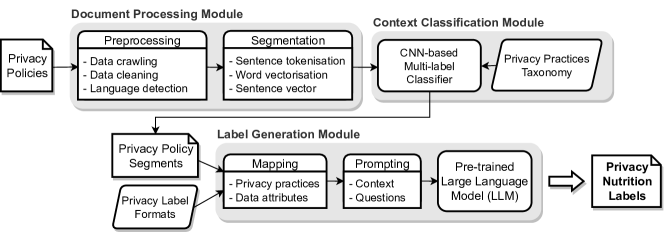
- Leverage large language models (LLMs) to extract and classify data collection and usage practices from privacy policies.
- Design a two-stage prompting strategy: first, extract raw data practices; second, map them to standardized privacy label categories.
- Use fine-tuned LLMs with few-shot prompting and chain-of-thought reasoning to improve classification accuracy.
- Apply structured templates aligned with Google’s Data Safety Report and Apple’s App Privacy Details formats for label generation.
- Implement a consistency-checking module to detect discrepancies between ground truth and curated labels, focusing on under-claiming.
- Evaluate performance using F1-scores on first-party data collection, third-party data sharing, and general security practices.
Experimental results
Research questions
- RQ1Can an LLM-based framework accurately extract and structure data collection practices from unstructured privacy policies into standardized privacy nutrition labels?
- RQ2How well does the framework generalize across different privacy label formats, such as Google’s Data Safety Report and Apple’s App Privacy Details?
- RQ3What are the main failure modes affecting the framework’s performance, particularly in detecting under-claimed data practices?
- RQ4To what extent does a fully LLM-based design improve performance compared to hybrid prompting and rule-based components?
- RQ5How effective is the framework in identifying inconsistencies between ground truth data practices and those reported in curated privacy labels?
Key findings
- The framework achieves a 0.75 F1-score on generating first-party data collection practices, demonstrating strong performance on a core task.
- It attains an average F1-score of 0.93 on general security practices, indicating high reliability for these structured fields.
- The framework detects 90.1% of under-claimed data practices when compared to ground truth, highlighting its effectiveness in identifying omissions.
- Performance on third-party data sharing is lower at 0.63 F1, primarily due to ambiguity in group-specific clauses and omnibus data types.
- A fully LLM-based design improves F1 by 13.1% on third-party data sharing but increases cost by approximately fivefold with no significant gain on first-party data.
- The framework generalizes reasonably well to Apple’s App Privacy Details, achieving an average F1-score of 0.70 across all categories.
Read this paper
Open the full text in the Nubint reader and ask about any passage as you read.
Read this paper on NubintThis review was generated by AI from the original paper. Please check the paper before citing it.