
[Paper Review] Toward Value-oriented Renewable Energy Forecasting: An Iterative Learning Approach
This paper proposes a value-oriented point forecasting method for renewable energy that minimizes expected two-stage operation costs (day-ahead and real-time dispatch) by formulating forecast model training as a bilevel optimization problem. The approach iteratively aligns forecasts with operational outcomes, reducing total costs by 15 % compared to quality-oriented methods while being 4,500× faster than stochastic programming.
Energy forecasting is an essential task in power system operations. Operators usually issue forecasts and leverage them to schedule energy dispatch ahead of time. However, forecast models are typically developed in a way that overlooks the operational value of the forecasts. To bridge the gap, we design a value-oriented point forecasting approach for sequential energy dispatch problems with renewable energy sources. At the training phase, we align the loss function with the overall operation cost function, thereby achieving reduced operation costs. The forecast model parameter estimation is formulated as a bilevel program. Under mild assumptions, we convert the upper-level objective into an equivalent form using the dual solutions obtained from the lower-level operation problems. Additionally, a novel iterative solution strategy is proposed for the newly formulated bilevel program. Under such an iterative scheme, we show that the upper-level objective is locally linear regarding the forecast model output, and can act as the loss function. Numerical experiments demonstrate that, compared to commonly used statistical quality-oriented point forecasting methods, forecasts obtained by the proposed approach result in lower operation costs. Meanwhile, the proposed approach is more computationally efficient than traditional two-stage stochastic programs.
Motivation & Objective
- To address the gap between statistically accurate forecasts and their actual operational value in power system dispatch.
- To develop a forecasting framework that directly optimizes for lower expected operation costs in day-ahead and real-time energy dispatch.
- To enable computationally efficient forecasting that remains compatible with the standard 'predict, then optimize' paradigm in power systems.
- To demonstrate that forecasts optimized for operational cost outperform those optimized for statistical accuracy, especially under high wind penetration.
- To establish a scalable, iterative training framework that links forecast model parameters to operational outcomes via bilevel optimization.
Proposed method
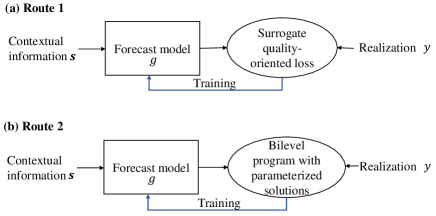
- Formulates forecast model training as a bilevel program: the upper level optimizes model parameters to minimize expected two-stage operation cost, while the lower level solves day-ahead and real-time dispatch problems using the forecast as input.
- Uses an iterative solution strategy where the upper-level loss function is derived from the optimal operation cost returned by the lower-level optimization.
- Demonstrates that the upper-level objective is locally linear with respect to forecast model outputs, enabling gradient-based optimization.
- Employs a surrogate loss function based on the regret between forecast-based and true-realization-based operation costs, enabling efficient training.
- Applies the method to a centralized wind power dispatch problem with linear programming (LP) formulations for both day-ahead and real-time stages.
- Solves the bilevel program iteratively by alternating between solving the lower-level dispatch problems and updating the forecast model parameters via gradient descent.

Experimental results
Research questions
- RQ1Can a forecast model trained to minimize operational cost outperform traditional quality-oriented forecasting in real-world dispatch problems?
- RQ2How does the proposed value-oriented forecasting approach compare in computational efficiency to two-stage stochastic programming?
- RQ3To what extent does the forecast quality (measured by RMSE) trade off against operational cost reduction in two-stage dispatch?
- RQ4Does the iterative bilevel learning framework effectively align forecast outputs with optimal dispatch decisions across multiple time periods?
- RQ5Can the proposed method maintain low operation costs under high renewable penetration without requiring full stochastic optimization?
Key findings
- The proposed method reduces the average total operation cost by 15 % compared to quality-oriented forecasting methods, despite a higher RMSE.
- The proposed approach achieves an average operation cost of $2,036, compared to $2,051 for the stochastic program, indicating superior cost performance.
- Computation time is reduced from 17.8 seconds (stochastic program) to 3.99 ms (proposed method), a 4,500× speedup.
- The average day-ahead cost is lower under the proposed method ($2,106) than under the stochastic program ($2,201), indicating more efficient scheduling.
- The real-time cost is negative ($-70) under the proposed method, indicating effective balancing and reduced penalties, compared to $-150 under the stochastic program.
- The method maintains local linearity of the loss function with respect to forecast outputs, enabling stable and efficient optimization via gradient descent.
Read this paper
Open the full text in the Nubint reader and ask about any passage as you read.
Read this paper on NubintThis review was generated by AI from the original paper. Please check the paper before citing it.