
[Paper Review] Towards 6G Hyper-Connectivity: Vision, Challenges, and Key Enabling Technologies
This paper proposes a vision for 6G hyper-connectivity, enabling terabit-per-second (Tbps) data rates, zero coverage holes, and pervasive computing through key enabling technologies like cell-free massive MIMO, integrated terrestrial and non-terrestrial networks, and over-the-air distributed computing. The core contribution is a holistic framework for achieving ubiquitous, intelligent, and low-latency connectivity across physical and virtual domains.
Technology forecasts anticipate a new era in which massive numbers of humans, machines, and things are connected to wireless networks to sense, process, act, and communicate with the surrounding environment in a real-time manner. To make the visions come true, the sixth generation (6G) wireless networks should be hyper-connected, implying that there are no constraints on the data rate, coverage, and computing. In this article, we first identify the main challenges for 6G hyper-connectivity, including terabits-per-second (Tbps) data rates for immersive user experiences, zero coverage-hole networks, and pervasive computing for connected intelligence. To overcome these challenges, we highlight key enabling technologies for 6G such as distributed and intelligence-aware cell-free massive multi-input multioutput (MIMO) networks, boundless and fully integrated terrestrial and non-terrestrial networks, and communication-aware distributed computing for computation-intensive applications. We further illustrate and discuss the hyper-connected 6G network architecture along with open issues and future research directions.
Motivation & Objective
- Address the limitations of 5G in supporting immersive, real-time, and globally connected services for humans, machines, and sensors.
- Identify core challenges for 6G hyper-connectivity: terabit-per-second (Tbps) data rates, coverage-hole-free networks, and computation-intensive connected intelligence.
- Propose a system-level vision for 6G that unifies communication, computing, and intelligence across terrestrial, aerial, and space-based networks.
- Outline enabling technologies and open research issues to realize a truly hyper-connected, ubiquitous, and intelligent 6G society.
Proposed method
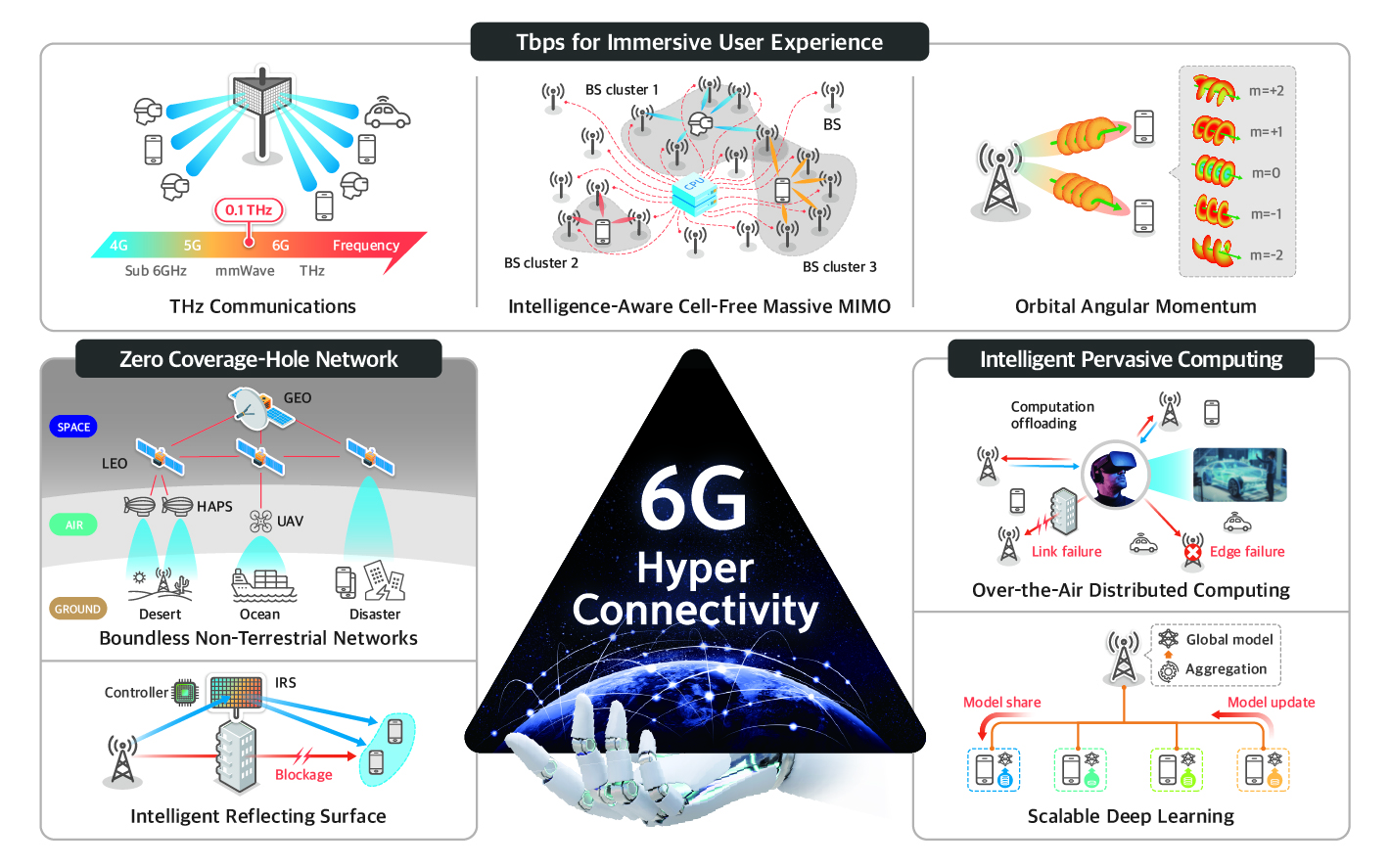
- Leverage terahertz (THz) communications and ultra-massive MIMO (UM-MIMO) with plasmonic nano-antennas to achieve Tbps data rates through beamforming and spectrum exploitation.
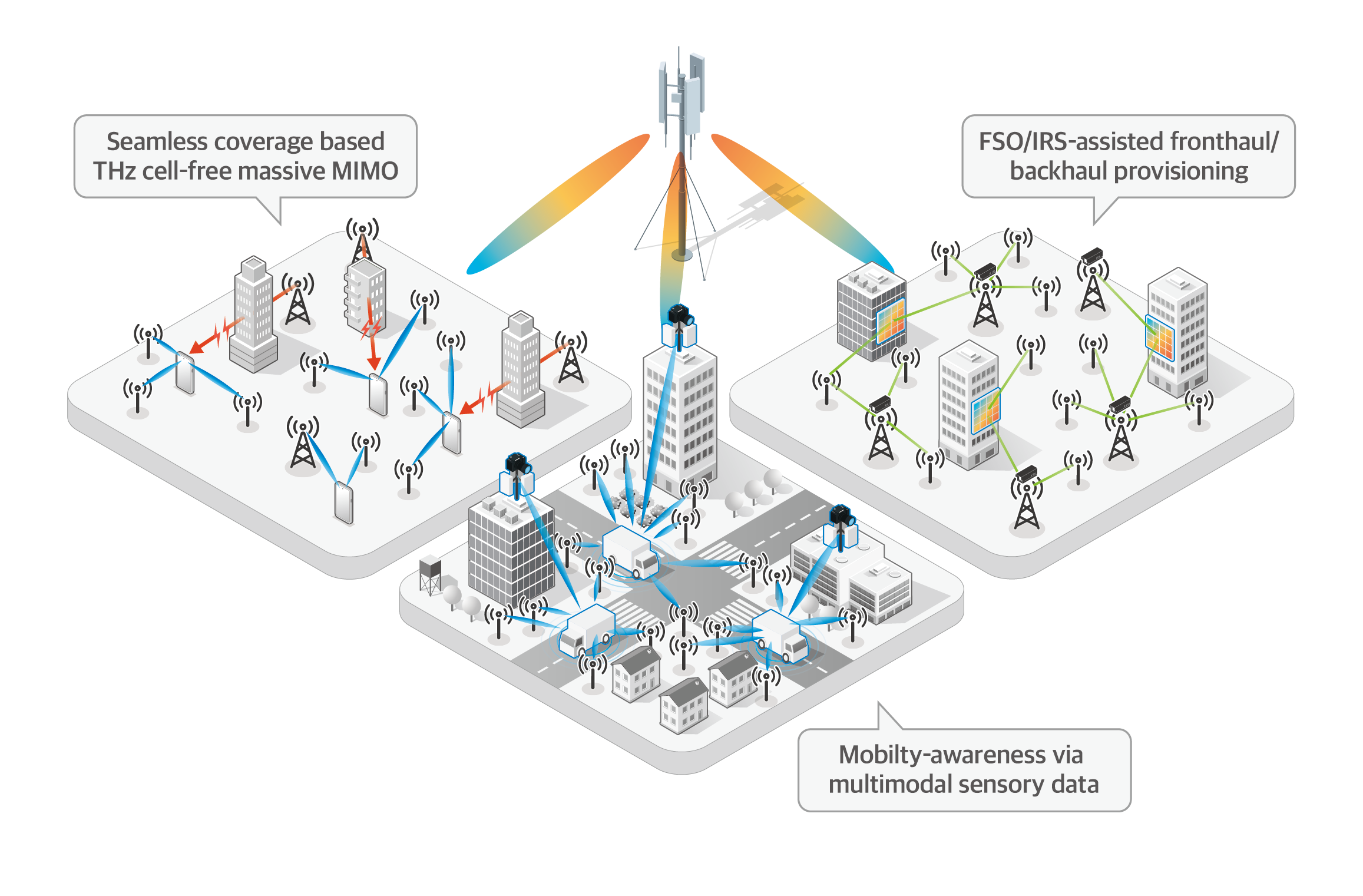
- Design cell-free massive MIMO networks to eliminate cell boundaries and support seamless connectivity, replacing traditional cell-based architectures.
- Integrate terrestrial and non-terrestrial networks (NTN) including satellites and high-altitude platforms (HAPS) for global, 3D-coverage and zero coverage holes.
- Implement over-the-air computation and coded distributed computing to reduce communication overhead and improve resilience to straggling or failed devices.
- Apply communication-aware distributed computing and scalable deep learning techniques (e.g., federated, split, and over-the-air learning) to enable low-latency, scalable AI at scale.
- Use orbital angular momentum (OAM) multiplexing, full-duplex, and spatial modulation-MIMO (SM-MIMO) to enhance spectral efficiency and data rates.
Experimental results
Research questions
- RQ1How can 6G achieve Tbps data rates to support immersive applications like 24K VR and digital twins?
- RQ2What architectural and technological innovations are required to eliminate coverage holes and enable ubiquitous 3D connectivity?
- RQ3How can communication and computing be co-designed to support pervasive, low-latency, and resilient distributed intelligence?
- RQ4What role do integrated terrestrial and non-terrestrial networks play in achieving global hyper-connectivity?
- RQ5How can over-the-air and coded computation techniques improve reliability and efficiency in distributed computing for 6G?
Key findings
- Tbps data rates are essential for immersive XR, holographic displays, and digital twin applications, with 24K VR at 64 PPD and 200 Hz requiring at least 6.37 Gbps per stream.
- Cell-free massive MIMO with UM-MIMO and beamforming can provide 10–100× data rate gains over 5G, especially in ultra-dense THz networks.
- Non-terrestrial networks (NTN), including satellites and HAPS, are critical for achieving zero-coverage-hole, global 3D connectivity beyond terrestrial limitations.
- Over-the-air computation enables simultaneous wireless transmission and aggregation of computation results, reducing communication and computation overhead.
- Coded distributed computing using MDS codes allows recovery of straggling tasks from completed subtasks, improving system resilience under link failures.
- Scalable deep learning techniques such as federated and split learning combined with over-the-air aggregation enable efficient, low-latency AI training across distributed devices.
Read this paper
Open the full text in the Nubint reader and ask about any passage as you read.
Read this paper on NubintThis review was generated by AI from the original paper. Please check the paper before citing it.