
[Paper Review] Towards Realistic Ultrasound Fetal Brain Imaging Synthesis
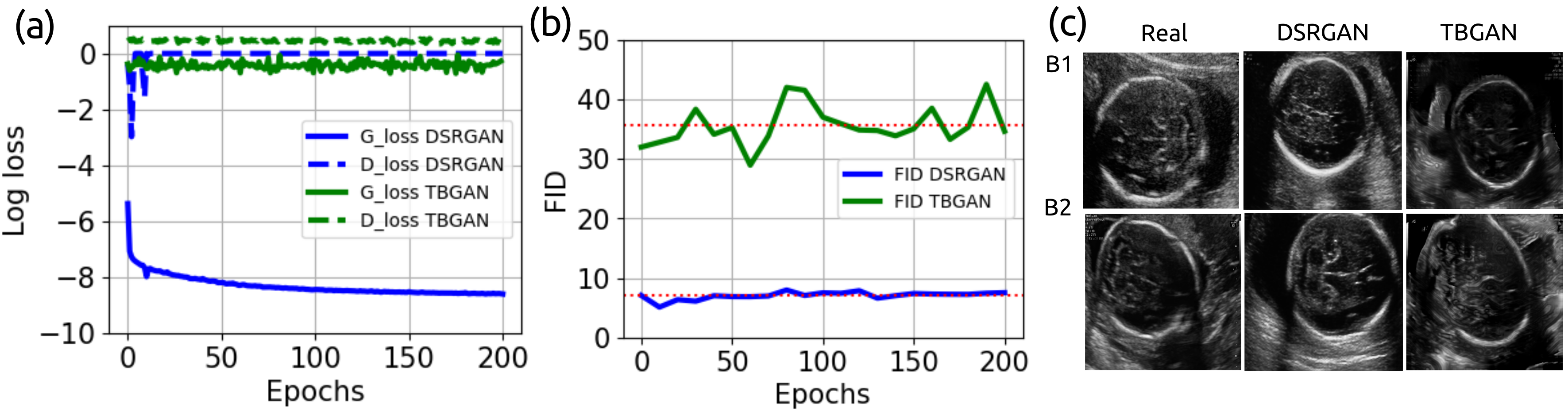
This paper proposes a GAN-based approach to synthesize high-resolution (256×256) fetal trans-cerebellum brain ultrasound images using a diffusion-super-resolution-GAN (DSR-GAN) and a transformer-based-GAN (TB-GAN) to address data scarcity in prenatal ultrasound imaging. The DSR-GAN achieved significantly lower Fréchet Inception Distance (FID) scores (average 7.04, best 5.09) than the TB-GAN (average 36.02, best 28.93), demonstrating superior realism and training stability with limited data.
Prenatal ultrasound imaging is the first-choice modality to assess fetal health. Medical image datasets for AI and ML methods must be diverse (i.e. diagnoses, diseases, pathologies, scanners, demographics, etc), however there are few public ultrasound fetal imaging datasets due to insufficient amounts of clinical data, patient privacy, rare occurrence of abnormalities in general practice, and limited experts for data collection and validation. To address such data scarcity, we proposed generative adversarial networks (GAN)-based models, diffusion-super-resolution-GAN and transformer-based-GAN, to synthesise images of fetal ultrasound brain planes from one public dataset. We reported that GAN-based methods can generate 256x256 pixel size of fetal ultrasound trans-cerebellum brain image plane with stable training losses, resulting in lower FID values for diffusion-super-resolution-GAN (average 7.04 and lower FID 5.09 at epoch 10) than the FID values of transformer-based-GAN (average 36.02 and lower 28.93 at epoch 60). The results of this work illustrate the potential of GAN-based methods to synthesise realistic high-resolution ultrasound images, leading to future work with other fetal brain planes, anatomies, devices and the need of a pool of experts to evaluate synthesised images. Code, data and other resources to reproduce this work are available at \url{https://github.com/budai4medtech/midl2023}.
Motivation & Objective
- Address the critical challenge of limited public fetal ultrasound datasets due to data scarcity, privacy concerns, and expert availability.
- Develop a data augmentation strategy using deep generative models to synthesize realistic, high-resolution fetal brain ultrasound images for improved AI/ML training.
- Evaluate the performance of two GAN architectures—diffusion-super-resolution-GAN and transformer-based-GAN—on synthesizing trans-cerebellum plane images from a small public dataset.
- Demonstrate that GAN-based synthesis can produce realistic fetal ultrasound images with stable training and low FID scores, even with limited real data.
- Lay the foundation for future synthesis of other fetal brain planes, anatomies, and imaging devices using synthetic data.
Proposed method
- A two-stage generative framework: first, a finetuned denoising diffusion probabilistic model (DDPM) generates 128×128 pixel images, followed by a super-resolution GAN (SRGAN) to upsample to 256×256 pixels.
- Histogram matching is applied between real and synthetic images to align color distributions and improve visual realism.
- For the transformer-based-GAN, a StyleSwin architecture with Swin Transformer blocks is used to capture high-frequency details while reducing memory usage.
- Differentiable data augmentation (DiffAug) and adaptive pseudo augmentation (APA) are applied to prevent discriminator overfitting due to small training data.
- The models are trained using the Adam optimizer with a two-time-scale update rule, and transfer learning is used by pre-training on trans-thalamic plane data before fine-tuning on trans-cerebellum images.
- Image quality is evaluated using Fréchet Inception Distance (FID), which measures distributional similarity between real and generated images.
Experimental results
Research questions
- RQ1Can GAN-based methods effectively synthesize realistic 256×256 fetal ultrasound trans-cerebellum brain images from a small public dataset?
- RQ2How do diffusion-super-resolution-GAN and transformer-based-GAN compare in terms of training stability and image quality?
- RQ3To what extent can data augmentation and transfer learning improve the performance of GANs trained on limited fetal ultrasound data?
- RQ4Can FID scores reliably indicate the realism of synthesized fetal ultrasound images in this context?
- RQ5What is the potential of such synthetic data to support future AI/ML applications in fetal brain imaging?
Key findings
- The diffusion-super-resolution-GAN (DSR-GAN) achieved a lower average FID score of 7.04 and a best FID of 5.09 at epoch 10, indicating high realism and stable training.
- The transformer-based-GAN (TB-GAN) showed significantly higher FID scores, with an average of 36.02 and a best score of 28.93 at epoch 60, indicating less realistic image generation.
- DSR-GAN demonstrated faster convergence and more stable training losses compared to TB-GAN, which required 60 epochs to reach its best FID performance.
- The use of histogram matching improved color consistency between real and synthetic images, enhancing visual plausibility.
- Transfer learning from a larger trans-thalamic plane dataset improved the fine-tuning performance of the TB-GAN on the smaller trans-cerebellum dataset.
- The results suggest that GAN-based synthesis is a viable solution for generating realistic fetal ultrasound images even with limited clinical data, supporting future data-efficient AI development.
Read this paper
Open the full text in the Nubint reader and ask about any passage as you read.
Read this paper on NubintThis review was generated by AI from the original paper. Please check the paper before citing it.