
[Paper Review] Transparency and Privacy: The Role of Explainable AI and Federated Learning in Financial Fraud Detection
This paper proposes a federated learning (FL)-based fraud detection system enhanced with Explainable AI (XAI) to address data privacy and model transparency in financial institutions. By training models locally on bank data and sharing only encrypted model updates, the approach preserves privacy while achieving 93% accuracy in detecting rare fraudulent transactions, with SHAP analysis enabling interpretable, trustworthy predictions.
Fraudulent transactions and how to detect them remain a significant problem for financial institutions around the world. The need for advanced fraud detection systems to safeguard assets and maintain customer trust is paramount for financial institutions, but some factors make the development of effective and efficient fraud detection systems a challenge. One of such factors is the fact that fraudulent transactions are rare and that many transaction datasets are imbalanced; that is, there are fewer significant samples of fraudulent transactions than legitimate ones. This data imbalance can affect the performance or reliability of the fraud detection model. Moreover, due to the data privacy laws that all financial institutions are subject to follow, sharing customer data to facilitate a higher-performing centralized model is impossible. Furthermore, the fraud detection technique should be transparent so that it does not affect the user experience. Hence, this research introduces a novel approach using Federated Learning (FL) and Explainable AI (XAI) to address these challenges. FL enables financial institutions to collaboratively train a model to detect fraudulent transactions without directly sharing customer data, thereby preserving data privacy and confidentiality. Meanwhile, the integration of XAI ensures that the predictions made by the model can be understood and interpreted by human experts, adding a layer of transparency and trust to the system. Experimental results, based on realistic transaction datasets, reveal that the FL-based fraud detection system consistently demonstrates high performance metrics. This study grounds FL's potential as an effective and privacy-preserving tool in the fight against fraud.
Motivation & Objective
- To address the challenge of data privacy in financial fraud detection, where centralized data sharing violates regulatory and institutional constraints.
- To overcome the class imbalance in transaction datasets, where fraudulent transactions are rare and difficult to detect.
- To improve model trustworthiness by integrating Explainable AI (XAI) techniques for transparent, interpretable predictions.
- To develop a decentralized fraud detection framework that enables collaborative model training without sharing raw customer data.
- To evaluate the performance of a FL-based system with XAI integration on realistic transaction datasets, focusing on accuracy, precision, recall, and F1-score.
Proposed method
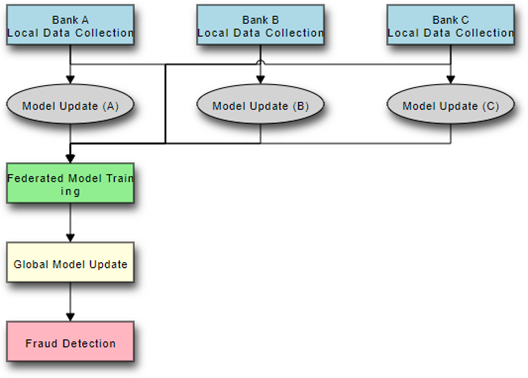
- Federated Learning (FL) is employed to train a global fraud detection model across multiple financial institutions without sharing raw transaction data.
- Each client (bank) trains a local neural network on its proprietary, imbalanced transaction dataset and sends only updated model weights to a central server.
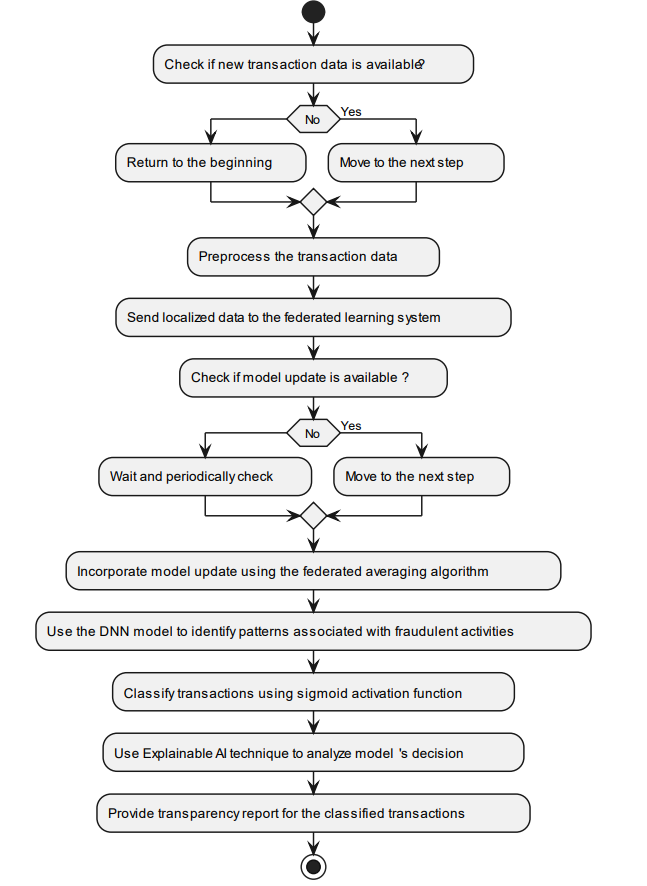
- The central server aggregates these model updates using FedAvg (Federação Averaging) to form a global model, iteratively improving performance across all clients.
- Explainable AI (XAI) is integrated using SHAP (SHapley Additive exPlanations) to interpret feature contributions to model predictions, with color-coded SHAP plots showing positive (red) and negative (blue) impacts.
- Model performance is evaluated using standard metrics: accuracy, precision, recall, and F1-score, computed over multiple training epochs.
- The system is implemented using Flask for server-client communication and multi-threading to ensure scalability and real-time model aggregation.
Experimental results
Research questions
- RQ1Can a federated learning-based fraud detection system achieve high performance while preserving data privacy across financial institutions?
- RQ2How does the integration of Explainable AI (XAI) improve transparency and trust in fraud detection predictions?
- RQ3To what extent does the FL framework mitigate performance degradation due to data imbalance in transaction datasets?
- RQ4What is the convergence behavior and performance stability of the FL model across multiple training epochs?
- RQ5Which transaction features have the highest influence on fraud prediction, as revealed by SHAP analysis?
Key findings
- The FL-based fraud detection model achieved a final accuracy of 93% after convergence, demonstrating strong performance on imbalanced transaction data.
- Precision increased linearly up to around 40 training epochs, then fluctuated, indicating the model reached a performance plateau.
- Recall steadily increased with the number of epochs, showing the model’s growing ability to identify fraudulent cases over time.
- The F1-score improved with training epochs, indicating a balanced improvement in both precision and recall, though with diminishing returns after 40 epochs.
- SHAP analysis revealed that features such as 2.15, 0.418, and 0.517 had the strongest positive impact on fraud prediction, while others like 1.15 and -0.8 had weaker influence.
- The model’s interpretability was enhanced through SHAP plots, which clearly illustrated how individual feature values contributed to predictions, supporting trust and auditability in critical financial applications.
Read this paper
Open the full text in the Nubint reader and ask about any passage as you read.
Read this paper on NubintThis review was generated by AI from the original paper. Please check the paper before citing it.